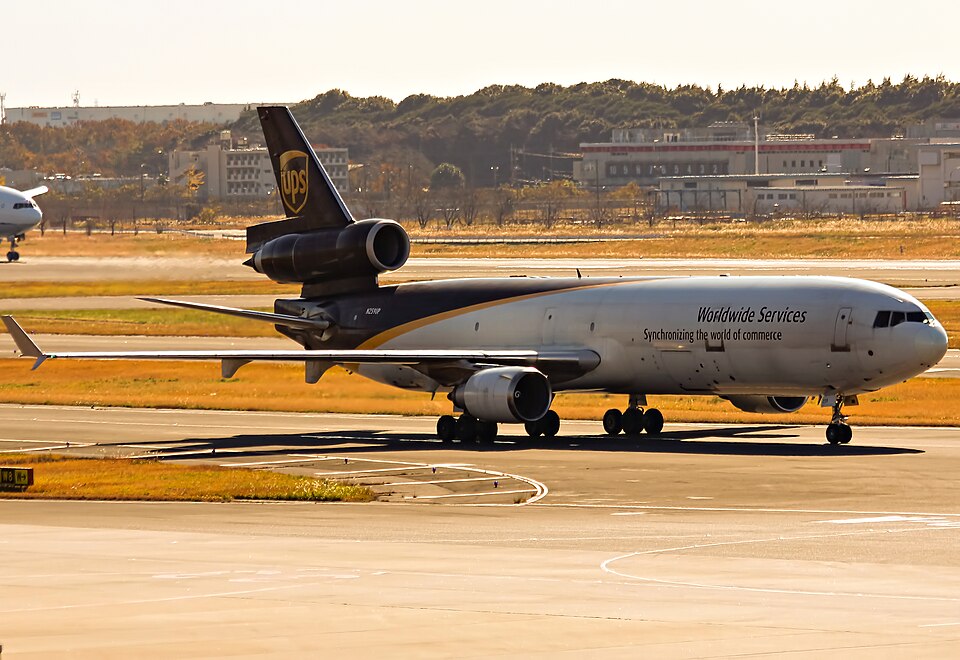
Accident Overview
On a cargo service from Louisville-Muhammad Ali Intl Airport to Honolulu-Daniel K. Inouye Intl Airport, an airplane with three crew members experienced a left engine fire during takeoff roll on runway 17R. The pilot-in-command initiated rotation despite the fire. The aircraft became airborne but failed to climb, reaching a maximum height of approximately 30 feet in a nose-up attitude at around 183 knots. After passing over the threshold of runway 35L, it rolled left, struck an industrial building, and crashed left wing first onto multiple buildings and vehicles in the Knopp industrial area, coming to rest about one kilometer from the runway end and bursting into flames. Debris scattered for approximately 800 meters. The aircraft was totally destroyed by impact forces and post-crash fire.
Flight Details
The crew consisted of Pilot Richard Wartenberg, Copilot Lee Truitt, and International Relief Officer Dana Diamond. The left engine (engine number 1) and its pylon separated from the wing structure after rotation and were found standing in a grassy area along the left side of runway 17R. Multiple pieces of engine fan blades and the main component of the left engine were found on runway 17R.
Casualties and Damage
All three crew members were killed, along with 11 people on the ground. Twenty-three people on the ground were injured, two seriously. The aircraft was destroyed, and multiple buildings and vehicles were damaged or destroyed.
Investigation
The Flight Data Recorder (FDR) and Cockpit Voice Recorder (CVR) were recovered with limited fire damage and transferred to the NTSB lab for analysis. The FDR contained approximately 63 hours of data covering 24 flights, including the accident sequence. The CVR contained 124 minutes of audio, including the accident sequence. Analysis focused on the catastrophic failure of engine number 1 and the loss of power on engine number 2 resulting from debris ingestion.
Probable Cause
The NTSB reported that after initial cleaning of the fracture surfaces, examination of the left pylon aft mount lug fractures found evidence of fatigue cracks in addition to areas of overstress failure. On the aft lug, on both the inboard and outboard fracture surfaces, a fatigue crack was observed where the aft lug bore met the aft lug forward face. For the forward lug's inboard fracture surface, fatigue cracks were observed along the lug bore. For the forward lug's outboard fracture surface, the fracture consisted entirely of overstress with no indications of fatigue cracking. The forward top flange of the aft mount assembly was examined for indications of deformation or pre-existing fractures, but no indications were found. The spherical bearing was removed from the wing clevis for further evaluation.