Accident Overview
At 1042 mountain daylight time, the flight reported moderate turbulence at flight level 240 (FL240) but elected to remain at that altitude. At 1055, air traffic control cleared the flight to descend at pilot's discretion to maintain 12,000 feet. Approximately eight minutes later, shortly after beginning a descent, the flight was instructed to change frequency. The crew replied 'standby please,' after which radio and radar contact were lost. The wreckage was found approximately 26 miles east of the destination airport in mountainous terrain.
Flight and Weather Conditions
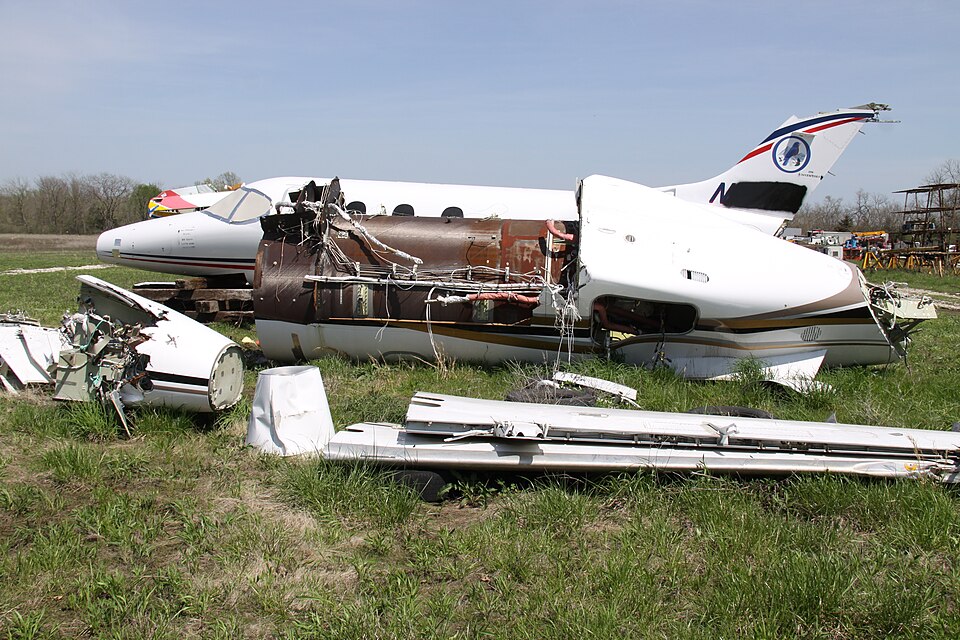
An examination revealed that the empennage had separated in flight; pieces of it were found up to one mile away, with evidence of overload failure. The engines were not operating at ground impact. The ignition switches were engaged; the left engine start switch was in the 'air' start position, and the right switch was beyond the 'ground' start position. The right propeller was feathered. Passenger oxygen masks were deployed, indicating that the cabin had depressurized above 15,000 feet.
Weather information indicated cloud bases at 10,000 feet with instrument meteorological conditions (IMC) and turbulence up to 25,000 feet. Mixed icing was present from 20,000 feet to 25,000 feet, along with light rain and snow showers and widely scattered thunderstorms. Approximately 15 miles south, 4 to 5 inches of hail fell at approximately that time. The aircraft was equipped with TPE331 engines, which had a history of flameouts due to ice ingestion caused by the impossibility of using anti-ice and ignition systems.
Wreckage and Damage
All six occupants were killed in the accident.
Probable Cause
The official probable cause findings are as follows:
Occurrence #1: In-flight encounter with weather. Phase of operation: descent - normal. Findings: (f) weather condition - clouds; (f) weather condition - low ceiling; (f) weather condition - turbulence in clouds; (f) weather condition - icing conditions.
Occurrence #2: Loss of engine power (total) - nonmechanical. Phase of operation: descent - normal. Findings: (c) in-flight planning/decision - improper - pilot in command; (c) procedures/directives - not followed - pilot in command; (c) anti-ice/deice system - improper use of - pilot in command; (f) aircraft performance, two or more engines - inoperative; (f) fuselage, cabin - decompression.
Occurrence #3: Loss of control - in flight. Phase of operation: descent - emergency. Findings: (c) aircraft handling - not maintained - pilot in command; (c) spatial disorientation - pilot in command; (f) remedial action - attempted.
Occurrence #4: Airframe/component/system failure/malfunction. Phase of operation: descent - uncontrolled. Findings: (c) design stress limits of aircraft - exceeded; (f) horizontal stabilizer attachment - overload; (f) vertical stabilizer attachment - overload; (f) stabilizer - separation.
Occurrence #5: In-flight collision with terrain/water. Phase of operation: descent - uncontrolled. Findings: (f) terrain condition - mountainous/hilly.