Paraglider Crash in Puente Alto Injures Pilot and Passenger
A SkyWalk Join't 3 paraglider crashed into the ground near Las Vizcachas, Chile, on September 1, 2024. The pilot and passenger sustained serious spinal…
On September 24, 1955, a Douglas DC-4 (registration N90433) operated by Flying Tiger Line was involved in an aviation accident near Between Honolulu and Wake Island. Investigators recorded the probable cause as: The Board determined that the probable cause of the accident was "the loss of power in three engines due to incorrect fuel system management and faulty restarting methods which resulted in the ditching of the aircraft.". This summary draws on records from the U.S. Civil Aeronautics Board (CAB) accident report collection at the National Transportation Library; 8 related events involving the same aircraft type or operator are linked below.
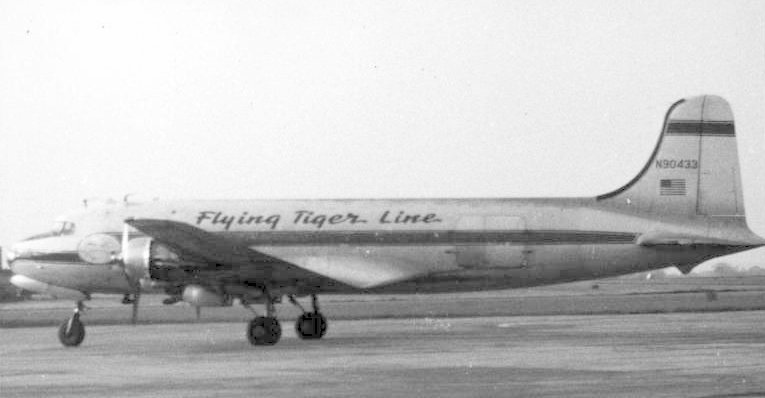
The Board determined that the probable cause of the accident was "the loss of power in three engines due to incorrect fuel system management and faulty restarting methods which resulted in the ditching of the aircraft."
— NTSB Determination
On September 24, 1955, at 0642 GMT, a Flying Tiger Line Douglas DC-4 operating a military contract cargo flight ditched in the Pacific Ocean approximately 1,000 miles west of Honolulu. The aircraft, registered N90433, lost power in three of its four engines. Two of the five crew members survived; one went down with the aircraft, and two drowned before rescue arrived the following day.
### The flight
Trip 7413-23 was a scheduled cargo flight from Travis Air Force Base, California, to Tokyo, Japan, with refueling stops at Honolulu and Wake Island. The aircraft carried 15,333 pounds of properly secured cargo. The crew consisted of Captain A. J. Machado, First Officer W. F. Gin, Copilot R. C. Hightower, and Navigators R. C. Olsen and D. Ventresca. Captain Machado had 13,450 total pilot hours, including 8,895 in DC-4s. First Officer Gin had 7,603 hours (380 in DC-4s), and Copilot Hightower had 1,328 hours (20 in DC-4s).
After an uneventful flight from California, the aircraft was refueled at Honolulu. It departed at 0013 GMT on an instrument flight plan to Wake Island, cruising at 8,000 feet. Weather forecasts indicated scattered cumulus clouds with tops at or below 12,000 feet, and no rain showers in the ditching area. The sea surface was faintly illuminated by a quarter moon, with swells up to six feet.
### The emergency
The flight made routine hourly reports until 0630, when control was transferred to Wake Island. At 0633, the crew declared an emergency, advising Wake that they had lost power in three engines and could not return to Honolulu.
According to the statements of Captain Machado and Copilot Hightower, the flight had taken off on its main tanks. About an hour later, the captain rested, and Copilot Hightower took his seat. When the main tanks were down to 400 gallons each, First Officer Gin switched engines 1 and 2 to the No. 2 auxiliary tank, and engines 3 and 4 to the No. 3 auxiliary tank. When these inboard auxiliary tanks dropped to approximately 20 gallons each, the selectors were moved to the outboard auxiliary tanks (Nos. 1 and 4).
Captain Machado returned to the left seat after about five hours of rest, and First Officer Gin relieved the copilot. At this time, the No. 1 auxiliary tank was empty, and the No. 4 auxiliary tank contained 100 gallons. First Officer Gin had positioned the selectors to transfer the remaining 20 gallons from the inboard to the outboard auxiliary tanks—a practice contrary to the company flight manual and an existing Airworthiness Directive.
About ten minutes after the captain's return, the No. 1 engine quit. Captain Machado stated he immediately moved the No. 2 and No. 3 fuel selectors to the full forward position, mistakenly thinking this selected the main tanks, and shut off the crossfeeds. The No. 3 engine then quit. Realizing his error, the captain pulled all four selectors to the center position—which on this aircraft selected the main tanks—and moved the mixture controls to auto-rich. During this operation, the No. 2 engine quit.
The captain stated he checked that the selectors were on the main tanks, crossfeeds were off, and main boost pumps were on. He then moved the crossfeed controls to "all engines to crossfeed," which caused the No. 4 engine's fuel pressure to fluctuate. He shut the crossfeeds off, and No. 4 stabilized.
The propellers of engines 1, 2, and 3 continued to windmill. When the engines did not start after a period the captain considered sufficient, he feathered the three propellers and applied full power to the No. 4 engine. During the descent, engines 1 and 2 were separately unfeathered in unsuccessful restart attempts. While attempting to restart No. 3, the aircraft struck the water in a slightly nose-high attitude.
### Evacuation and rescue
On impact, the cargo broke loose and shifted forward, trapping First Officer Gin and Copilot Hightower. Navigator Olsen opened the astrodome while Captain Machado freed the trapped men, and the four exited through the dome. Navigator Ventresca, who had been in the cargo compartment attempting to jettison cargo, went down with the sinking aircraft.
Captain Machado stated he could not locate his life jacket and was without one until after First Officer Gin and Navigator Olsen died in the water. The two survivors, Machado and Hightower, floated for more than 30 hours and were repeatedly bitten by sharks before being rescued by the SS Steel Advocate on September 25.
### What the investigation found
The investigation noted that Flying Tiger Line operated DC-6s, 6-tank DC-4s, and 8-tank DC-4s, and Captain Machado piloted all three. The fuel selector positions differed among the types: on the DC-6 and 6-tank DC-4, the forward position selected the main tanks, while on the 8-tank DC-4 involved in the accident, the center position selected the main tanks and the forward position selected the auxiliary tanks.
To evaluate the captain's account, the Board requested flight tests using an identically equipped 8-tank DC-4. The tests duplicated the control configurations described by Captain Machado. The Board found conclusively that if the propellers had been allowed to windmill with the selectors on the main tanks, the main boost pumps on, and the crossfeeds off, the engines would have restarted. Original 1945 certification tests also showed that recovery time after a tank shift with boost pumps on was 10 seconds.
The Board noted that while feathering the propellers slowed the rate of descent, it definitely removed any possibility of restarting the engines in that condition. The subsequent unfeathering and restart attempts likely consumed more time and altitude than the original feathering had gained.
The Board concluded that the captain's and copilot's recollection of the sequence of events and actions taken after the power loss was incorrect, though it noted this absence of accurate recollection was understandable given the stress of the emergency and the prolonged ordeal in the water. Furthermore, the Board found that if First Officer Gin had not transferred the fuel from the inboard auxiliary tanks, the power loss would not have occurred when it did. This would have allowed the captain time to make an unhurried switch to the main tanks, each of which still contained 400 gallons—enough fuel for approximately eight hours of flight at the aircraft's uniform consumption rate of 200 gallons per hour.
### Probable cause
The Board determined that the probable cause of the accident was "the loss of power in three engines due to incorrect fuel system management and faulty restarting methods which resulted in the ditching of the aircraft."
A SkyWalk Join't 3 paraglider crashed into the ground near Las Vizcachas, Chile, on September 1, 2024. The pilot and passenger sustained serious spinal…
A Cessna 172N struck electrical cables while on final approach to land at Aucó Aerodrome in Chile. The pilot was uninjured, but the aircraft sustained damage…
A Bombardier DHC-8-402 suffered a tail strike during landing at Puerto Williams on September 9, 2024. All 76 occupants were unharmed, but the aircraft…
A MYD JS-MD 3 glider veered off the runway and struck a wall at Vitacura Aerodrome on January 6, 2025. The pilot was uninjured, but the aircraft sustained…
A recreational paraglider flight in Puchuncaví, Chile, ended with the pilot sustaining serious injuries after a rapid descent and impact with a hillside on…
A Tecnam P2006T landed on its belly at an aerodrome in Poland after the crew failed to confirm landing gear deployment. The incident resulted in no injuries…