What happened
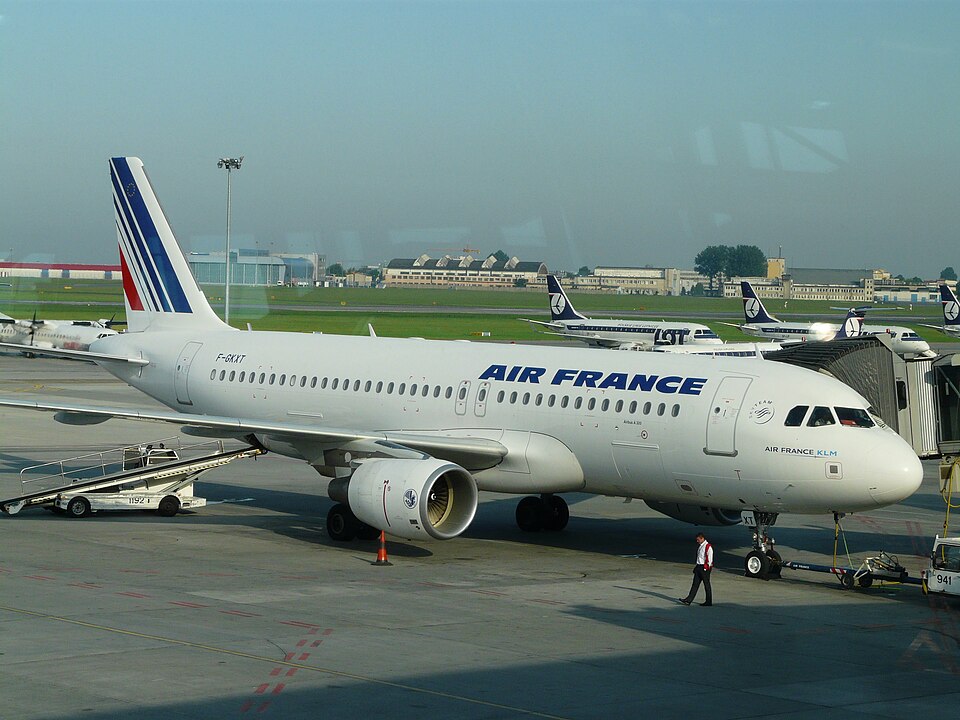
Two distinct incidents occurred involving Air France flights approaching Paris Charles de Gaulle airport. On February 19, 2016, an Airbus A320, registration F-GKXT, was on an ILS approach to runway 26L. While descending through 5,400 ft, the pilot flying spotted a dark, circular drone with a roughly one-meter wingspan. The pilot disconnected the autopilot and performed an avoidance maneuver, observing the drone pass just a few meters below the left wing. The crew reported the drone to air traffic control, noting it had passed at a distance of approximately five meters.
On July 2, 2016, an Airbus A319, registration F-GRHK, was on final approach at approximately 2,000 ft and 7.5 NM from the runway. During this flight, the crew had already decided to operate without autopilot or autothrust due to a malfunctioning radio altimeter. The pilot flying identified a black drone with a swept-wing design and a single propeller, approximately one meter in width, passing roughly five meters to the right of the cockpit. Unlike the first incident, the crew was unable to perform an avoidance maneuver before the drone passed.
The investigation
The BEA examined the flight data, meteorological conditions, and the technical capabilities of drone detection. The investigation noted that the drones involved were too small to be detected by primary or secondary radar systems used by air traffic control. The investigation also reviewed the regulatory framework in France, noting that while regulations prohibit drones from flying above 15 and 150 meters, the surge in consumer drone popularity has led to increased unauthorized activity in controlled airspace.
Findings
- The primary cause of both incidents was the unauthorized presence of drones in controlled airspace, which constitutes a violation of existing flight regulations.
- The small size of these drones makes them nearly impossible to detect via radar, leaving the safety of the aircraft dependent solely on the "see and avoid" principle.
- The rapid growth of the drone market and the availability of amateur-built models increase the likelihood of operators lacking sufficient aeronautical knowledge.
- There is a lack of standardized procedures for air traffic controllers to manage subsequent traffic following a drone report, and delays in notifying law enforcement can prevent the identification of the drone's pilot.