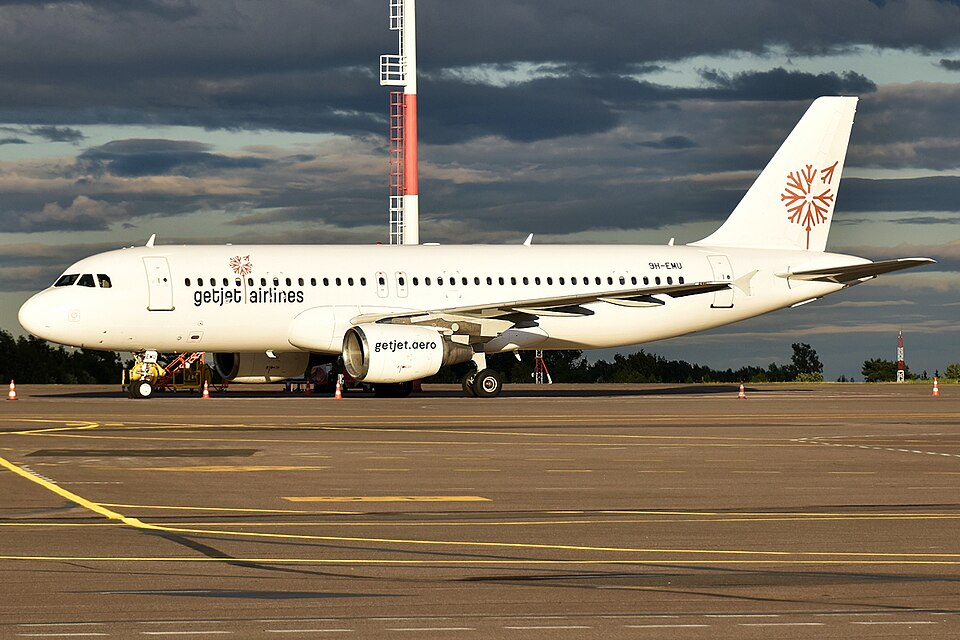
Incident Overview
On Monday 23 May 2022, an Airbus A320 registered 9H-EMU, operated by Airhub Airlines, was conducting scheduled flight NSZ4311 from Stockholm Arlanda airport (Sweden) to Paris-Charles de Gaulle airport (CDG). Due to maintenance work on the ILS for runway 27R, the crew performed a satellite approach with barometric vertical guidance (RNP APCH down to LNAV/VNAV minima).
Sequence of Events
During the approach, in a rain shower that severely impaired visibility, the air traffic service provided an incorrect altimeter setting (QNH) of 1011 hPa instead of the actual 1001 hPa, a difference of 10 hPa. This error caused the aircraft's actual altitude to be approximately 280 ft (85 m) below the displayed altitude, resulting in the approach being flown on a vertical profile parallel to but below the published one.
At low height, a ground proximity warning (MSAW) was triggered in the control tower. The air traffic controller informed the crew using incorrect and inappropriate phraseology; the crew did not hear this announcement and continued the descent. Upon reaching the indicated altitude corresponding to the chosen minima, the crew executed a go-around because they had not acquired the visual references needed to continue the landing. During the go-around, the minimum recorded and corrected radio-altimeter height was 6 ft (about 2 m) when the aircraft was approximately 0.9 NM from the runway threshold, outside the airport limits. There was no onboard ground proximity alert (TAWS) during the event, as per design. The crew reported being unaware of the proximity to the ground.
A second approach was flown with the same incorrect QNH. This time, the crew acquired visual contact with the ground at a height above 600 ft. The pilot flying corrected the flight path and landed without further incident.
Contributing Factors
The investigation identified several factors that contributed to two barometric approaches being flown with an incorrect altimeter setting: human error in QNH communication (probability never zero), operating procedures for crews and air traffic controllers that were not robust or ineffective against this threat, and onboard and ground systems that were not robust or ineffective against this threat.
Factors that contributed to the aircraft descending to a near collision with the ground included: the approach lights not being illuminated; the absence of an onboard ground proximity warning (TAWS operating as designed); the late triggering of the Minimum Safe Altitude Warning (MSAW) system (operating as designed); and a late and inadequate reaction by the air traffic controller to the MSAW alert, with insufficient training contributing to the inappropriate response.
Safety Recommendations
The BEA issued twelve safety recommendations in total. Six recommendations accompanied the preliminary report published on 11 July 2022, and six additional recommendations accompanied the final report. These latter recommendations addressed: reassessment of CFIT risk related to incorrect altimeter setting for baro-VNAV operations; maintaining safety levels of approach operations in Europe by 2030 under IR-PBN regulation; ground systems for detecting incorrect altimeter settings; onboard TAWS; air traffic controller training for MSAW alerts; and the DSNA safety management system.