History of the Flight
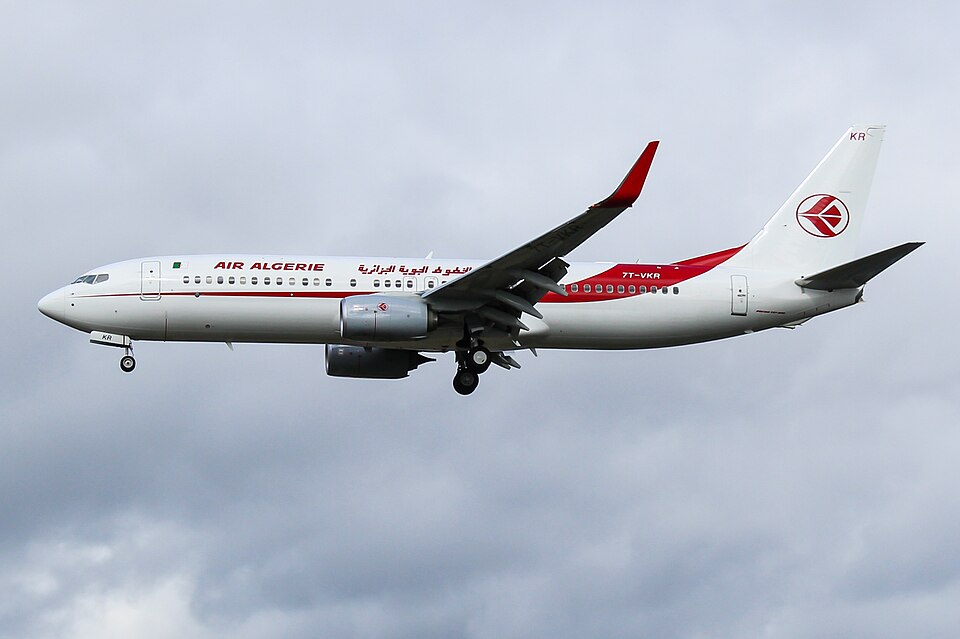
Runway 17R at Lyon-Saint-Exupéry was unavailable for one hour due to work, resulting in a single runway configuration on 17L. At 08:14, the Air Algérie Boeing 737-800 (registered 7T-VKR) was established on ILS for runway 17L. At 08:15:43, the tower controller asked the KLM Embraer ERJ-175 (registered PH-EXH) if it was ready for immediate takeoff. The crew affirmed, and the controller cleared them to line up on runway 17L from taxiway B4. At that time, the Boeing was 4.3 NM from the threshold at 2,100 ft.
At 08:16:31, the controller cleared the Embraer to take off while the Boeing was 2.4 NM from the threshold at 1,525 ft. The Embraer crew read back the clearance and applied brakes; engine thrust increased at 08:16:51. At 08:16:42, runway incursion (RwyInc) information associated with the Embraer appeared on the ground radar display. The Embraer’s speed began to increase at 08:16:58, with the Boeing at 1.3 NM and 1,205 ft.
At 08:17:13, RwyInc information for both aircraft disappeared for 18 seconds. At 08:17:14, the Boeing was 0.7 NM from the threshold, and the controller informed the crew that landing clearance would be given late. At 08:17:30, as the Embraer’s wheels lifted off, the controller cleared the Boeing to land. The Boeing was 0.11 NM from the threshold at 60 ft, while the Embraer was 0.5 NM from the opposite threshold. RwyInc alerts reappeared. The Embraer continued its takeoff, and the Boeing landed.
Meteorological Information
Wind was from 170° at 10 kt, varying from 130° to 200°, visibility greater than 10 km, and CAVOK conditions.
Air Traffic Management on a Single Mixed-Mode Runway
Lyon-Saint-Exupéry has two parallel runways. Normally, runway 17L is used for landings and 17R for takeoffs. Single mixed-mode operations on 17L were uncommon, accounting for 16% of operating time in early 2022. At the time, no specific working methods were formalized for such operations except under low visibility procedures. The Operations Manual only defined a 90-second interval for arrivals only, with no minimum for inserting departures, no approach aids, and no specific phraseology for warning arriving crews of departing traffic.
Regulatory References
European regulations SERA and IR ATM/ANS were in force, amended in January 2022. French adoption occurred via an Order of 4 March 2022.
Separation Between Aircraft
General requirements state that controllers should not permit a landing aircraft to cross the threshold or a departing aircraft to start takeoff until the preceding departure has crossed the end of the runway or turned, or all landing aircraft are clear. Reduced separation may be applied under certain conditions after a safety study, with suitable means to assess distances.