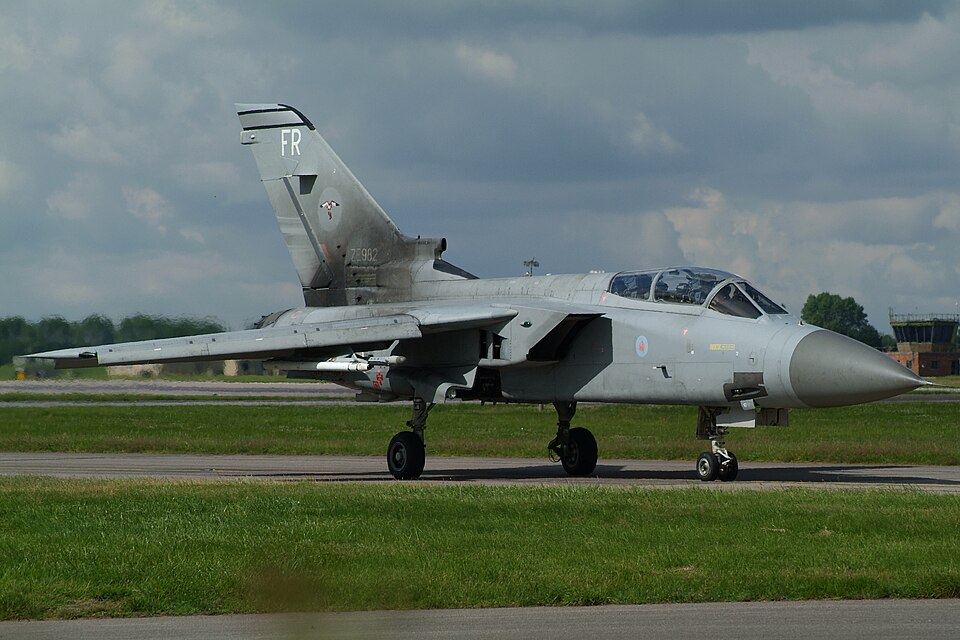
Aircraft and Crew
The aircraft involved was a Tornado F3, registration ZE982, operating under the callsign BLACKSMITH 1. It was configured with two 2250-litre under-wing tanks, two wing pylons, a RAIDS pod on the starboard outer stub pylon, and an acquisition training missile on the port outer stub pylon—known as the Lima fit. The aircraft had flown 4101:45 total hours, with 25:10 hours since its last primary maintenance. Both Rolls-Royce RB199 Mk 104 engines were fitted; the right engine had 282:35 hours since reconditioning, the left 163:50 hours. The aircraft was declared fully serviceable before the flight.
The pilot, who joined the RAF in 2004, had 180 hours on type and had been assessed as proficient. The navigator had 2930 hours on type and was assessed as above average. Both were reported to be in good spirits before the flight.
Flight Sequence
The sortie was a routine training mission involving medium- and low-level intercepts for an E3D AWACS squadron acceptance check, followed by a low-level navigation exercise. Due to a delay in AWACS availability, the order was swapped, and the low-level navigation was conducted first.
BLACKSMITH 1 and BLACKSMITH 2 (the second aircraft) took off from RAF Leuchars at 1128 hrs local time on 2 July 2009. After takeoff, they climbed to 3000 ft, then descended to low level in the Strathallen area. They routed south of Perth, then turned south down Loch Lomond. As they flew along Loch Lomond, the pilot selected wing sweep to 27.9 degrees and remarked on the winding terrain. The aircraft selected manoeuvre flap and slat. The Ground Proximity Warning System (GPWS) sounded briefly for 2 seconds, which was acknowledged by the pilot. The navigator made a radar-altimeter call of 270 ft, which was acknowledged.
As the aircraft approached Rest and Be Thankful, the pilot retarded throttles slightly. The aircraft then entered a right turn, and the GPWS sounded again for 6 seconds without acknowledgement. The aircraft crested the ridge, and the pilot initiated a left turn. The GPWS sounded again at 7 seconds to end of data, and the navigator warned of high ground. At 5.2 seconds to end of data, left rudder was applied, causing a 256 ft height loss. At 5 seconds, a maximum left bank of 96° was achieved. At 4.7 seconds, a large right control column input was applied, and the left bank began to reduce. The aircraft struck the north slope of Glen Kinglas at 1198 ft above mean sea level. The impact destroyed the aircraft, and both crew members were killed.
Aftermath
BLACKSMITH 2, which was trailing, witnessed a fireball in the vicinity of ZE982 and took immediate recovery action. The accident occurred on civilian-owned open hillside. The squadron was in its final days of operation before disbandment. Toxicology showed no alcohol in the pilot's blood; alcohol was found in urine but was not considered a factor. No alcohol was consumed by the navigator.