Background
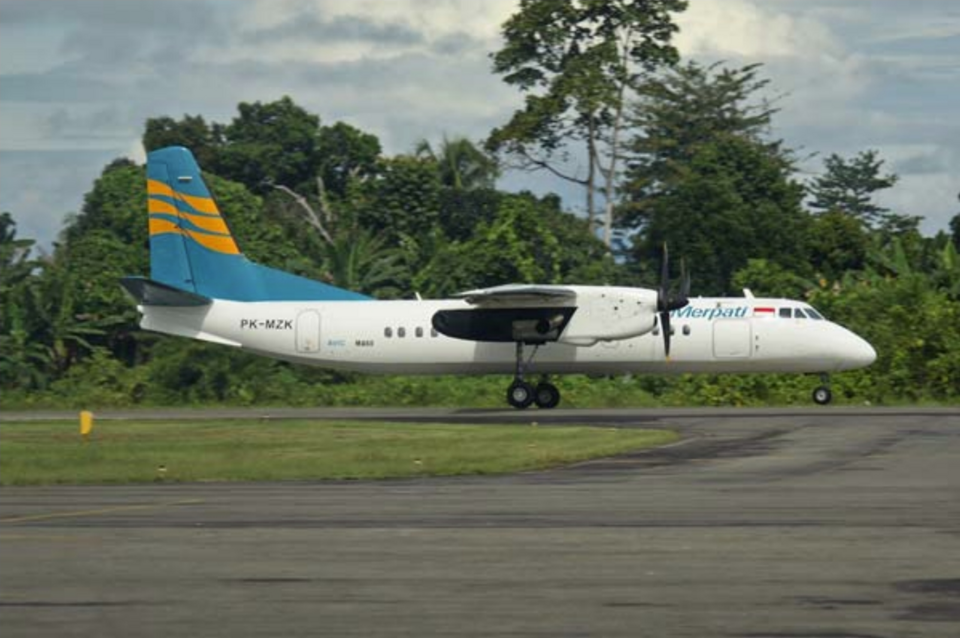
On 7 May 2011, an Xi'An MA60, registered PK-MZK, operated by PT. Merpati Nusantara Airline as Flight MZ 8968, crashed during approach to Utarom Airport (WASK) in Kaimana, Papua Barat. The flight originated from Domine Eduard Osok Airport in Sorong, Papua Barat, at 0345 UTC with an estimated arrival time of 0454 UTC. The crew consisted of a Pilot in Command (PIC) and a Second in Command (SIC). The SIC was Pilot Flying, while the PIC was Pilot Monitoring. On board were 2 pilots, 2 flight attendants, 2 engineers, and 19 passengers (16 adults, 1 child, 2 infants), totaling 25 occupants.
Flight
The flight was conducted under Instrument Flight Rules (IFR) but Kaimana had no published instrument approach, requiring visual flight rules (VFR) for terminal operations. At about 0425 UTC, after passing waypoint JOLAM, the crew contacted Kaimana Radio and reported weather conditions: rain, horizontal visibility 3–8 km, cumulonimbus clouds broken at 1,500 feet, southwesterly wind at 3 knots, and ground temperature 29°C. The last communication occurred around 0450 UTC, when the crew asked about ground visibility and were informed it was 2 km. Minimum VFR visibility is 5 km with a cloud base above 1,500 feet.
During the final segment, both crew members were looking outside to sight the runway. The aircraft's flight path altitude varied between 376 and 585 feet, bank angle increased to 38° left, and descent rate increased to approximately 3,000 feet per minute. The aircraft impacted the sea about 800 meters southwest of the start of runway 01 and 550 meters from the coastline. Most wreckage submerged between 7 and 15 meters deep. All 25 occupants were fatally injured, and the aircraft was destroyed.
Investigation Findings
Findings indicated the aircraft was airworthy with no malfunction evidence. Crew had valid licenses and medical certificates with no incapacitation. The SIC acted as Pilot Flying until the PIC took control near the end. According to the company's operation manual, a "minimum, minimum" EGPWS alert during an unstabilized approach should prompt aborting the approach. The crew did not conduct approach briefings or checklist readings. Cockpit voice recorder data showed both crew looking outside, likely reducing situational awareness.
Flight data recorder (FDR) details: The go-around was initiated at 376 feet pressure altitude (250 feet radio altitude), climbing to 585 feet with a left bank up to 38°. Engine torque increased to 70% (left) and 82% (right). Flaps were retracted to 5° then 0°, and the landing gear retracted. The aircraft descended with pitch angle up to 13° nose-down and descent rate reaching 3,000 feet per minute. The Emergency Rating Switch (ERS) was in CRUISE mode instead of TOGA. The standard go-around procedure for the MA60 sets flaps at 15°, not retracted to 0.
Limited crew communication indicated a steep trans-cockpit authority gradient. The SIC trained under early batches by manufacturer instructors, while the PIC trained under a modified Merpati syllabus. Non-standard English aviation language was found in the Flight Crew Operation Manual and Aircraft Maintenance Manual, as noted by the Australian Transport Safety Bureau. The DFDR lacked lateral and longitudinal acceleration parameters, which were mandatory under CASR but not required during certification. The Emergency Locator Transmitter did not transmit due to impact and immersion.
Probable Cause
The official probable cause identified several contributing factors: the flight was conducted in VFR conditions unsuitable for visual approach (visibility 2 km); no checklist reading or crew briefing; lack of situational awareness during runway search; missed approach initiated at 376 feet with flaps retracted to 0 while bank angle increased to 38°; low crew experience on type; and inadequacy in training programs leading to deviation from standard procedures.