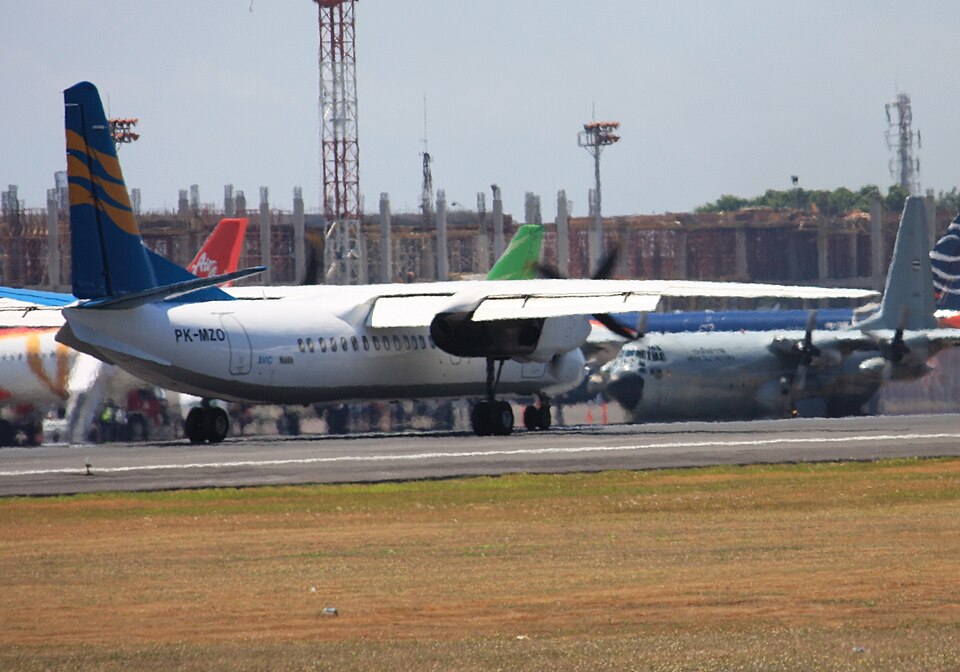
Event Overview
On 10 June 2013, a Xi 'An MA60 aircraft registered PK-MZO, operated by PT. Merpati Nusantara Airlines as flight MZ 6517, departed from Bajawa Airport (WATB) at 0102 UTC bound for El Tari Airport (WATT) in Kupang, Nusa Tenggara Timur. The flight was the second sector of the day for the aircraft and crew; the first leg from Kupang to Bajawa was uneventful. On board were two pilots, two flight attendants, and 46 passengers (45 adults and 1 infant).
Flight Sequence
During the flight, the Second in Command (SIC) acted as Pilot Flying (PF) and the Pilot in Command (PIC) as Pilot Monitoring (PM). The flight was uneventful until the approach. At 0122 UTC, the crew made initial contact with El Tari Tower, reporting their position on radial 298° at 110 nautical miles from KPG VOR, maintaining 11,500 ft. The tower advised runway 07 in use and provided weather information: wind 110° at 11 knots, visibility 10 km, few clouds at 2,000 ft, temperature 30°C, dew point 22°C, QNH 1010 mb, QFE 998 mb.
At 0133 UTC, the aircraft was on radial 297° at 68 nm from KPG VOR, and the pilot received clearance to descend to 5,000 ft. At 0138 UTC, passing 10,500 ft, the pilot reported Visual Meteorological Conditions (VMC). At 0150 UTC, the aircraft was on left base for runway 07 at 5 nm from KPG VOR. The tower confirmed visual contact and issued landing clearance, adding wind 120° at 14 knots, QNH 1010 mb. At 0151 UTC, the pilot reported final approach, and the tower reissued landing clearance.
Hard Landing and Evacuation
The Flight Data Recorder (FDR) recorded that the left power lever entered BETA MODE at approximately 112 ft above ground level, followed by the right power lever at 90 ft, until ground contact. The aircraft touched down at about 58 meters from the beginning of runway 07 and came to a halt at about 261 meters. The vertical deceleration recorded was 5.99 G, followed by -2.78 G. After stopping, the flight attendants assessed the situation and evacuated passengers through the rear main entrance door. One pilot and four passengers seated in rows three, seven, and eight suffered serious injury. The aircraft was removed from the runway on 11 June 2013 at 2100 UTC and moved to the Air Force hangar.
Probable Cause
The official investigation identified the following contributing factors:
- The procedure of selecting Power Lever Lock to “OPEN” during approach was made without comprehensive risk assessment.
- Both power levers entered BETA MODE at 90 feet due to the safety device namely Power Lever Lock has been opened during approach, which was in accordance to the operator procedure and lifting of Mechanical Power Lever Stop Slot which was not realized by the pilots.
- The movement of power levers to BETA MODE resulted the pitch angle changed to low pitch angle which produced significant drag and made the aircraft loss of significant lift.