Casualties unknown

Smoke in Cockpit Prompts Emergency Evacuation; Slides Fail to Deploy (N404KW)

Fort Lauderdale, FL, US

On September 26, 1995, a Boeing 737-400 (registration N404KW) operated by Carnival Airlines was involved in an aviation accident near Fort Lauderdale, FL. Investigators recorded the probable cause as: Smoke and fumes entered the airplane through the air conditioning system as a result of a wash solution remaining in the left engine longer than required during an engine wash. This summary draws on records from the U.S. National Transportation Safety Board (NTSB) historical archive; 9 related events involving the same aircraft type or operator are linked below.

Sourcesthe U.S. National Transportation Safety Board (NTSB) historical archivePrimary reportUpdated 2026-06-10Data APIEditorial standards
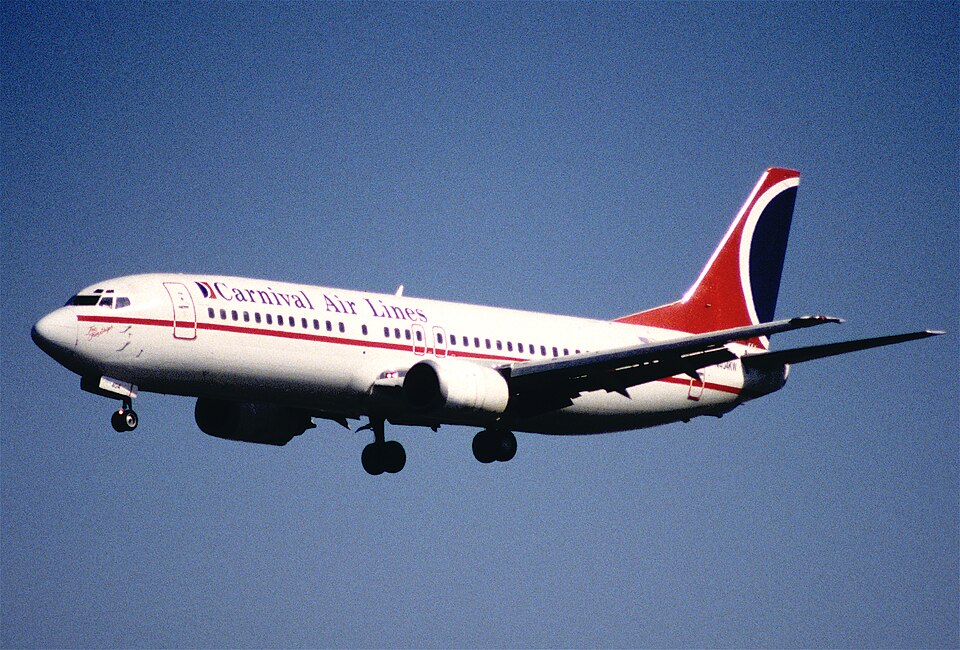
Aircraft registered N404KW
Aircraft registered N404KW. Photo: Aero Icarus from Zürich, Switzerland / CC BY-SA 2.0, via Wikimedia Commons

During initial climb, smoke filled the cockpit and cabin. The crew returned to the airport and evacuated. Slides failed to deploy due to installed safety pins. Smoke originated from engine wash residue.

Incident Overview

During the initial takeoff climb, the flight crew encountered smoke in both the cockpit and passenger compartment. The pilot-in-command declared an emergency, returned to the departure airport, and commanded an emergency evacuation of all passengers and flight crew. During the evacuation, two aft emergency slides did not deploy.

Examination Findings

Examination of the airplane revealed that the smoke and fumes had entered the airplane through the air conditioning system. This occurred as a result of a wash solution remaining in the left engine longer than required during an engine wash performed the day before the incident. While the engine was being washed, the starter failed, and the solution remained in the engine for more than the required 20 minutes while the starter was being changed.

Emergency Slide Issue

Examination of the aft emergency slides disclosed that the installation safety pins were still installed, preventing their deployment during the evacuation.

Sequence of Events

The events began when the flight crew initiated a takeoff and during climb noticed smoke. After declaring an emergency, the aircraft returned to the departure airport. The pilot-in-command then ordered an emergency evacuation. The failure of the two aft slides to deploy was traced to the safety pins left in place, which are designed to prevent inadvertent deployment during maintenance.

Probable cause

Smoke and fumes entered the airplane through the air conditioning system as a result of a wash solution remaining in the left engine longer than required during an engine wash.

Investigation report by the U.S. National Transportation Safety Board (NTSB) historical archive. Original record: https://carol.ntsb.gov/event/20001207X04543. This page is a structured re-presentation; facts and quotes are in the National Transportation Safety Board (NTSB), United States.