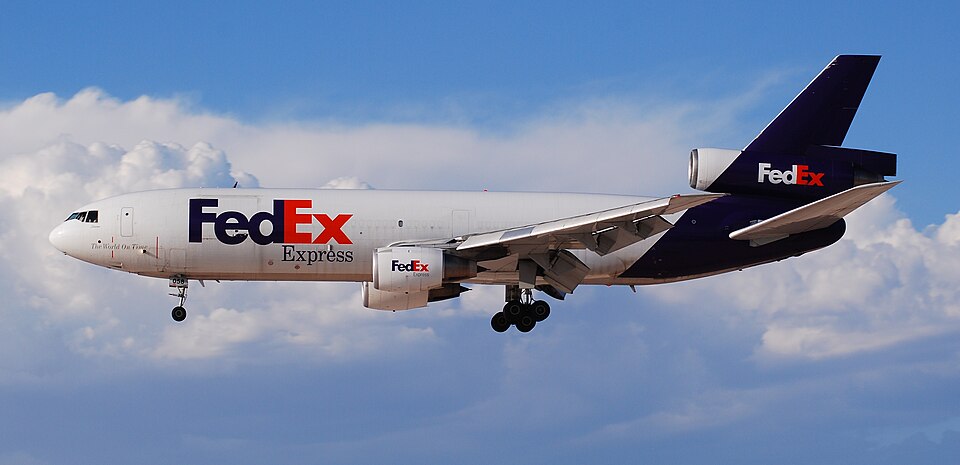
Incident Description
On final approach with full flaps selected and indicated, the left inboard trailing edge flap and associated vane separated from the aircraft. The autopilot was disconnected, and approximately one-half right aileron input was required to counter a left banking tendency. The subsequent landing was described as firm but with reduced controllability. Contact between the separated flap and/or vane caused structural damage to the left side of the fuselage.
Examination of Failed Components
Investigation focused on the attachment bolts of the left inboard trailing edge flap. The four H-11 type bolts securing the forward attach point of the outboard hinge failed due to stress corrosion cracking. Chromium was detected at the fracture origin of three of these bolts; however, the reason for the presence of chromium could not be determined. The two H-11 type bolts at the aft attach point of the outboard hinge failed due to ductile overload. No material or processing discrepancies were found in the failed bolts. H-11 bolts are known to be susceptible to stress corrosion cracking.
Flight Data Recorder Analysis
The flight data recorder (FDR) indicated a maximum left roll of 8.09 degrees during the event. Additionally, during landing No. 1, the flap extension speed was exceeded for approximately 13 seconds while the flaps were extending from 16 to 20 degrees. No flap overspeed protection is provided in that flap range.