Casualties unknown

2005-08-08: Boeing 737-824 (N73270) — Continental Airlines Inc — Newark, NJ

Newark, NJ, US

On August 8, 2005, a Boeing 737-824 (registration N73270) operated by Continental Airlines Inc was involved in an aviation accident near Newark, NJ. Investigators recorded the probable cause as: The airport's failure to install markings on a parking "block" that bordered the taxiway, which failed to provide adequate clearance between taxiing airplanes and airplanes parked in the block. This summary draws on records from the U.S. National Transportation Safety Board (NTSB) historical archive; 3 related events involving the same aircraft type or operator are linked below.

Sourcesthe U.S. National Transportation Safety Board (NTSB) historical archivePrimary reportUpdated 1781061362Data APIEditorial standards
Aircraft registered N73270
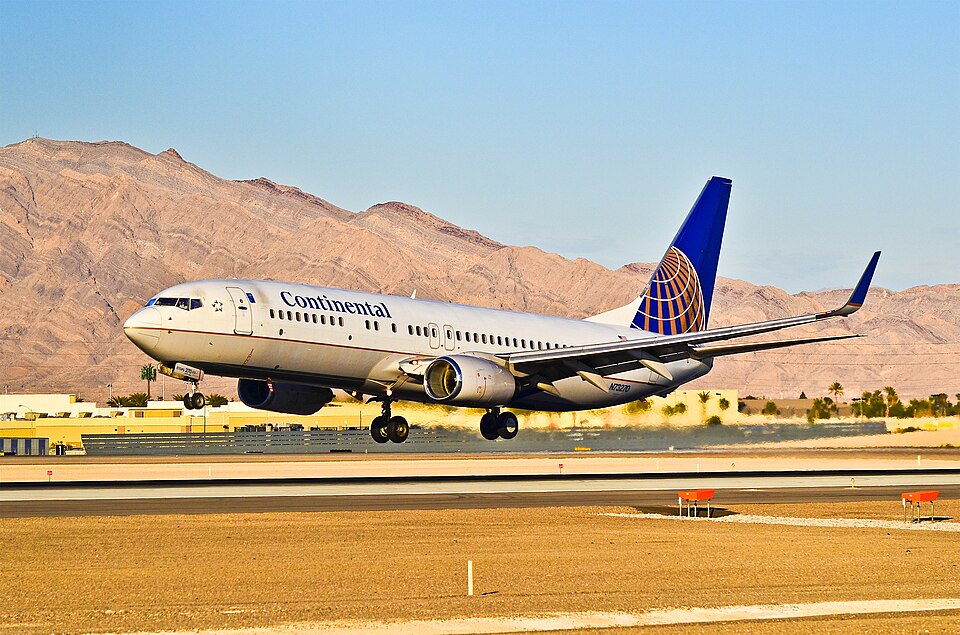
Aircraft registered N73270. Photo: Tomás Del Coro from Las Vegas, Nevada, USA / CC BY-SA 2.0, via Wikimedia Commons

A Boeing 737-824's right winglet struck the tails of two parked Embraer 145s while taxiing to park between them, causing substantial damage to one. The aircraft was centered on the taxiway centerline.

Incident Description

Six Embraer 145 airplanes were parked side-by-side in an unmarked, paved "run-up block" area between two parallel taxiways at a large international airport, awaiting further instruction from air traffic control. A Boeing 737-824 was instructed by ATC to continue on the taxiway behind the line of airplanes and park between the fifth and sixth aircraft in the row. With the nose wheel centered on the taxi line, the right winglet of the Boeing struck the tails of the first two parked airplanes in the run-up block.

Damage

The collision resulted in substantial damage to one of the parked Embraer 145s.

Context

According to Advisory Circular 150/5300-13, Taxiway and Taxilane Design Rationale, "The need for ample wingtip clearance is driven by the fact that the pilots of most modern jets cannot see their airplane's wingtips." The circular also states that a minimum separation between a taxiway centerline and an object is 0.70 times the wingspan of the most demanding airplane plus 10 feet (3 m). The Airman's Information Manual (2-3-4b) notes that the taxiway centerline "provides a visual cue to permit taxiing along a designated path. Ideally the aircraft should be kept centered over this line during taxi to ensure wing-tip clearance." The FAA inspector who responded to the scene confirmed that the nose wheel of the Boeing was centered over the taxiway centerline.

Investigation report by the U.S. National Transportation Safety Board (NTSB) historical archive. Original record: https://carol.ntsb.gov/event/20050825X01313. This page is a structured re-presentation; facts and quotes are in the National Transportation Safety Board (NTSB), United States.