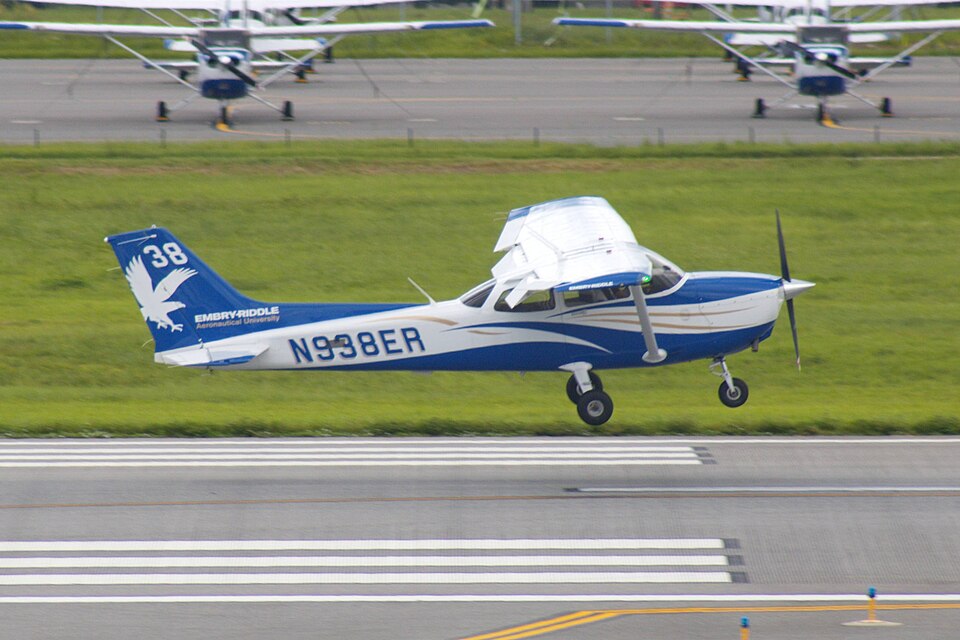
Incident Overview
During the landing roll, the aircraft touched down and immediately veered sharply to the left, departing the runway. It collided with a runway distance remaining sign, resulting in damage to the right wing.
Landing Gear Status Before Touchdown
Prior to landing, the landing gear was confirmed to be down and locked. All three green annunciator lights were noted, and the nose landing gear was visually observed to be in the down and locked position.
Post-Accident Examination
Examination of the aircraft after the incident revealed that the nose landing gear had collapsed. The upper drag brace, which connects the nose gear to the fuselage, was found fractured. The pivot lug, which connects the upper brace to the lower brace, exhibited fractures in two locations. The fractures on the pivot lug were consistent with overload stress separations.
Metallurgical Analysis of the Drag Brace
At least 13 internal horizontal and parallel cracks were discovered near the vertical centerline of the brace. These cracks followed the grain flow lines resulting from the forging process. Flow lines in the arm portion of the brace were longitudinal, with a smooth, gently curving transition into the thicker portion of the lug. However, the flow lines in the upper fracture were convoluted and tightly twisted.
A laboratory-induced fracture of the brace exhibited an irregular boundary with ductile overstress features interspersed along the crack edge. Low magnification revealed a smooth, undulating surface, while high magnification showed a fine granular texture. Energy dispersive X-ray spectra detected an increased oxygen level on the crack surface.