History of Flight
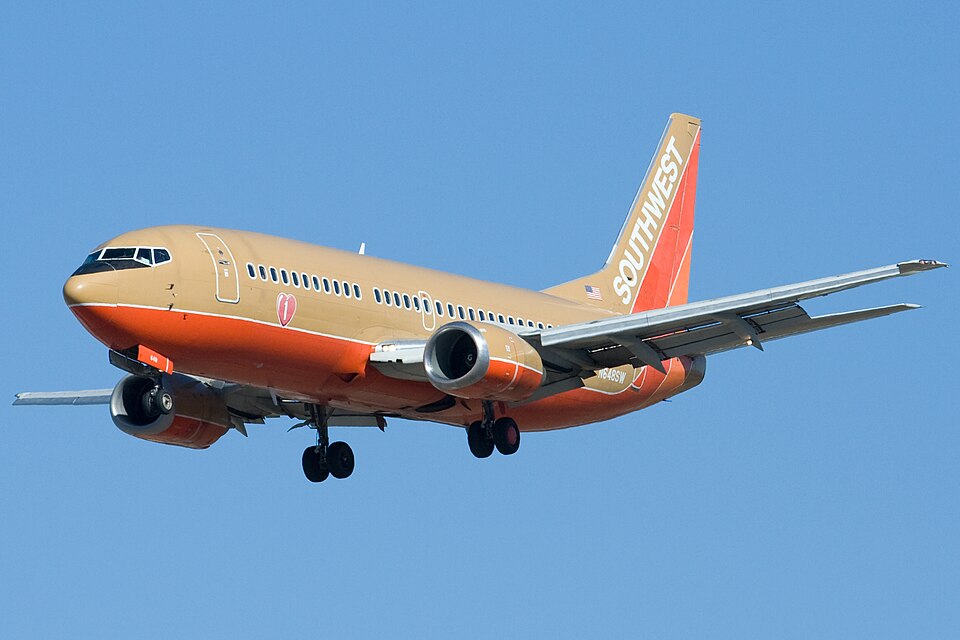
On February 24, 2008, at approximately 1340 Pacific standard time, Southwest Airlines flight 2809, a Boeing 737-300 (registration N648SW), encountered severe turbulence while descending to McCarran International Airport in Las Vegas, Nevada. The flight originated from Ontario, California, at 1251, operating under 14 Code of Federal Regulations Part 121 as a regularly scheduled domestic passenger flight. Visual meteorological conditions prevailed, and an instrument flight rules flight plan was filed. The airplane was at an altitude of 11,400 feet above mean sea level when the turbulence occurred. The flight continued to Las Vegas and landed without further incident.
Injuries and Damage
Five passengers and one flight attendant sustained minor injuries. Two of the passenger injuries resulted from their seat belts becoming unhooked. An infant held by his mother also hit the overhead area. Two additional passengers were injured by contact with the airplane structure. The remaining 132 passengers and 4 crewmembers were uninjured. The airplane itself was not damaged, although an overhead bin was damaged when a passenger contacted it.
Crew and Passenger Accounts
According to the flight crew, the seatbelt sign remained illuminated throughout the flight. The captain made several calls advising flight attendants to sit down until turbulence subsided and to clean up the cabin early. One flight attendant reported that while bracing, her body lifted off the floor and her head struck the ceiling. Another flight attendant struck her head on the ceiling and later her face and neck hit the galley door during the turbulence. She witnessed an infant on his mother's lap hitting the ceiling.
A passenger in seat 21B described two episodes of violent vertical turbulence, approximately 20 seconds each. During the second episode, his seat belt became unhooked, and he was thrust upward, hitting his head on the overhead bin. He noted a young female in the same row whose restraint also became unhooked, and her contact with the overhead bin damaged a corner of it. A passenger in seat 23F was holding her infant on her lap; when the airplane dropped, the infant was launched upward and sustained a gash on his head. The captain later apologized, stating he did not see any turbulence on radar prior to the event.
Flight Data Recorder Analysis
Data from the flight recorder showed that the airplane experienced a vertical acceleration minimum of approximately -0.761 G, followed two seconds later by a positive peak of approximately +1.762 G.
Investigation Findings
Investigators examined the restraints from seats 21B and 22F. Both seats were equipped with D-ring shackle attachments (part number 4144000) manufactured by B/E Aerospace Inc. The restraints were manufactured by Davis Aircraft Products Co. Inc. The hardware included a steel hook and spring-loaded keeper secured with a cotter pin and two rivets. The keepers for the male restraint at seat 22F and the female restraint at seat 21B were bent about 15 degrees from the center of the steel hook.
Southwest Airlines reported that seat belts were not individually tracked during maintenance. The aircraft's last 8-year scheduled inspection (8Y Check) occurred on July 5, 2007, during which all seat assemblies were removed and refurbished. Seat belt assemblies were sent to Davis Aircraft Products for inspection and rewebbing. No subsequent maintenance actions involved the seat belts at seats 22F and 21B.
Additional Information
The National Transportation Safety Board had previously issued recommendation A-99-11 in 1999, urging the Federal Aviation Administration (FAA) to reexamine seat belt designs after two seat belts became unhooked on an American Airlines Boeing 727 in 1998. In response, the FAA formed an industry team that determined that detachment of seat belts with D-ring fittings occurred when out-of-plane loads depressed the spring keeper. The FAA issued Special Airworthiness Information Bulletin No. NM-04-37 in December 2003, advising operators to expedite replacement of D-ring-type seat anchors with an improved design. Compliance with this bulletin was not mandatory.