History of Flight
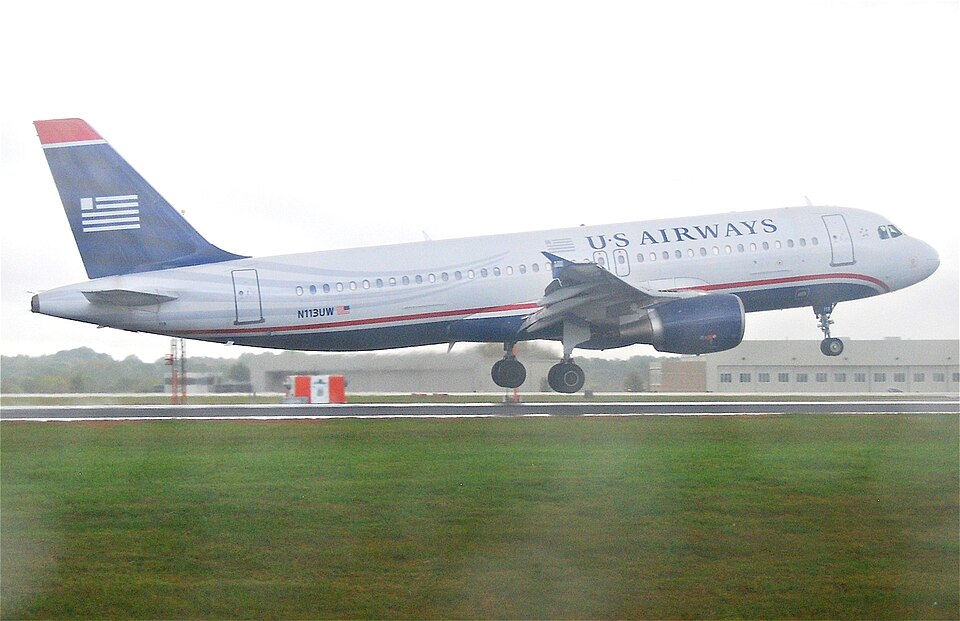
On March 13, 2014, about 1830 eastern standard time, US Airways flight 1702, an Airbus A320 (N113UW), experienced substantial damage after the captain rejected the takeoff after rotation on runway 27L at Philadelphia International Airport (PHL), Philadelphia, Pennsylvania. The airplane came to rest on the edge of the runway, and the crew and passengers exited via emergency slides. Of the 149 passengers, 2 pilots, and 3 flight attendants on board, 2 passengers reported minor injuries related to the evacuation. The airplane was substantially damaged. The flight was operating under 14 CFR Part 121 as a regularly scheduled passenger flight from PHL to Fort Lauderdale/Hollywood International Airport (FLL), Fort Lauderdale, Florida. Day visual meteorological conditions prevailed.
The accident occurred on the third flight of the day for the flight crew. The first two flights from Charlotte (CLT) to Tampa (TPA), then to PHL, were uneventful. The inbound flight arrived on schedule at 1649, and the crew changed gates and airplanes for the scheduled 1750 departure.
Crew Actions and Events
According to crew interviews, upon arrival at the accident airplane, the first officer (pilot monitoring) prepared the cockpit while the captain spoke with the dispatcher. The first officer initialized the flight management computer (FMC) with the ATC-provided flight plan and manually entered the departure runway. Both pilots stated they verified the ATC routing loaded into the FMC at the gate before pushback; however, neither realized the departure runway loaded was runway 27R instead of the assigned 27L.
Flight 1702 pushed back from gate B8 about 1752, and taxi out was normal. Weather at 1754 was clear skies, 10 statute miles visibility, temperature 0°C, dewpoint -21°C, winds from 290° at 18 knots gusting to 28 knots. ATIS information "Yankee" called for runway 27L as departure runway. The flight had an expect departure clearance time of 1829; the captain decided to conduct a single-engine taxi.
At 1808:20, flight 1702 contacted ground control; the ground controller advised departure runway 27L and provided taxi instructions. At 1819:29, the tower controller advised they were number six for departure from runway 27L. At 1820:29, the crew started the second engine and conducted a flight control check. At 1821:22, the tower advised flight 1702 would be next; the crew acknowledged. The first officer started the Taxi checklist but was interrupted by a flight attendant about a passenger in the bathroom; she continued the checklist as the captain taxied toward runway 27L.
At 1822:35, flight 1702 was cleared to line up and wait on runway 27L. As the captain taxied onto the runway, he noticed runway 27R was inserted into the FMC instead of 27L and requested the first officer change it, which was completed at 1823:10.
At 1823:26, flight 1702 received a heading of 230° on departure and clearance for takeoff. FDR data indicate the airplane had ground speed 0 knots for about 11 seconds before accelerating. At 1823:34, throttle levers advanced to MAX CLIMB; captain's longitudinal control moved nose down at 1823:41. Throttles advanced to FLEX detent by 1823:43 with airplane moving about 46 KIAS. When the captain set thrust levers in FLEX detent at 1823:45, the crew received an ECAM message and chime at 1823:47 indicating thrust not set. The first officer stated "engine thrust levers not set." Thrust levers briefly reduced to climb detent then returned to FLEX detent about 1 second later. The captain responded "they're set" 3 seconds later.
According to FDR and CVR data, the first officer did not make a required callout at 80 KIAS. The captain and first officer noticed no V-speeds indicated on their PFDs. As the airplane accelerated through 86 KIAS, an aural RETARD alert sounded. At 1823:56, the captain asked the first officer "what did you do, you didn't load. We lost everything." At 1824:03, at 143 KIAS, the captain stated "we'll get that straight when we get airborne" and continued the takeoff roll.
The airplane accelerated to 152 KIAS at 1824:08. At 1824:09, the first officer stated "wh*. I'm sorry", the captain's longitudinal control moved nose up, and pitch increased as rotation began. Airspeed was 164 KIAS, and nose gear weight off wheels discrete changed to "air" by 1824:10.
Over the next 4 seconds, with nose gear indicating "air" and main gear indicating "ground", the captain's control moved nose down and nose up twice, reaching 16° up and 16° down. Pitch and vertical acceleration followed inputs. As vertical acceleration decreased, crew reduced thrust, and control pulled nose up again. Vertical acceleration reached a minimum of 0.121 G as control pulled to 16° up (maximum operational value), and throttle lever angles reduced to idle thrust for the remainder of the recording.
By 1824:14, nose gear weight off wheels changed back to "ground." During the previous 4 seconds, main gear weight on wheels recorded "ground" and maximum radio altitude was 6 ft agl for only 1 second. Once pitch reduced to -0.4°, vertical acceleration rapidly increased to 3.7 G, consistent with gear impacting the runway. Pitch parameter became invalid. As vertical acceleration peaked, captain's longitudinal input reached 16° up.
The captain's longitudinal control cycled nose up and down over the next 2 seconds; vertical acceleration dropped to 0.47 G then increased to 1.2 G. As longitudinal stick pulled back to over 16° up and held, main gear weight off wheels changed to "air" for 2 seconds, and radio altitude increased to about 15 ft agl.
As the airplane reached 15 ft agl, longitudinal control moved nose down, pitch reduced, and airplane descended. Control moved nose up again as descent began; pitch increased. Surveillance video from Philadelphia Airport captured final impact: airplane impacted runway first with the tail, then main landing gear, then rotated nose down, resulting in nose gear impacting and collapsing.
At 1824:48, the crew advised tower they aborted takeoff as the airplane came to rest on the left side of runway 27L. At 1829:14, crew advised they were evacuating. Flight attendants stated all slides deployed normally except door 2R (not deployed due to smoke on right side) and 2L (did not reach ground due to nose gear collapse).
Damage to Aircraft
The airplane nose gear collapsed upon impact with the paved runway, resulting in fuselage and engine cowling damage. Due to tailstrike, additional damage occurred to the lower aft fuselage section, including the aft pressure bulkhead, fuselage, struts, and cross beams. Damage to the left engine occurred after nose gear collapse due to ingestion of debris.
Personnel Information
The captain, age 61, was hired by Piedmont Airlines on March 3, 1986. He had about 23,800 total flying hours, including about 7,500 hours as pilot-in-command and about 4,500 hours on the A320. His most recent proficiency check was December 19, 2013. He held an airline transport pilot certificate with A320 type rating and a first-class medical certificate with a limitation valid until May 31, 2014, including a special issuance related to previous bypass surgery in February 2011. No previous incidents or accidents were recorded.
The first officer, age 62, was hired by US Airways as a pilot on March 25, 1999 (previously a flight attendant). She estimated 13,000 total flying hours, including about 4,700 hours on the A320. Her most recent continuing qualification training was May 15, 2013. She held an airline transport pilot certificate with A320 type rating and a first-class medical certificate with a requirement to wear corrective lenses. No previous incidents or accidents were recorded.
Aircraft Information
The accident airplane, an Airbus A320-214 (N113UW), serial number 1141, was manufactured in 1999 and registered to US Airways, Inc. It had a maximum ramp weight of 170,635 pounds and seating capacity of 159 (4 flight crew, 5 cabin crew, 150 passengers). At the time of the accident, it had 44,230 airframe hours; last recorded inspection was March 3, 2014. The takeoff weight was about 152,525 pounds, including 24,090 pounds of fuel, with center of gravity within limits.
Relevant Airplane Systems
The ECAM (Electronic Centralized Aircraft Monitoring) processes and displays engine and system parameters, fault monitoring, and corrective procedures on two center instrument panel screens. ECAM uses color codes: red for immediate action, amber for awareness, green for normal, white for titles, blue for actions, magenta for special messages. Warnings and cautions have three levels: Level 3 (red, continuous aural, immediate action), Level 2 (amber, single chime, awareness), Level 1 (amber caution, monitoring).
Thrust levers have five detents: TO/GA (max takeoff), FLX MCT (flex or max continuous), CL (max climb), IDLE (idle), MAX REV (max reverse). With thrust lever in FLX/MCT detent on ground, engine runs at FLEX takeoff thrust if FLEX temperature was entered; otherwise MCT. The US Airways pilot handbook states the PF advances thrust to 50% N1, then positions in FLEX or TO/GA detent by 40 knots.
Probable Cause
null