History of Flight
On October 30, 2014, at 0948 central daylight time, a Raytheon Aircraft Company King Air B200, registration N52SZ, impacted the FlightSafety International (FSI) building during initial climb from Wichita Mid-Continent Airport (ICT), Wichita, Kansas. The airplane was operated by Gilleland Aviation, Inc., under 14 CFR Part 91 as a ferry flight from ICT to Mena Intermountain Municipal Airport (MEZ), Mena, Arkansas. Visual meteorological conditions prevailed, and an instrument flight rules flight plan was filed.
Air traffic controllers cleared the flight for takeoff on runway 1R with instructions to fly the runway heading. After becoming airborne, the pilot declared an emergency, stating the airplane "lost the left engine." The airplane entered a shallow left turn, continued turning, and descended into a building. Controllers observed flames and black smoke after impact.
Witnesses from the Cessna Service Center noted the airplane porpoised several times before turning left. It cleared a hangar and then descended. The landing gear was extended, and the engines could not be clearly heard. The altitude appeared less than 150 ft above ground level (agl).
Airport surveillance video captured the last 9 seconds. The airplane was in a left turn with a nose-left sideslip as it overflew a hangar. It was about 120 ft agl when it struck the FSI building, followed by an explosion and fire.
Personnel Information
The pilot, age 53, held an airline transport pilot certificate with single-engine and multiengine land ratings. He was issued a second-class medical certificate on August 4, 2014, with a requirement to wear corrective lenses. At that time, he reported 3,067 total flight hours with 200 hours in the preceding 6 months. Training records from FlightSafety International dated September 18, 2014, indicated 3,139 total hours, 2,843 of which were in multiengine airplanes. The King Air B200 did not require a type rating.
From September 4 to 19, 2014, the pilot completed Beechcraft King Air 300 series initial training at FSI in Wichita, specifically for the King Air 350 Proline 21 model. The course included 58.5 ground training hours, 12 briefing hours, 14 pilot-flying simulator hours, and 12 pilot-not-flying hours. Emergency procedures were reviewed. The pilot passed with a 2.5-hour written/oral exam and 2.2 simulator flying hours.
On September 19, 2014, he was issued an FAA ATP temporary certificate with ratings for several aircraft, including Beechcraft 300, and second-in-command privileges for others. His logbook was not located.
Aircraft Information
The King Air B200 (serial number not provided) was a six-seat, low-wing, twin-engine airplane manufactured in 2000. It was powered by two Pratt & Whitney PT6A-42 turboprop engines driving Hartzell four-bladed, hydraulically operated constant-speed propellers with full feathering and reversing. Propeller blade angle settings were -11.0° reverse, 18.2° low, and 85.8° feather.
On October 28, 2014, Gilleland Aviation purchased the airplane. Maintenance on October 22, 2014, at Hawker Beechcraft Services in Wichita included left and right engine hot-section inspections and an overhaul of the right propeller. The airplane had accumulated 1.4 hours and 2 cycles since release. No maintenance record discrepancies were found.
Postmaintenance test flights on October 22 noted a left throttle lever ahead of the right by about 1/4 inch and a high cabin pressurization leak rate. Engine ITT gauge indications were split but both engines achieved maximum power without exceedance. On October 27, a second test flight showed the throttle mismatch corrected and acceptable bleed air valve leak rates, though one flow pack was weaker. The left and right flow packs, electronic controllers, and thermistors were swapped for further investigation.
The airplane was equipped with a rudder boost system utilizing pneumatic servos to assist directional control during asymmetrical thrust. It was controlled by a toggle switch placarded "RUDDER BOOST – OFF" on the pedestal. An autofeathering system automatically feathered the propeller on engine failure when armed; the system was required to be operable for all flights and armed for takeoff. The King Air B200 POH outlined an Engine Failure During Takeoff procedure, including maintaining power, airspeed, raising gear, and feathering the propeller.
Meteorological Information
At 0953, the automated weather observation at ICT reported wind from 350° at 16 knots, visibility 10 miles, few clouds at 15,000 ft, temperature 59°F, dew point 37°F, and altimeter 30.12 inHg.
Wreckage and Impact Information
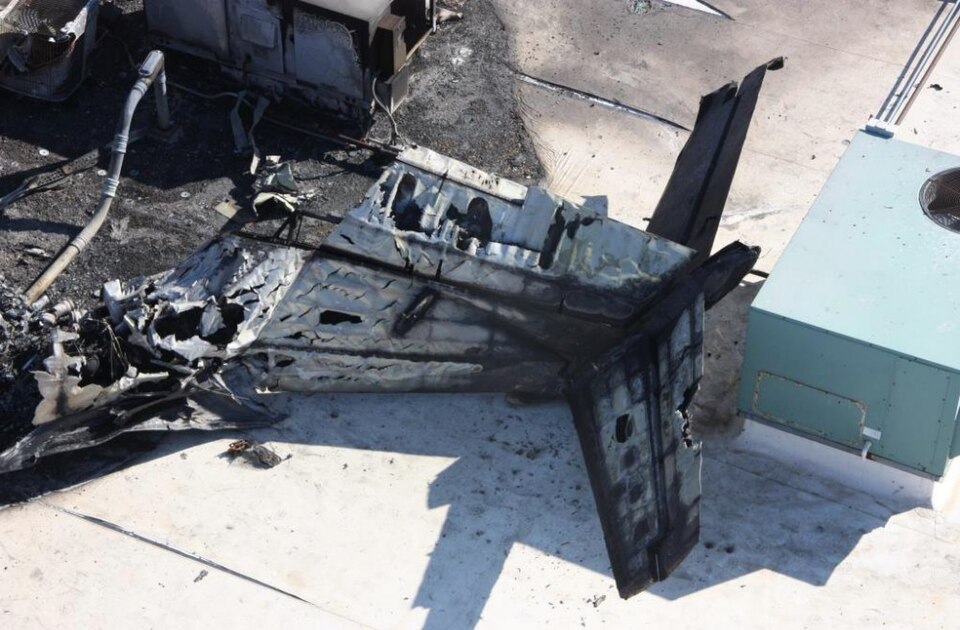
The accident site was at 37°39.592'N, 97°25.490'W, elevation 1,363 ft. The airplane struck the northeast corner of the FSI building, which housed flight simulators. Most wreckage was distributed from the northeast to southwest within a simulator room, with postimpact fire consuming much of the airplane.
The left engine, propeller, and left main landing gear were found inside the building at ground level. A portion of the left outboard wing was at the building's exterior east wall. The fuselage, tail section, cockpit, right engine, and right main landing gear were on the rooftops. The cockpit and right engine were about 160 ft from initial impact. The cabin and empennage were inverted on a lower west roof, mostly consumed by fire. The right wing separated and was found on another roof; a propeller blade tip was in a parking lot.
The left main landing gear was extended and locked. Witness and video evidence confirmed the landing gear were extended before impact. The nose gear strut, wheel, and tire were in the north parking lot.
Rudder flight control continuity was established; some cables showed thermal separation or overload. Down elevator continuity was confirmed. Flap actuator position corresponded to about 10° extension; the flap switch handle was in the UP detent. Flaps could be set to UP (0°), APPROACH (14°), or DOWN (35°).
Rudder trim actuator position indicated greater than 15° tab trailing edge left (rudder right). Elevator trim actuators were at 0°. Right aileron trim was about 9° tab trailing edge up.
The rudder boost and autofeathering systems and their controls were mostly destroyed by fire and could not be examined.
Both engines and propellers were relocated for examination. The left engine and propeller had separated; the right propeller was partially separated. Detailed examination of internal components was not possible due to impact damage and fire.
(Note: The source does not state a probable cause.)