Accident Overview
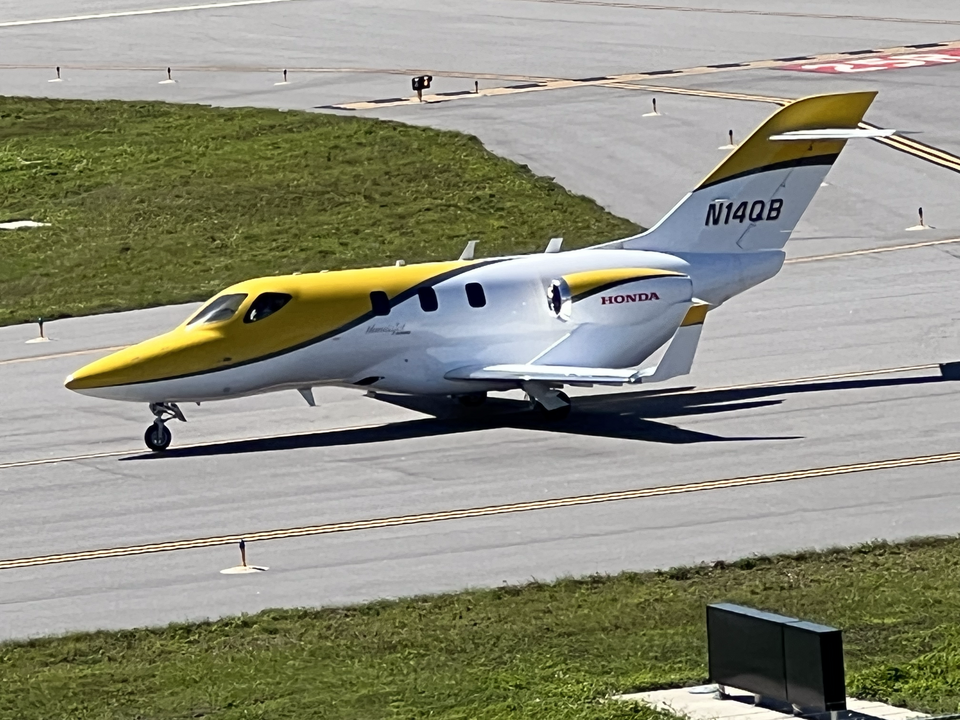
On February 17, 2023, at 1116 central standard time, a Honda Aircraft HA-420 airplane, registration N14QB, was substantially damaged during a runway excursion at William P. Hobby Airport (HOU), Houston, Texas. The pilot and five passengers were not injured. The flight was operated as a personal flight under Title 14 Code of Federal Regulations Part 91.
Flight History
The flight departed Miami Executive Airport (TMB) at 0905 eastern standard time. Upon arrival in the Houston area, the pilot received radar vectors for an instrument landing system (ILS) approach to runway 4. After an initial clearance to land, the tower controller instructed a go-around due to another airplane on the runway. Following vectors for a second ILS approach to runway 4, the pilot was cleared to land and given the current wind as 340° at 15 knots. About two minutes later, the tower issued wind information of 330° at 15 knots, gusting to 25 knots, to a departing airplane; the accident airplane was on a 3-mile final at that time.
Landing and Excursion
As the airplane crossed the runway threshold, onboard avionics recorded an altitude of 86 feet mean sea level and 125 knots indicated airspeed (IAS). The published runway 4 threshold elevation is 42 feet. The airplane flight manual lists landing reference speeds ranging from 100 knots IAS at 7,500 lbs landing weight to 111 knots IAS at 9,500 lbs; the exact landing weight was unavailable. Weight-on-wheels (WOW) parameters transitioned from air to ground at about 1116:02, consistent with initial touchdown, when the airplane was approximately 2,000 feet from the threshold at 108 knots IAS and 96 knots groundspeed. The airplane tracked the runway centerline for about 4 seconds, then drifted left and departed the pavement at about 1116:09 at 75 knots groundspeed. It came to rest upright in the grass infield approximately 150 feet north of the runway 4/runway 31L intersection. The outboard portion of the right wing separated near midspan, and the landing gear collapsed.
Aircraft Systems
Data from the Central Maintenance Function (CMF) system showed no anomalies from liftoff to touchdown; multiple system anomalies were recorded after the excursion, consistent with airframe damage. After initial touchdown, the left WOW parameter returned to air about 2 seconds later, then back to ground at 1116:16; the right WOW remained on ground until 1116:10, then returned to air for the remainder of the data set. The airplane flight manual specifies a crosswind limitation of 20 knots for takeoff and landing. Based on the most recent wind information, the crosswind component on runway 4 was about 24 knots. The Pilot's Operating Manual describes brake touchdown protection that inhibits braking until wheel spin-up occurs. After weight-on-wheels is true for three seconds, power braking is enabled. The airframe manufacturer noted that touchdown protection deactivates within one second if the average wheel speed is at least 60 knots. The aircraft is not equipped with thrust reversers or wing-mounted speed brakes; an aft fuselage-mounted speed brake is available but not automatically deployed on touchdown.
Pilot Actions
The pilot reported that upon touchdown, he established aileron controls into the wind and applied brakes, but no braking action was observed, and the airplane drifted off the left side of the runway. He noted that the crosswind component was near the limitation and that he made two requests to land on runway 31L, which were denied. A review of air traffic control communications between the pilot and the tower (local control) found routine transmissions. A recording from a third-party source of communications with terminal radar control (TRACON) included multiple frequencies with some unclear transmissions; therefore, no determination could be made regarding any pilot request for an alternate runway due to crosswind.
Regulatory Context
FAA regulations specify that the pilot in command is directly responsible for and has final authority over the operation of the aircraft (14 CFR 91.3) and that no person may operate a civil aircraft without complying with the operating limitations in the approved Airplane Flight Manual (14 CFR 91.9).