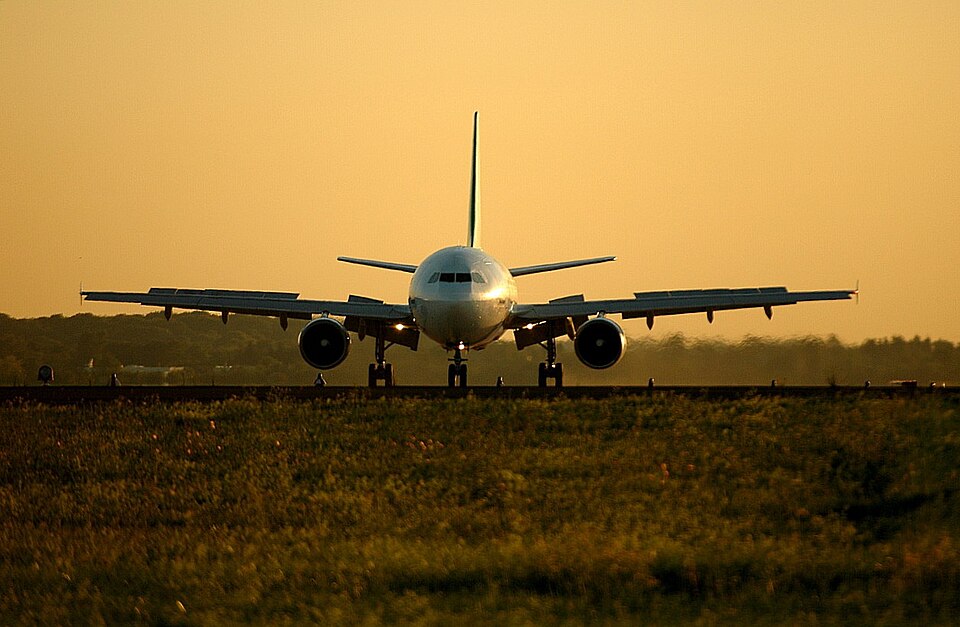
Incorrect DME usage leads to serious incident at Birmingham International

Casualties unknown • On approach to Birmingham International Airport, GB

An Airbus A310-304 experienced two early descents during approach to Birmingham due to the crew using incorrect distance information.

What happened

On 23 February 2006, an Airbus A310-304, registration F-OJHI, operating for Mahan Air, was conducting a scheduled flight from Tehran to Birmingham International Airport. During the approach to Runway 33, the flight crew was radar vectored for a Localiser/DME approach.

During the first approach attempt, the aircraft began descending from 2,000 ft to the minimum descent altitude of 740 ft while still 11 nm from the runway threshold. By the time the aircraft was 6 nm from the runway, it had descended to 660 ft, leaving only 164 ft of clearance above the ground. This triggered a Ground Proximity Warning System (GPWS) 'SINK RATE' alert. The radar controller identified the unsafe profile and instructed an immediate climb. The crew subsequently initiated a missed approach, though the aircraft's altitude actually dropped from 1,750 ft to 1,300 ft during the maneuver before stabilizing.

On the second approach attempt, the crew repeated the error of an early descent. The radar controller again intervened, instructing the crew to maintain altitude. The pilot flying eventually completed the landing safely without the use of the automatic flight system.

The investigation

The AAIB investigation established that the aircraft's Flight Management System (FMS) had automatically tuned the Honiley VOR/DME, but the crew had not switched the navigation mode to VOR. Consequently, the crew relied on the DME/RMI distance display as their primary source for the procedure.

Investigators found that the crew used the distance from the Honiley VOR/DME rather than the distance to the runway threshold to time their descent. This resulted in the descent starting 5 nm earlier than required. The investigation also noted that a supernumerary captain was present on the flight deck but had not participated in the initial approach briefing. While the first officer attempted to highlight discrepancies in the distance readings, the presence of the third crew member contributed to a breakdown in communication.

Findings

  • The primary cause of the incident was the crew's use of the incorrect DME for the approach.
  • A significant breakdown in Crew Resource Management (CRM) occurred, exacerbated by the presence of an unbriefed supernumerary captain who inadvertently reinforced the commander's navigation errors.
  • The MDA was incorrectly set for the approach.
  • The FMS database lacked the specific ILS/DME approach data for Birmingham.
  • The aircraft was not equipped with a Terrain Awareness Warning System (TAWS).

Probable cause

The incident was primarily caused by the flight crew utilizing incorrect distance information from the Honiley VOR/DME to execute their descent, compounded by a failure in crew resource management and the presence of an unbriefed crew member.

All Airbus A310 accidents →

Frequently asked questions

What happened in the 2006-02-23 Airbus A310-304 accident near On approach to Birmingham International Airport, GB?

An Airbus A310-304 experienced two early descents during approach to Birmingham due to the crew using incorrect distance information.

What aircraft was involved and where did it happen?

The accident on 2006-02-23 involved a Airbus A310-304, registration F-OJHI, at On approach to Birmingham International Airport, GB.

What was the probable cause of the accident?

The incident was primarily caused by the flight crew utilizing incorrect distance information from the Honiley VOR/DME to execute their descent, compounded by a failure in crew resource management and the presence of an unbriefed crew member.

Loading the flight search…