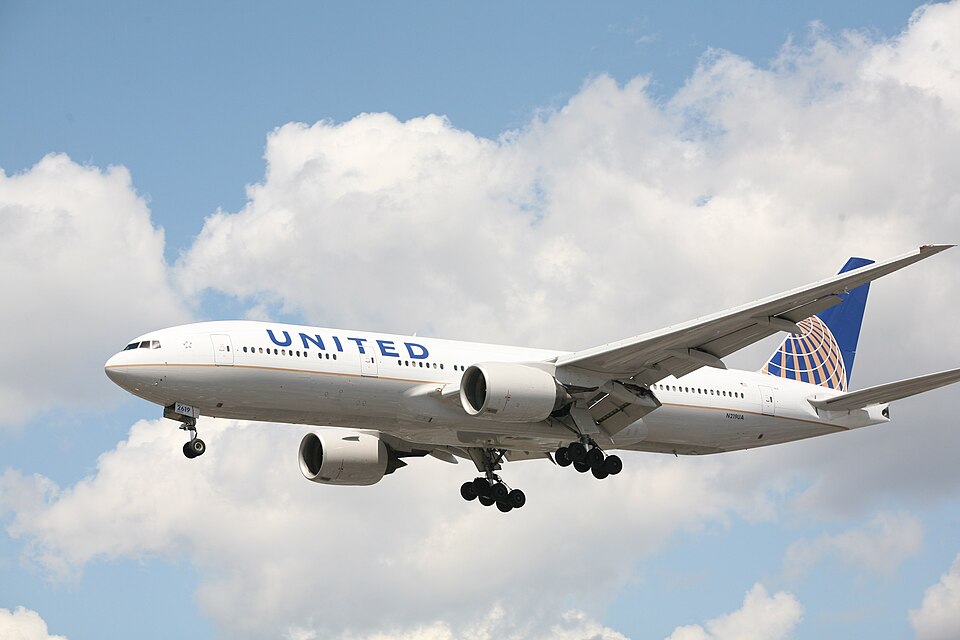
Incident Overview
On July 28, 2010, at approximately 18:04 Japan Standard Time, United Airlines Flight 852, a Boeing 777-200 registered N219UA, experienced a serious incident while climbing about 46 km east-southeast of Narita International Airport. The aircraft had departed Narita at 17:58 en route to San Francisco International Airport. The right engine stalled, prompting the crew to return to Narita, where the aircraft landed safely at 18:46. None of the 270 persons on board—2 pilots, a relief first officer, 12 cabin attendants, and 255 passengers—were injured.
Flight History
According to digital flight data recorder records and air traffic control communications, the aircraft took off from runway 16R at 17:58. At 18:03:43–45, while at about 11,700 ft, the right engine's variable stator vanes began moving toward the closed position. Subsequently, the exhaust gas temperature rose, vibrations developed, bleed valves opened, and both low- and high-pressure compressor rotation speeds (N1 and N2) dropped, with fuel flow falling to zero. At 18:04:07, the crew reported returning to Narita due to engine failure, and at 18:04:20 declared an emergency. The right engine throttle was retarded to idle at 18:04:27, and its fuel cutoff lever was moved to cutoff at 18:04:35. Fuel jettison commenced at 18:09:25, and the aircraft landed on runway 16R around 18:46.
Crew Actions
The captain, serving as pilot flying, reported hearing a loud bang and a whine from the right engine about seven minutes after takeoff, followed by a drop in N2 to nearly zero and a yaw of about 10° to the right. He called out "Engine failure!" and instructed the two first officers (the pilot not flying and a relief pilot) to perform the Severe Engine Damage Check List. The captain communicated with Tokyo terminal control, declared an emergency, and requested emergency vehicle standby. Both first officers completed the engine shutdown procedures. Fuel jettison was initiated but stopped when the aircraft weight reached 480,000 lb, slightly above the allowable landing weight of 460,000 lb. The actual landing weight was 473,000 lb. The captain disengaged the autopilot for a manual landing. After landing, airport emergency staff confirmed no fire or external damage.
Damage to the Aircraft
The interior of the right engine was destroyed. The high-pressure compressor could not rotate. Borescope inspection revealed dust-like material adhering inside, with broken blades and vanes. Some inspection holes were clogged, preventing borescopy. The diffuser in front of the combustion chamber and the high-pressure turbine interior were covered with dust-like material. No other damage was reported.
Background
The aircraft, a Boeing 777-200, was operated by United Airlines, Inc. The crew consisted of a captain with 22,400 total flight hours and two first officers with 10,109 and undisclosed hours. The investigation was conducted by the Japan Transport Safety Board, with participation from the United States as the state of registry, operator, and manufacturer.