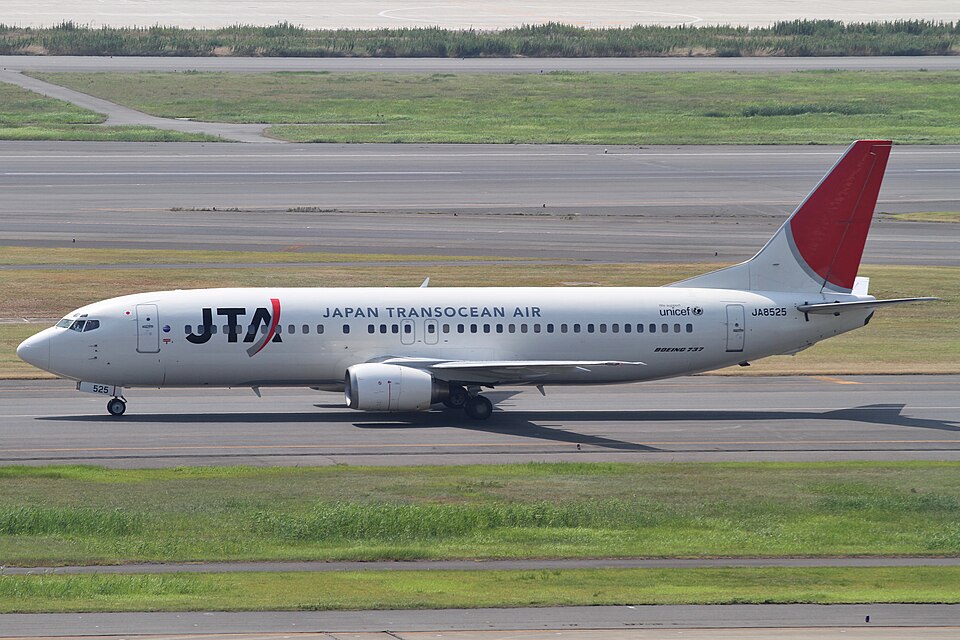
Incident Overview
On June 30, 2015, a Boeing 737-400, registration JA8525, operated by Japan Transocean Air Co., Ltd. as scheduled Flight 002 from Naha Airport to Kansai International Airport, experienced an abnormal decompression inside the aircraft. The event occurred at approximately 8:20 JST while the aircraft was cruising at flight level 370, about 55 km east-northeast of Tanegashima Airport.
Sequence of Events
At 7:26, the aircraft departed Naha Airport. After reaching cruising altitude, at 8:18, the left-side BLEED TRIP OFF light illuminated, indicating a malfunction of the left bleed air system. While the flight crew began the corresponding checklist, the right-side BLEED TRIP OFF light also illuminated, stopping both bleed air systems. The duct pressure indicators showed approximately 0 psi on both sides. The cabin altitude began to rise, and at 8:20, exceeding 10,000 ft triggered the CABIN ALTITUDE WARNING. The crew immediately donned oxygen masks, initiated emergency descent procedures, and declared an emergency with air traffic control. The cabin altitude reached approximately 16,000 ft before descending. After leveling off at about 10,000 ft with no further abnormalities, the crew canceled the emergency and continued to Kansai International Airport, where they landed safely.
Injuries and Damage
No injuries to persons and no damage to the aircraft were reported.
Aircraft and Crew Information
The aircraft, a Boeing 737-400 (serial number 26605, manufactured September 1, 1995), had a total flight time of 46,550 hours. The pilot in command, aged 48, held an airline transport pilot certificate and had 12,213 total flight hours. The first officer, aged 30, held a commercial pilot certificate with 2,630 total flight hours. Both pilots were appropriately qualified.
Bleed Air System Malfunctions
Investigation revealed that both left and right bleed air systems experienced failures in their 450°F thermostats and pre-cooler control valves. The 450°F thermostats had cracks in the sensor section, causing them to not respond to temperature changes. The pre-cooler control valves had deteriorated, producing less cooling airflow than required. Consequently, when the left bleed air system failed, the right system overloaded, and both PRSOVs closed due to high bleed air temperature exceeding 490°F.
Additional Findings
The 450°F thermostats and pre-cooler control valves installed on the aircraft were not of the improved type recommended by a part manufacturer's service bulletin issued in 2008. The investigation noted that such malfunctions can be difficult to detect during normal flight or maintenance.
Probable Cause
The Japan Transport Safety Board determined that the serious incident likely occurred because both bleed air systems stopped supplying air, leading to cabin decompression. The stoppage likely resulted from PRSOV closure as bleed air temperature rose above specified limits due to failures of the 450°F thermostats and pre-cooler control valves.