History of the Flight
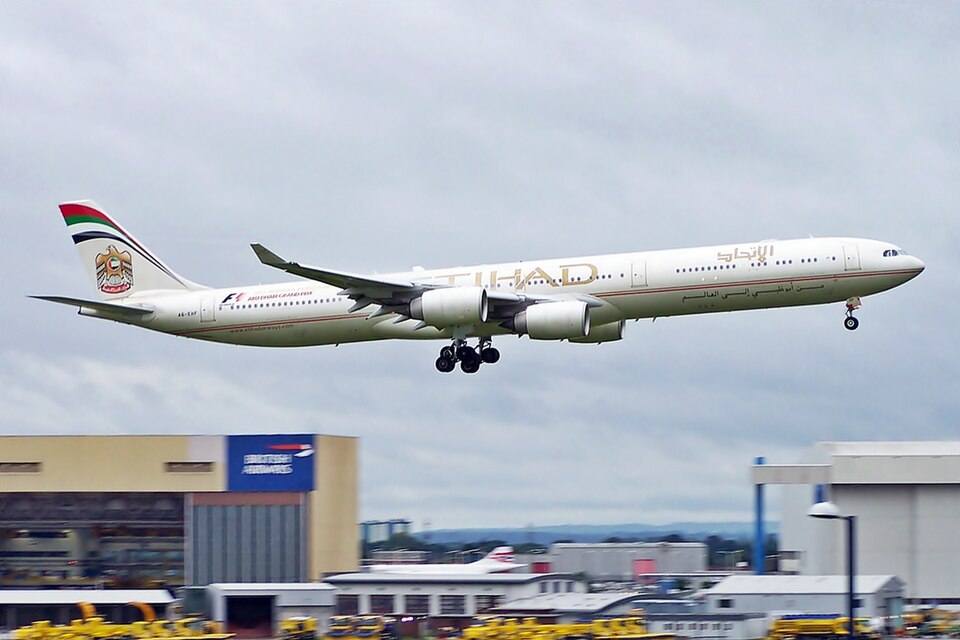
On 2 February 2013, an Airbus A340-600 aircraft, registration A6-EHF, operated by Etihad Airways, departed Abu Dhabi International Airport at approximately 1935 UTC on a scheduled passenger flight to Melbourne International Airport, Australia. The aircraft carried 295 persons: 4 flight crew, 13 cabin crew, and 278 passengers. The captain was the pilot flying and the first officer was the pilot monitoring.
While cruising at flight level 350, shortly after leaving the Colombo Flight Information Region and entering the Melbourne FIR, the aircraft encountered moderate to heavy turbulence. During this turbulence, significant airspeed oscillations appeared on both the captain's and the standby airspeed indicators. The autopilot, autothrust, and flight directors disconnected automatically. The flight control law changed from Normal to Alternate Law twice, resulting in the loss of some flight mode and flight envelope protections. The aircraft remained in Alternate Law for the remainder of the flight. The autothrust and flight directors were successfully re-engaged, but neither autopilot could be re-engaged, requiring manual flight until landing. Additionally, high N1 vibration occurred on the No. 2 engine.
The aircraft lost the capability to maintain Reduced Vertical Separation Minima (RVSM), prompting the flight crew to divert to Singapore Changi International Airport. The diversion required fuel dumping to reduce the aircraft weight for landing. The landing was uneventful, and none of the persons on board were injured.
Cause of the Incident
The investigation, conducted by the Air Accident Investigation Sector of the UAE General Civil Aviation Authority, determined that the cause of the unreliable airspeed indication was the intermittent obstruction of the aircraft's left side pitot probes. This was most probably due to an accumulation of ice crystals, which caused temporary blockages of the pitot probes.
Contributory Factors
The investigation identified two contributory factors to the incident: an incorrect radar tilt setting that prevented the flight crew from being aware of an area of isolated embedded cumulonimbus clouds, and the ambient temperature and aircraft altitude being beyond the certified icing envelope of the JAR specification and manufacturer requirements.
Additional Findings
The high N1 vibration on the No. 2 engine was determined to be caused by water ingress through a gap created after an Omega seal disbanded. The water froze to ice, which entered and passed through the spinner fairing and accreted under the annulus fillers.
Safety Recommendations
The report includes four safety recommendations addressed to the operator, the European Aviation Safety Agency, and the General Civil Aviation Authority.