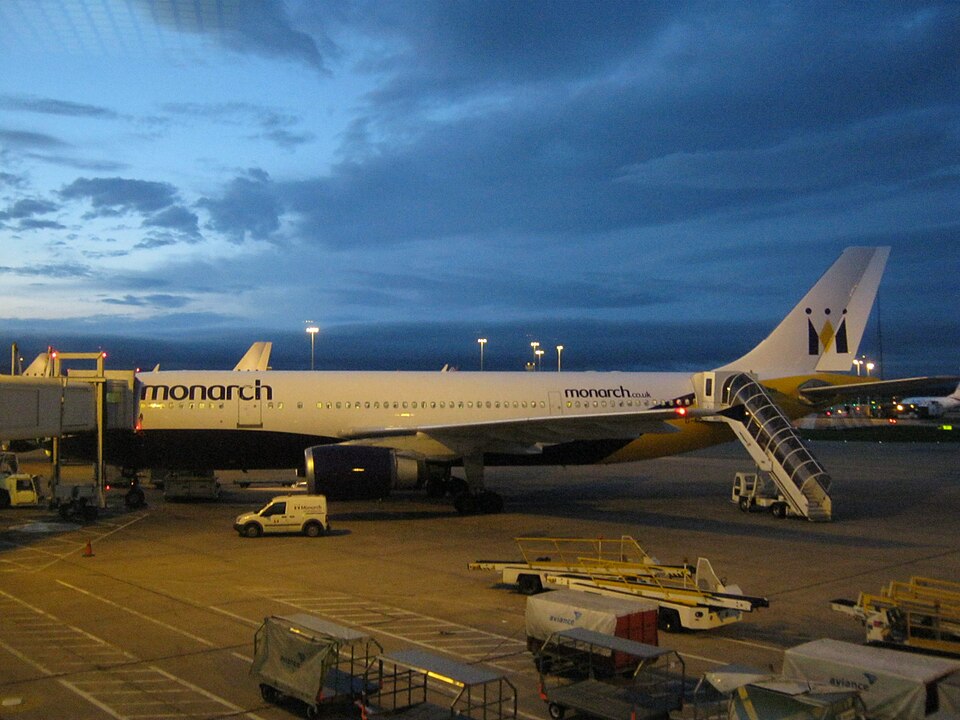
Incident
On 18 May 2001, at 1120 UTC, an Airbus A300B4-605R, registration G-MONS, was operating a scheduled passenger flight from London Gatwick Airport to Banjul, Gambia. While in stabilized cruise at flight level 290 abeam Casablanca, the crew experienced a sudden onset of noticeable vibration accompanied by thrust loss from the No 2 engine. The N2 vibration indication rapidly rose to 5.8 units. The crew selected manual throttle, applied maximum continuous thrust on the No 1 engine, and retarded the No 2 engine throttle to idle. The vibration decreased and settled at 4.4 units. A PAN call was broadcast to Casablanca, and approval was obtained for a descent and precautionary diversion to Faro, Portugal. A positioning A300 crew traveling on G-MONS assisted the flight crew during the diversion.
Following checklist procedures, the No 2 engine throttle was kept at idle and parameters monitored; except for N2 vibration, all remained normal. An uneventful overweight landing at 150 tonnes was carried out at Faro with the Airport Fire Service in attendance. After taxiing off the runway, the No 2 engine was shut down. The fire service reported no sign of fire or obvious damage, and the aircraft taxied to the stand. Subsequently, several holes were noticed in the No 2 engine cowl.
Aircraft and Engine Information
The No 2 engine was a General Electric CF6-80C2A5 turbofan, serial number 695-323, with a maximum takeoff thrust rating of 60,100 lbs and maximum continuous thrust rating of 56,210 lbs. At the time of the incident, the engine had accumulated 7,778 hours and 2,513 cycles since its previous overhaul in December 1998. A review of the aircraft technical log reports found no significant defects on the No 2 engine, and there were no recent reports of bird or foreign object ingestion. Flight data recorder and engine trend monitoring data showed no significant trends prior to the failure.
The engine had completed 717 hours and 237 cycles since the previous routine boroscope inspection of the combustion chamber and high pressure turbine (HPT) on 13 March 2001. That inspection noted two HPT Stage 2 blades with cracks 0.080 inch in length in the tip cap area, which were within maintenance manual limits, but no other damage to HPT Stage 2 blades. The operator's engine maintenance program required boroscope inspection of the HPT module at each A check (every 43 calendar days). At the time, there was no requirement to inspect the HPT Stage 2 nozzle guide vanes (NGVs).
Aircraft Damage
Examination of the aircraft at Faro revealed a large hole measuring approximately 12 inches circumferentially at the 10 o'clock position on the left-hand core cowl of the No 2 engine, located in the plane of the low pressure turbine (LPT) Stage 5 rotor. A circular hole about 3 inches in diameter was visible in the right-hand core cowl at the 2 o'clock position in the same axial plane. The edges of both holes were petalled outward. A breach approximately 0.5 inch wide extended over an arc of about 330° in the LPT case in the plane of the LPT Stage 5 rotor. Debris released through the breach struck the lower surface of the starboard wing, causing minor penetrations to the inboard aileron and access panels behind the leading edge on the underside of the wing. The fuselage and aircraft systems sustained no damage.
Investigation Findings
During the engine strip examination at GE's facility in Prestwick, Scotland, investigators observed that one HPT Stage 2 blade had completely separated approximately 0.125 inch above the root platform. The fracture plane aligned with the apex of a notch worn into the blade's leading edge. The notch was V-shaped, parallel to the blade platform, and approximately 0.25 inch deep chordwise. Metallurgical analysis of the remaining blade part revealed a fatigue crack originating in the notch, with final failure due to tensile overload. Similar notches were found on all 73 remaining HPT Stage 2 blades.
The trailing edge of the inner platform of the NGV segment at the 12 o'clock position was almost entirely missing. This NGV segment had sagged rearward by approximately 5/8 inch, allowing the NGV inner platform trailing edge to contact the HPT Stage 2 blade leading edges, wearing notches into the blades. Five NGV segments at and adjacent to the 12 o'clock position exhibited severe cracking in the fillet where the aerofoil meets the outer platform.
The LPT module showed a circumferential breach in the LPT case over a 330° arc, with edges curled outward and heavily blued and scored. Metallurgical examination of the LPT case identified a heat-affected zone approximately 0.6 inch wide extending 360° around the case in the plane of the LPT Stage 5 rotor, with local hardness of 10 HRC, significantly below the specification limits of 37-48 HRC. The fracture surface was intergranular, indicative of high-temperature overload failure. It was concluded that debris wedged under the LPT Stage 5 blade tips had been spun inside the LPT case for a short period (less than 1 second), generating heat that softened the LPT outer shrouds and case, leading to tensile overload failure. Other punctures were found in the LPT case at various locations, with debris penetrating the engine cowl and pylon heat shield.
The engine failure was precipitated by the detachment of a single HPT Stage 2 blade due to fatigue and subsequent tensile overload, caused by the presence of a 0.25-inch deep notch worn into the leading edge of the blade. This notch was produced by an HPT Stage 2 NGV segment that had sagged rearward and made contact with the HPT Stage 2 turbine blades, due to the propagation of thermally induced fatigue cracks in the NGV aerofoil outer fillet.