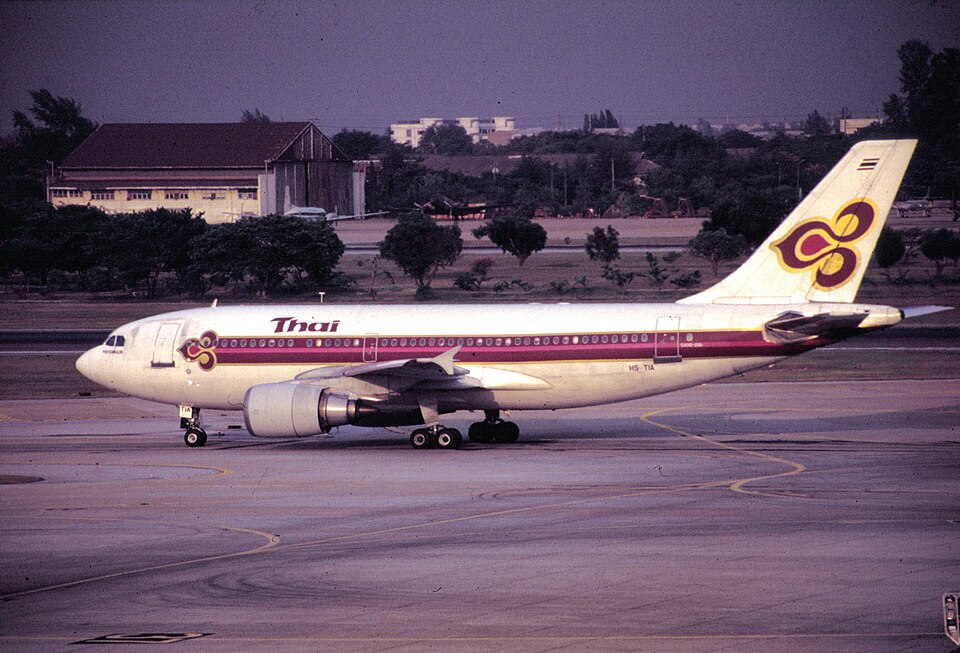
Flight History
Thai Airways International flight 261, an Airbus A310, departed Bangkok-Don Mueang International Airport at 17:54 local time for a domestic flight to Surat Thani. At 18:26 hours, the copilot established contact with the Surat Thani approach controller while the aircraft was 70 nautical miles away. The controller advised that the crew could expect a VOR/DME instrument approach to runway 22. At that time, surface wind was calm, visibility was 1500 meters, with light rain and a cloud base of 1800 feet.
Approach and Go-Arounds
At 18:39, the copilot contacted the Surat Thani aerodrome controller and reported over the Intermediate Fix (IF). The controller informed him that the precision approach path indicators (PAPI) on the right side of runway 22 were unserviceable while the left lights were in use. At 18:41, the copilot reported passing the final approach fix (FAF). The controller cleared the flight to land on runway 22, noting that surface wind was from 310 degrees at 5 knots and warning of a slippery runway. At 18:42, the copilot reported the runway in sight, and the controller also had the aircraft in sight. The pilot decided to go around. The controller asked the distance at which the runway was visible; the copilot reported 3 nautical miles and requested a second approach.
The controller requested a report over the FAF. During the second approach, the copilot reported over the FAF, and the controller cleared the flight to land, although he again could not see the runway. When the flight crew failed to observe the runway lights, the captain decided to go around again. The controller again instructed the flight to report over the FAF and reported that visibility had decreased to 1000 meters in light rain.
Final Approach and Accident
At 19:05, after reporting over the FAF, the flight was cleared to land on runway 22. The flight maintained the Minimum Descent Altitude (MDA) but the crew were unable to see the runway. The autopilot was disconnected, and shortly thereafter the captain decided to go around. The pitch attitude increased continuously, reaching approximately 40°, at which point the pilot applied elevator, decreasing the pitch attitude to 32-33°. When he discontinued applying elevator, the pitch increased to 47-48°. Consequently, the speed decreased to 100 knots. The captain was not aware of the attitude due to stress and the expectation that the go-around would be flown exactly like the first two. The airplane lost altitude until it impacted terrain to the left of the runway.
Survival and Casualties
Of the occupants, 45 people survived and 101 others were killed, including 11 crew members.
Probable Cause
The Aircraft Accident Investigation Committee of the Kingdom of Thailand concluded that the accident occurred because the aircraft entered a stall condition, which might have been caused by the following: 1. The pilot attempted to approach the airport in lower than minimum visibility with rain. 2. The pilot could not maintain the VOR course as set forth in the approach chart; the aircraft flew left of the VOR course on every approach. 3. The pilots suffered from accumulation of stress and were not aware of the situation until the aircraft entered the upset condition. 4. The pilots had not been informed of the document concerning wide-body airplane upset recovery provided by Airbus Industrie for use in pilot training. 5. The lighting system and approach chart did not facilitate the low visibility approach. 6. Stall warning and pitch trim systems might not have fully functioned as described in the FCOM and AMM.