History of Flight
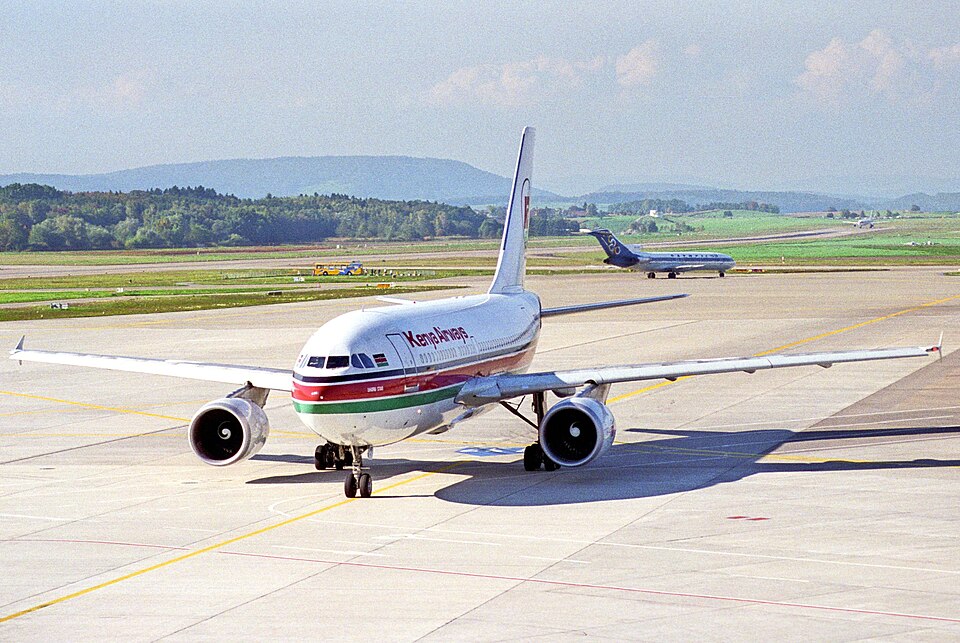
The aircraft, an Airbus A310 registered 5Y-BFT, was departing London Heathrow Airport for Nairobi on a scheduled public transport flight at 2048 UTC on 8 November 1998. The takeoff from Runway 27L appeared normal, climbing to about 600 feet above ground level. The nose then dropped and the aircraft lost height. After a few seconds, it regained a normal climbing flight path and continued the departure. Visibility was reported as 10 km with few clouds at 1,200 feet and overcast at 1,700 feet.
Witnesses on the ground observed the abnormal maneuver and reported it to air traffic control. Later during the departure, when asked if they had encountered a problem, the flight crew replied that they had a problem with the landing gear and a slight problem with the flight director.
Flight Director System and Mode Reversion
The A310 is equipped with flight directors that provide pitch and lateral guidance. During takeoff, the normal flight director pitch mode is SRS (Speed Reference System), which commands pitch to maintain V2+10 kt. Lateral guidance initially uses the ILS localiser beam for runway centerline tracking (RWY mode), then transitions to NAV mode at 30 feet radio height if pre-armed.
According to Airbus Operational Engineering Bulletin OEB 144/1, issued in July 1998, several cases had been reported of flight director and autothrust reversion from THR-SRS-RWY to SPD-V/S-HDG following temporary loss of the flight director during the takeoff roll. This reversion was identified or suspected to be the result of loss of RWY mode due to signal noise affecting the localiser signal. After the disturbance, the flight director reverts to basic V/S (vertical speed) and HDG (heading) modes. The pitch bar then commands the pitch required to maintain the vertical speed at the time of reversion—potentially a fly-down demand if reversion occurred before lift-off. After landing gear retraction, the autothrust reclutches and engages in SPD mode, reducing thrust to acquire and maintain the FCU-selected speed (V2).
The mechanism involves two processing channels in each Flight Control Computer. Asynchronous real-time clocks can cause the channels to sample a noisy localiser signal at different times, leading to a discrepancy detected by comparator circuits, which resets the computer. The reset takes less than one second and may go unnoticed.
Crew Actions and Observations
The commander, who was handling, set V2 speed (172 kt) and selected a target altitude of 6,000 feet, pre-arming vertical and lateral navigation. He selected TOGA thrust. Initially, the Flight Mode Annunciator showed THR, SRS, and RWY modes engaged, with PCLB and NAV armed. At about 100 kt, the commander noticed the lateral mode had changed from RWY to HDG. During rotation, the flight director pitch bar showed an illogical fly-down command; he ignored it and continued rotating to 12.5° nose-up. As the aircraft climbed, the commander instructed the co-pilot to raise the landing gear. At that point, the FMA indicated THR (blue), V/S, HDG, FD1, and the vertical speed window showed three dashes.
When the co-pilot selected gear up, the Master Warning illuminated with a continuous chime, and ECAM displayed "landing gear not down". The co-pilot cancelled the audio warning. Approaching 800 feet, the climb rate reduced, and the commander asked the co-pilot to select landing gear system 1 and recycle the landing gear lever. The commander noticed airspeed decreasing toward V2 and engine thrust reducing. He instinctively pushed the thrust levers fully forward, re-selected NAV on the FCU, and lowered the nose to increase airspeed. With the landing gear retracted and thrust restored, he resumed the climb. Thereafter, all flight director indications returned to normal.
Investigation and Flight Recorder Data
The aircraft was equipped with a 30-minute cockpit voice recorder, a 25-hour flight data recorder, and a 50-hour quick access recorder (QAR). At the time of the first landing after notification, the aircraft had flown at least 35 hours since the incident, so the CVR and FDR data had been overwritten. The QAR tape was removed and sent for replay. During inspection, the cartridge was found to be incorrectly assembled—the tape had not been threaded around all guide rollers, which would have reduced recording performance. After correction, the only recorded data found was from flights between 20 October and 24 October, but the year could not be determined (ranging from 1989 to 1998). The operator subsequently highlighted to engineers the requirement for adherence to cartridge assembly and replacement procedures.
Radar data from Heathrow showed the aircraft climbed to about 600 feet within 25 seconds of becoming airborne, then lost approximately 300 feet in height and 30 kt airspeed over the next 20 seconds before climbing away.
The sequence of events reported by the commander was consistent with OEB 144/1. The bulletin states that the correct recovery action if mode reversion occurs is to activate the go levers again. This re-engages the flight director pitch mode into SRS if on the ground, or GO AROUND mode if airborne. Subsequently selecting a lateral mode (NAV or HDG) exits GO AROUND and restores normal sequencing. The bulletin also advises to be alert to push throttle levers fully forward if required.