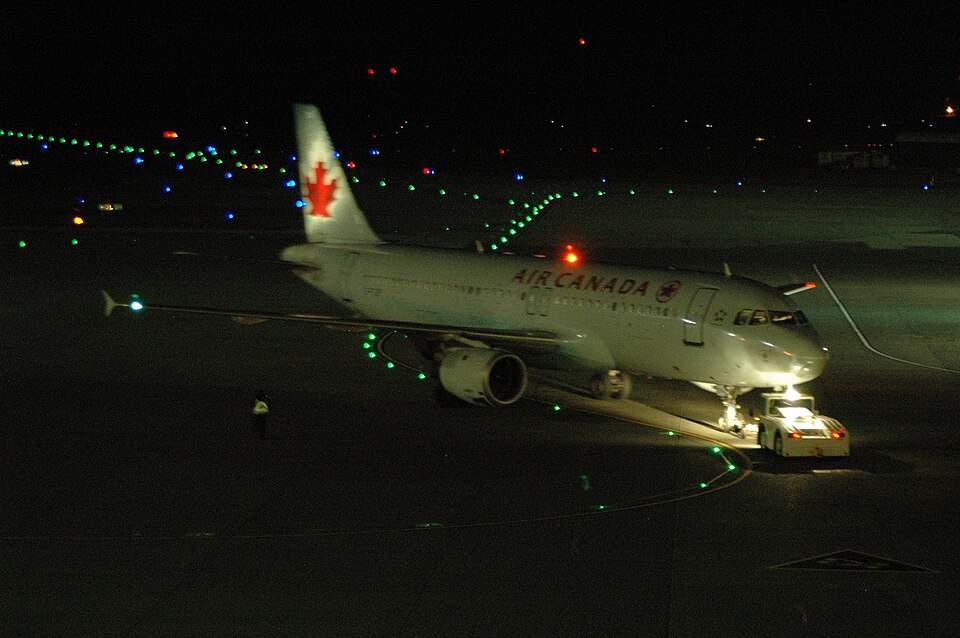
Accident Description
On 29 March 2015, an Air Canada Airbus A320-211 (registration C-FTJP, serial number 233) operating as flight 624 from Toronto/Lester B. Pearson International Airport, Ontario, to Halifax/Stanfield International Airport, Nova Scotia, was on a scheduled flight with 133 passengers and 5 crew members. At approximately 0030 Atlantic Daylight Time, during a non-precision approach to Runway 05, the aircraft severed power lines, then struck the snow-covered ground about 740 feet before the runway threshold. The aircraft continued airborne through the localizer antenna array, struck the ground twice more, and slid along the runway before coming to rest on the left side of the runway approximately 1900 feet beyond the threshold. The aircraft was evacuated; 25 people were taken to local hospitals with injuries. The aircraft was destroyed. There was no post-impact fire. The emergency locator transmitter was not activated. The accident occurred during hours of darkness.
Causes and Contributing Factors
The official investigation identified the following causes and contributing factors: 1. Air Canada’s standard operating procedure (SOP) and practice when flying in flight path angle guidance mode did not require flight crews to monitor aircraft altitude and distance from the threshold once past the final approach fix, contrary to flight crew operating manuals. 2. Following Air Canada’s practice, the flight crew did not monitor altitude and distance from the threshold after selecting the flight path angle. 3. The flight crew did not notice the aircraft had drifted below and diverged from the planned vertical descent profile, nor that it had crossed the minimum descent altitude further back from the threshold. 4. Given challenging conditions for acquiring and maintaining visual cues, the flight crew likely delayed disconnecting the autopilot beyond the minimum descent altitude due to reliance on the autopilot system. 5. Approach and runway lights were not changed from setting 4 to setting 5, so they were not at maximum brightness during the approach. 6. The system controlling airfield lighting preset selections for brightness setting 4 did not comply with NAV CANADA’s requirement for the omnidirectional approach lighting system to be at its brightest settings. 7. Limited visual cues, short availability, potential visual illusions, and reduced lighting brightness diminished the flight crew’s ability to detect that the approach path was taking the aircraft short of the runway. 8. The flight crew’s recognition of being too low was delayed due to plan continuation bias. 9. The aircraft struck terrain approximately 740 feet short of the runway threshold, bounced twice, then slid along the runway before stopping approximately 1900 feet beyond the threshold. 10. During the impact sequence, the captain’s head struck the glare shield because insufficient acceleration forces prevented the shoulder harness from locking. 11. The first officer sustained head and right eye injuries from striking the glare shield because the automatic locking feature of the right-side shoulder-harness inertia reel was unserviceable. 12. A flight attendant was injured by a coffee brewer that came free of its mounting base because its locking system was not correctly engaged. 13. Because no emergency was expected, passengers and cabin crew were not in a brace position at initial impact. 14. Most passenger injuries were consistent with not adopting a brace position.
Other Findings
The investigation reported: 1. The service director assessed the evacuation flow as good and determined no need to open the R1 door. 2. Flight attendants in the rear noted no life-threatening hazards; no evacuation order had been given, and deplaned passengers and firefighters were observed near the rear where slide deployment could create hazards, so they did not open the L2 and R2 doors. 3. Transport Canada required dual-exit drill training but did not require all cabin crew to receive it before an organization implemented the 1: (Note: The source sentence was incomplete; the article reflects the stated excerpt.)
Risk Findings
The investigation identified 12 risk findings, including issues with cockpit voice recorder power supply, Transport Canada’s aeromedical surveillance, child-restraint regulations, passenger dress for evacuation, approach lighting system visibility considerations, cargo compartment beam design, maintenance instructions, passenger address system emergency power, passenger baggage retrieval during evacuation, pre-departure briefing effectiveness, emergency response plan transportation resources, and practice for transporting persons from accident sites.