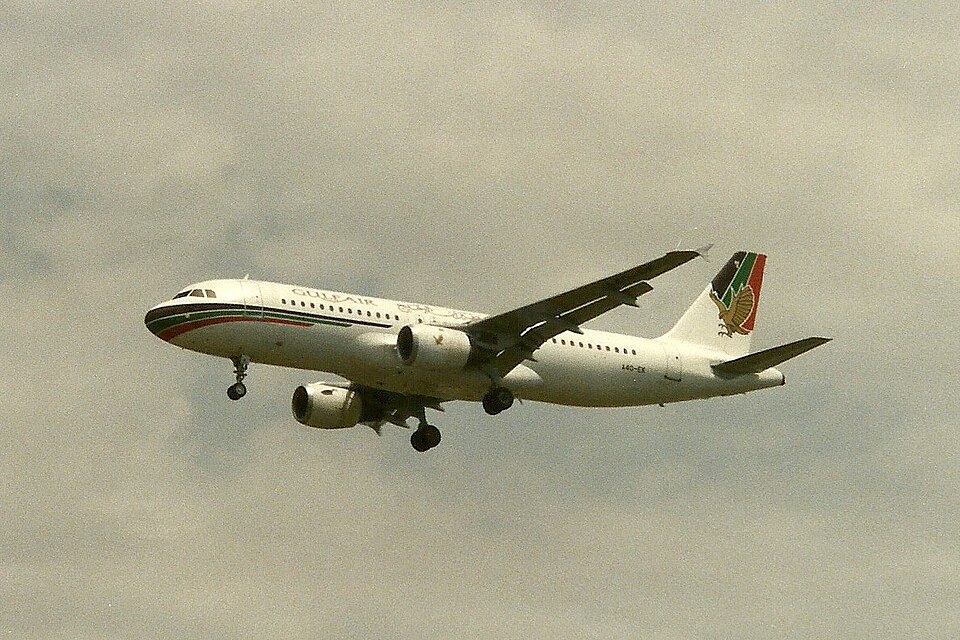
Accident Overview
On August 23, 2000, at approximately 1930 local time, Gulf Air Flight GF072, an Airbus A320-212 registered as A4O-EK, crashed into the sea about 3 miles northeast of Bahrain International Airport. The aircraft was operating a scheduled international passenger service from Cairo International Airport, Egypt, to Bahrain International Airport, with two pilots, six cabin crew, and 135 passengers on board. All 143 persons on board were killed by the impact forces.
Flight History
GF072 departed Cairo under an instrument flight rules (IFR) flight plan. The flight was cleared for a VOR/DME approach for Runway 12 at Bahrain. At about 1 nautical mile from touchdown and 600 feet altitude, the flight crew requested a left-hand orbit, which was approved by air traffic control (ATC). After the orbit, the captain decided to go around. ATC offered radar vectors, which the crew accepted. During the go-around, the aircraft initiated a climb, crossing the runway on a northeasterly heading, but as it accelerated, the master warning sounded for flap overspeed. According to a perceptual study conducted during the investigation, the flight crew likely experienced spatial disorientation, causing the captain to falsely perceive a pitch-up and respond with nose-down input, leading to a descent. The ground proximity warning system (GPWS) sounded "whoop, whoop pull-up" repeatedly for nine seconds until impact.
Investigation Findings
The investigation found that no single factor caused the accident; rather, it resulted from a combination of individual and systemic issues. Individual factors included the captain not adhering to standard operating procedures (SOPs), such as using higher than standard speeds, not stabilizing the approach, performing a non-standard orbit near the runway, and not correctly executing the go-around. The first officer failed to call out deviations as required by SOPs. The perceptual study indicated spatial disorientation during the go-around, leading to the captain's erroneous nose-down input. Neither pilot perceived or effectively responded to the increasing proximity to the ground despite repeated GPWS warnings.
Systemic factors included organizational issues at Gulf Air: lack of crew resource management (CRM) training, inadequacies in A320 training programs (SOP adherence, CFIT, GPWS responses), a malfunctioning flight data analysis system, and deficiencies in the flight safety department. There were also cases of non-compliance and slow corrective actions in regulatory areas over the three years preceding the accident. Safety oversight by the Directorate General of Civil Aviation and Meteorology (DGCAM) was insufficient to compel compliance.
Official Probable Cause
The probable cause, as stated by the investigation, is: "The factors contributing to the above accident were identified as a combination of the individual and systemic issues. Any one of these factors, by itself, was insufficient to cause a breakdown of the safety system. Such factors may often remain undetected within a system for a considerable period of time. When these latent conditions combine with local events and environmental circumstances, such as individual factors contributed by “frontline” operators (e.g.: pilots or air traffic controllers) or environmental factors (e.g.: extreme weather conditions), a system failure, such as an accident, may occur. The investigation showed that no single factor was responsible for the accident to GF072. The accident was the result of a fatal combination of many contributory factors, both at the individual and systemic levels. All of these factors must be addressed to prevent such an accident happening again."