Incident Summary
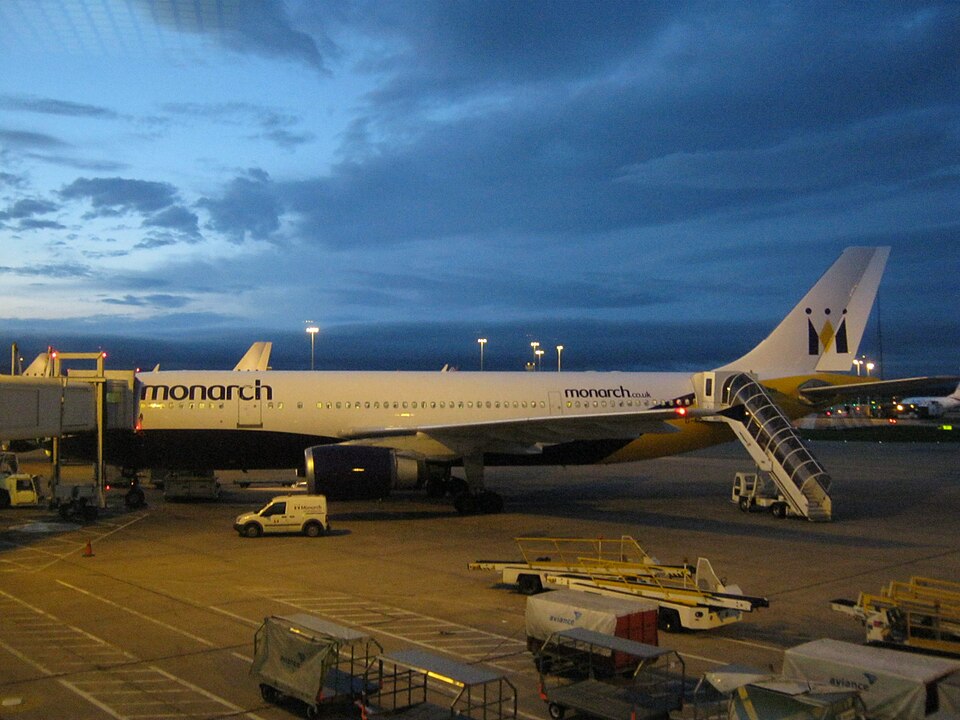
On 1 February 2002 at 2230 UTC, an Airbus Industries A300B4-605R (registration G-MONS) operated a positioning flight from Manchester Airport to London Gatwick Airport. The sector was conducted for training purposes with three flight deck crew members: a captain under training (left seat, handling pilot), the commander (right seat), and a safety pilot (jump seat). The captain under training was completing a re-conversion course and had over 3,000 hours on type. No passengers were on board and no crew injuries occurred.
Approach and Landing
The crew performed an ILS approach to Runway 26L at Gatwick in turbulent conditions. The commander recalled an Inertial Reference System wind speed readout of 70 kt at about 1,000 ft amsl. The reported surface wind was from 210° at 18 kt with gusts to 30 kt shortly before landing. During the flare, the pilot flying experienced a left wing drop and attempted correction with right aileron and additional power. The aircraft touched down heavily on the left main gear, then right main gear, rebounded, and following a nose-down elevator input, touched down in a nose-down pitch attitude with right roll. The right main gear, nose landing gear, and right engine contacted the runway. The aircraft made two more brief bounces during the landing roll. The crew were unaware of the engine contact but requested a hard landing inspection after taxi and shutdown.
Damage and Data
The hard landing inspection revealed damage to the underside of the No2 engine cowling; no further engine damage was found. The Flight Data Recorder indicated a reduction in airspeed of about 10 kt just before touchdown. Peak vertical accelerations were 1.96 g (first touchdown), 1.46 g (second touchdown at 2.5° nose down and 11.25° right roll, coinciding with engine cowling contact), and 1.54 g (third touchdown). The nose-down pitch appeared to result from forward control column input, and the pitch response was consistent with demanded inputs.
Relevant Conditions and Operational Information
The aircraft's landing mass was 105,000 kg, well below the maximum landing mass of 140,000 kg. The manufacturer's maximum computed and demonstrated crosswind for the A300 is 32 kt, which the operator adopted as the fleet crosswind limit. These computations assumed a steady-state crosswind. The United Kingdom Aeronautical Information Publication entry for London Gatwick Airport warns pilots of possible building-induced turbulence and windshear effects when landing on Runway 26L/R in strong southerly/southwesterly winds.
Probable Cause
No probable cause was stated in the report.