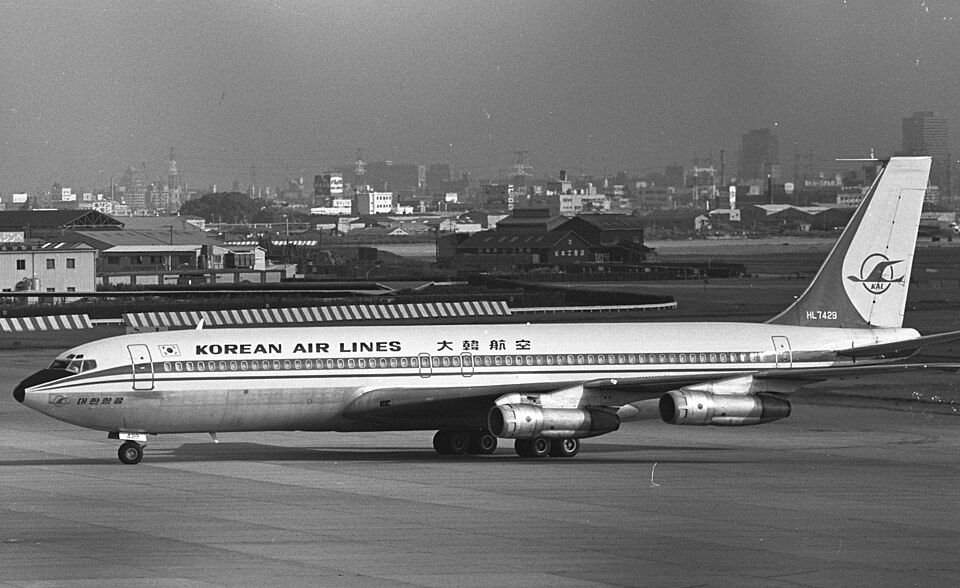
Incident Overview
Flight KE902, a Boeing 707 operated by Korean Air, departed Paris-Orly Airport at 1339 local time on a scheduled flight to Seoul, South Korea, with an intermediate stop in Anchorage, Alaska. After passing the North Magnetic Pole, while approaching Ellesmere Island, Canada, the aircraft made a right turn of 150 degrees instead of continuing straight toward northern Canada and Alaska. This deviation caused the airplane to fly southeast, over the Barents Sea, and into Soviet airspace. The aircraft reached the Soviet coast approximately three hours and 2,400 kilometers after the turn.
Interception and Attack
A Soviet Air Force Sukhoi Su-15TM interceptor was dispatched to intercept the aircraft and forced it to land. For reasons undetermined, the Korean crew did not respond to multiple requests and initiated a turn when the Soviet pilot was instructed to shoot down the Boeing 707. One air-to-air missile struck the left wing, tearing off approximately four meters of the wing. The missile also punctured the fuselage, causing rapid decompression and jamming one of the aircraft's four turbines.
Emergency Landing and Casualties
From an altitude of 30,000 feet, the crew initiated a rapid descent and eventually completed an emergency landing on the frozen Korpijärvi Lake, located in the region of Kem, Republic of Karelia. Two passengers were killed during the missile attack. All other occupants evacuated the aircraft; 13 were injured.
Aftermath
Both pilots and the navigator were arrested by Soviet authorities but were released on April 29.
Probable Cause
It is believed that the airplane deviated from the prescribed flight plan directly after it passed over the North Magnetic Pole, causing major disturbance of the aircraft's magnetic compass-based navigation systems. For the Soviet authorities, the deviation was the consequence of a navigation error on the part of the flying crew.