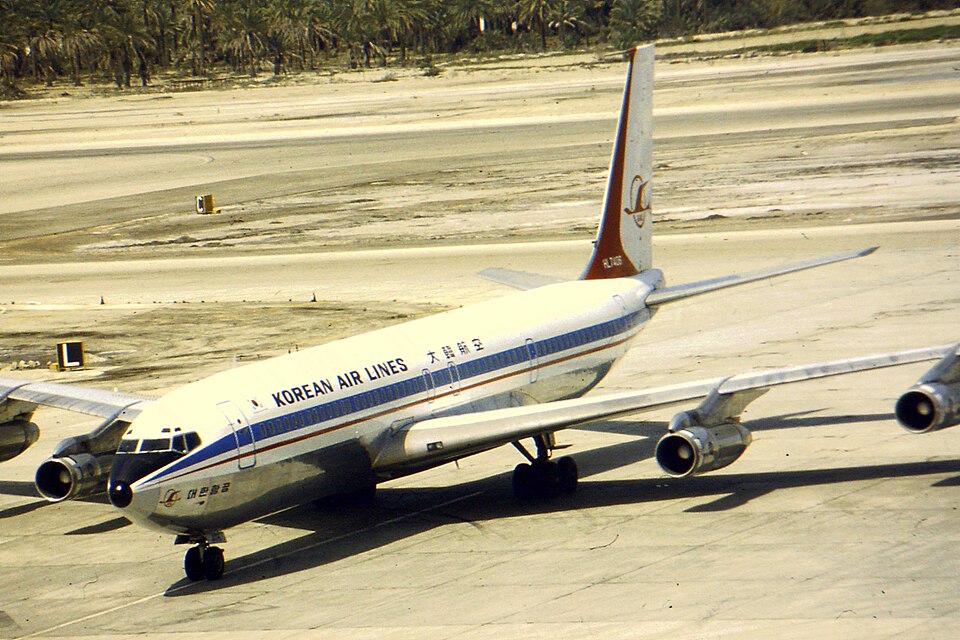
Accident Overview
On an unspecified date, Korean Air Flight 858, a Boeing 707-300 passenger aircraft registered HL7406, was destroyed in an accident over the Indian Ocean approximately 100 km off the coast of Myanmar. The aircraft was operating a scheduled passenger service from Baghdad, Iraq, to Seoul, South Korea, with planned intermediate stops at Abu Dhabi, United Arab Emirates, and Bangkok, Thailand.
Flight Sequence
The flight departed Baghdad and later departed Abu Dhabi at 00:01 UTC, climbing to a cruising altitude of flight level 370 (FL370). Last radio contact occurred at 05:01 UTC when the crew reported estimating arrival at the TAVOY waypoint over the Andaman Sea at 05:22. When the aircraft failed to arrive at its destination, it was declared missing.
Wreckage Discovery
On December 13, 1987, a local schooner discovered pieces of wreckage floating northwest off Tavoy, Myanmar.
Sabotage Investigation
Suspicion of sabotage arose after the aircraft went missing. Korean authorities checked passengers who had disembarked at Abu Dhabi and traced two suspects, Mr. Hachiya Shinichi and Miss Hachiya Mayumi, to Bahrain, where they were apprehended while going through exit formalities at the airport. They were found to be holding false Japanese passports. While under interrogation, both committed suicide by ingesting poison capsules hidden in their cigarettes. Mr. Hachiya Shinichi died; Miss Hachiya Mayumi survived and was later extradited to South Korea. It was reported that the passengers were actually named Mr. Kim Sung-il and Miss Kim Hyon-hui of North Korean origin. For her role in the bombing, Kim Hyon-hui was sentenced to death in March 1989, but South Korean President Roh Tae-woo pardoned her in 1998.
Casualties and Damage
All 104 passengers and 11 crew members on board were killed. The aircraft was destroyed.
Bomb Composition and Placement
Investigation revealed that the bomb consisted of a composition C4 type explosive hidden in a battery-operated portable transistor radio used as a timing device. The timer was activated while the perpetrators awaited embarkation at Baghdad Airport and was set to detonate 9 hours later. Together with the transistor radio, a liquor bottle containing liquid explosive (type PLX) was taken on board and placed in the overhead baggage rack above seat row number 7 in the forward cabin section of the economy class compartment where they were seated. These timed explosives were left in place when the suspects disembarked at Abu Dhabi.