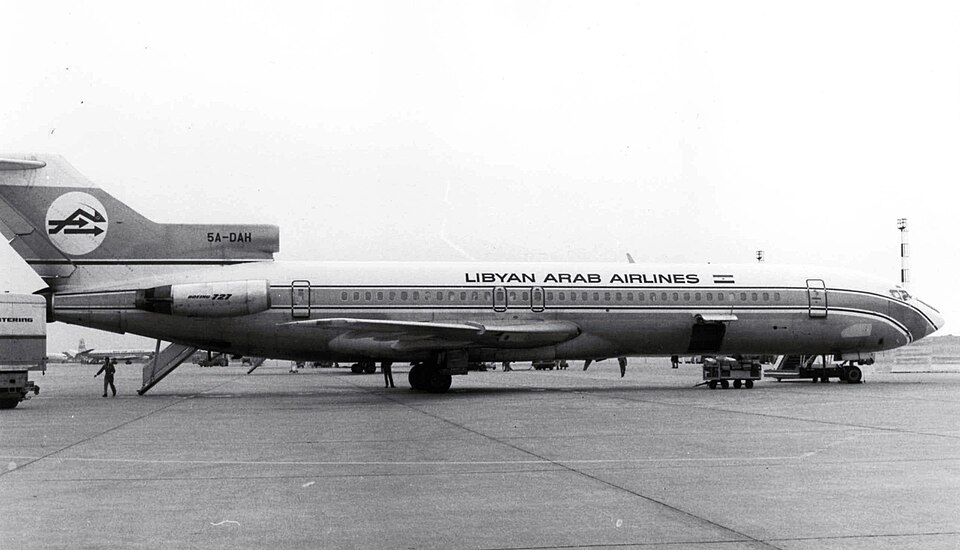
Incident Overview
On an international scheduled service from Tripoli to Bahrain with intermediate stops in Benghazi and Cairo, Flight 114 carried 104 passengers and a crew of nine, five of whom were from Air France. Among the crew was the captain, Jacques Bourgès, aged 42. The route from Benghazi to Cairo normally followed the Libyan coast eastward to Sidi Barrani in Egypt, then turned inland toward a VOR and NDB area west of Lake Qarun. Entry into the Cairo terminal area required a north-easterly heading over a 71-nautical-mile path between Lake Qarun and the Cairo VOR.
Off-Course and Interception
At 13:45, Cairo traffic control (CTC) observed the aircraft approaching from the west and cleared it to land on runway 23. However, by 13:50, CTC saw the Boeing heading east toward the Suez Canal. Evidence from the recovered Boeing 727 voice recorders and the Israeli authorities' flight data recorder later indicated that the aircraft was likely already off course when it reported its position over Qarun, probably due to strong westerly upper-level winds associated with a low-level sandstorm. The crew relied on instrument navigation because of the sandstorm, but both instrument and navigational errors caused the aircraft to stray off course and enter airspace dominated by Israel over the Sinai Peninsula. At this point, the aircraft was lost from Egyptian air traffic control. Believing they were near the destination airport, the crew began descent.
At 13:55, Israeli radar detected the aircraft entering Israeli airspace southeast of Suez at 15,000 feet. Two Israeli Air Force Phantoms intercepted the unidentified aircraft. After communications with CTC were reestablished, the Libyan pilot looked through the cabin's port window and saw the fighters but mistook them for Egyptian MiGs. The Libyan aircraft continued deeper into the Sinai at 325 mph (523 km/h) but suddenly veered westward. At that moment, the Boeing's crew realized they were having instrument problems. The Israeli fighter pilots attempted visual contact with the airliner's crew, signaling with their hands and dipping their wings. The 727 crew's response was interpreted as a denial of the request to follow them. The westward course was seen by the Israelis as an attempt to flee.
Attack and Crash
The Israeli Phantom pilots fired bursts from their 20 mm M61 cannons, severely damaging the airliner's control surfaces, hydraulic systems, and wing structure. Flight 114 attempted an emergency landing in sand dunes but crashed, with an explosion near the right main landing gear. Four passengers and the copilot survived while 108 other occupants were killed. The copilot later stated that the flight crew knew the Israeli jets wanted them to land but relations between Israel and Libya made them decide against following instructions. In direct contradiction, the Libyan government claimed the attack occurred without warning.
Aftermath
Israel's air force perceived Flight 114 as a security threat, suggesting it could have been on an aerial spy mission over the Israeli air base at Bir Gifgafa. The Israeli government revealed that the aircraft, with registration LN114, was shot down with personal authorization from Chief of Staff David Elazar. Israel argued that heightened security and erratic crew behavior justified the action. The United Nations took no action against Israel. The 30 member nations of the International Civil Aviation Organization (ICAO) voted to censure Israel. The United States did not accept Israel's reasoning and condemned the incident. Israel's Defense Minister, Moshe Dayan, called it an "error of judgment," and Israel paid compensation to the victims' families.