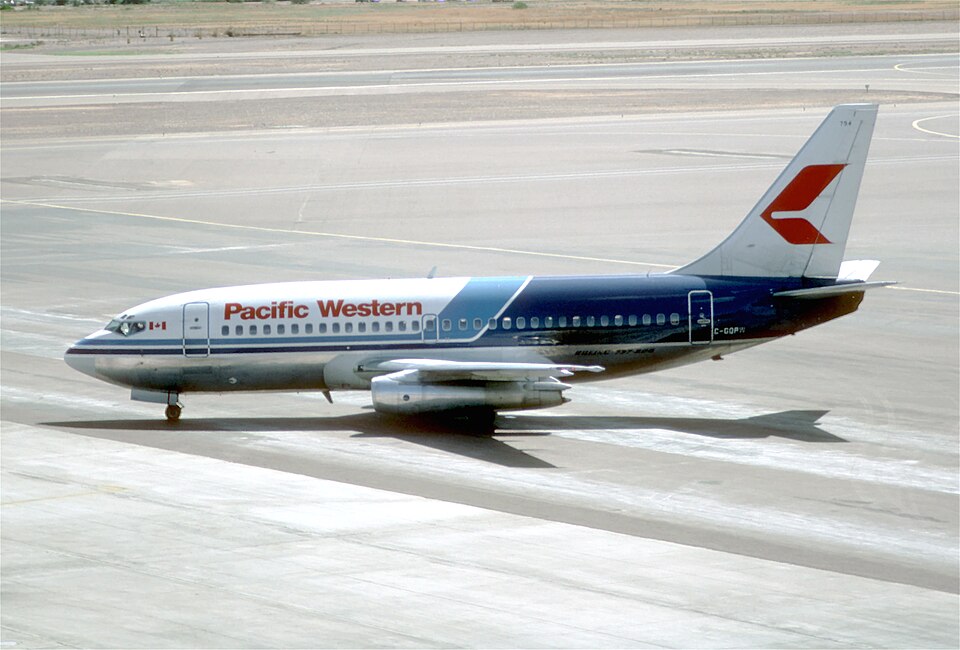
Background
Pacific Western Airlines flight 501 was a scheduled early morning service to Edmonton. After pushback from the gate at 07:35 and engine start, the aircraft taxied to runway 34 for departure. Takeoff began at 07:42 from the intersection of runway 34 and taxiway C-1.
Sequence of Events
Approximately 20 seconds into the takeoff roll, at an airspeed of around 70 knots, the flightcrew heard a loud bang accompanied by a slight veer to the left. The captain immediately rejected the takeoff using brakes and reverse thrust. Both crew members initially suspected a tire on the left main landing gear had blown. The captain decided to taxi clear of the runway at taxiway C-4. While approaching C-4, the crew noted that the left engine low pressure unit rpm was indicating 0 per cent. Twenty-three seconds after the initiation of the rejected takeoff, the first officer called clear of the runway on tower frequency: "501 clear here on Charlie 4".
Emergency Response
Shortly thereafter, the purser entered the flight deck and reported a fire on the left wing. The control tower confirmed the fire, stating: "Considerable amount off the back - on the left side engine there - and - eh - it's starting to diminish there. Eh - there's a fire going on the left side." One minute and two seconds had passed since the initiation of the rejected takeoff. The purser further stated that "the whole left-hand side, the whole back side of it is burning". The captain discharged a fire bottle into the engine, and the first officer requested emergency equipment. At an elapsed time of 1 minute 36 seconds, the cockpit fire warning bell activated. Simultaneously, the purser re-entered the cockpit and reported that it was getting bad at the back. The captain stopped the aircraft, and the crew carried out procedures for an emergency evacuation, which was initiated at an elapsed time of 1 minute 55 seconds. All 119 occupants were evacuated; 29 were injured. The aircraft was destroyed.
Investigation Findings
According to the official investigation, the accident was the consequence of a combination of factors: an uncontained rupture of the left engine thirteenth stage compressor disc occurred approximately 1,300 feet into the take-off roll. Failure of the disc was the result of fatigue cracking at three main locations in the rear snap and adjacent to 6 of the 12 tie-bolt holes. Fatigue cracking initiated as a result of an unidentified combination of factors which developed progressively over an undefined period of time, following the last major overhaul in May 1981. Some stator repair procedures carried out at the last major overhaul were not in accordance with the provisions of the Pratt & Whitney JT8D engine overhaul manual; as a result, deficiencies in the thirteenth stage stator assembly occurred. The ruptured piece of the compressor disc exited the engine and penetrated the left lower inboard wing skin, puncturing a fuel cell. Fuel leaking from the punctured fuel cell was ignited instantaneously. The fuel-fed fire increased in size and engulfed the left wing and aft section of the aircraft.