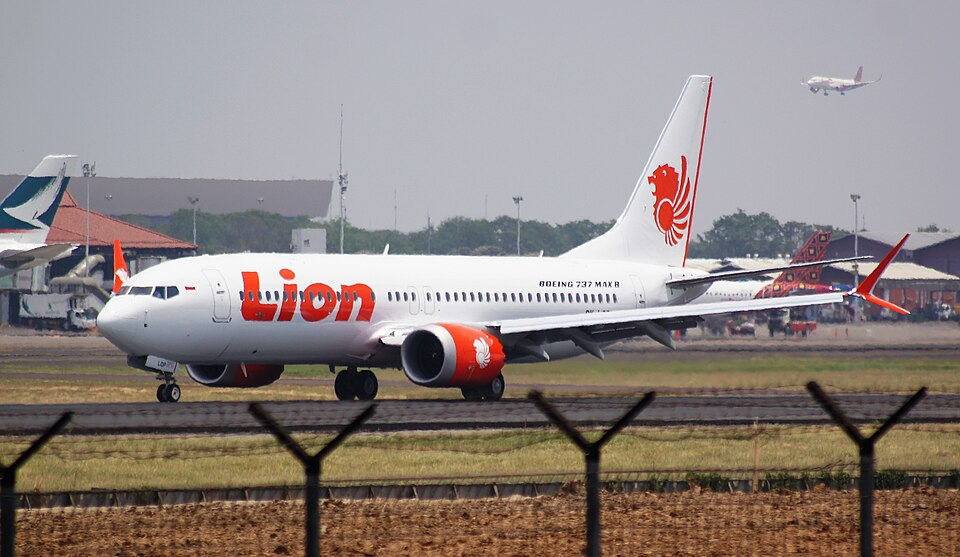
Accident Details
On the morning of the accident, a Lion Air Boeing 737 MAX departed runway 25L at Jakarta-Soekarno-Hatta Airport at 0621 local time, bound for Pangkal Pinang. The aircraft carried 181 passengers and 8 crew members. Weather conditions at the time were reported as good.
Sequence of Events
The crew was cleared to climb but experienced technical problems that prevented them from reaching an altitude higher than 5,375 feet. Flight data showed erratic speed and altitude values. The pilot declared an emergency and decided to return to Jakarta. While at an altitude of 3,650 feet and a speed of 345 knots, control was lost. The airplane entered a dive and crashed into the Kerawang Sea approximately 63 km northeast of the departure point, 12 minutes after takeoff. The aircraft disintegrated on impact, and no survivors were found.
Aircraft and Previously Reported Issues
The aircraft was delivered new to Lion Air on August 18 of the previous year. It had reportedly suffered various technical issues during a flight on the preceding Sunday night but was released for service on Monday morning. The Cockpit Voice Recorder (CVR) was recovered on January 14, 2019.
Investigation and Initial Findings
The investigation revealed that the flight control system on the Boeing 737 MAX could receive erroneously high single angle-of-attack (AOA) sensor input, potentially causing repeated automatic nose-down trim commands via the Maneuvering Characteristics Augmentation System (MCAS). This condition could activate the stick shaker on the affected side and trigger IAS, ALT, and/or AOA DISAGREE alerts. On November 6, 2018, Boeing issued an Operations Manual Bulletin directing operators to existing procedures for erroneous AOA input. The FAA subsequently issued an emergency Airworthiness Directive requiring revised flight manual procedures for runaway horizontal stabilizer trim.
Probable Cause Findings
The official investigation listed several contributing factors: 1. During design and certification of the Boeing 737-8 (MAX), assumptions about flight crew response to malfunctions were incorrect. 2. Based on those assumptions and an incomplete review of multiple flight deck effects, MCAS’s reliance on a single sensor was deemed appropriate and met certification requirements. 3. MCAS was designed to rely on a single AOA sensor, making it vulnerable to erroneous input. 4. Absence of guidance on MCAS or detailed trim use in flight manuals and training hindered crew response to uncommanded MCAS. 5. The AOA DISAGREE alert was not correctly enabled during development, so it did not appear during flight with a mis-calibrated sensor. 6. The replacement AOA sensor installed on the accident aircraft had been mis-calibrated during an earlier repair; this mis-calibration was not detected. 7. The installation test of the AOA sensor may not have been performed properly. 8. Lack of documentation in aircraft logs about continuous stick shaker and use of the Runaway Stabilizer NNC deprived maintenance and the accident crew of critical information. 9. Multiple alerts, repetitive MCAS activations, and distractions from ATC communications were not effectively managed due to difficulties in manual handling, NNC execution, and communication, leading to ineffective CRM and workload management.