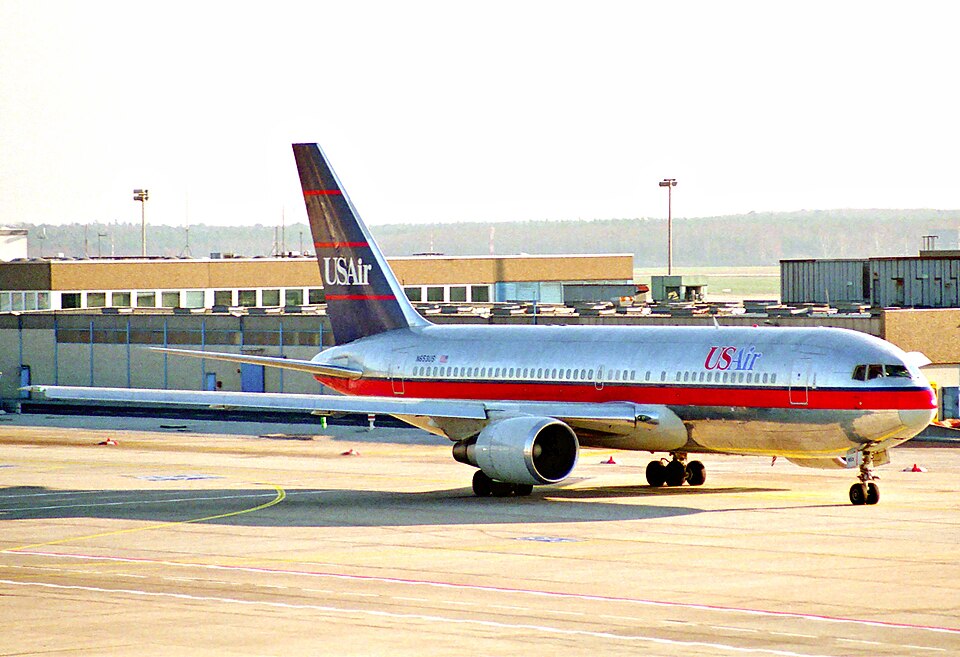
Incident Summary
On 6 November 2005, a Boeing 767-200 (registration N653US) operated a scheduled passenger flight from Philadelphia, USA, to London Gatwick Airport. During the final approach to Runway 26L, the landing gear was not selected down until the aircraft was at about 500 ft agl, and the landing flaps reached the full 30° setting only seconds before touchdown. The aircraft landed without incident, and no injuries or damage were reported.
Flight Sequence
The approach was flown with autopilot and autothrust engaged. The commander, acting as pilot flying, conducted a descent with radar vectors. At approximately 2,900 ft amsl, flap 20 was selected. The localizer was established at 2,000 ft amsl, and the glideslope was intercepted and followed from that altitude. The autopilot disconnected at 740 ft agl, followed by the autothrust at 711 ft agl. The gear lever was moved down around 500 ft agl, after which the tower controller queried the gear position. The crew confirmed three greens, and landing clearance was issued. Flaps began extending past 20° at 170 ft agl, reached 25° at 90 ft agl, and attained 29.7° at 16 ft agl. Touchdown occurred nine seconds later.
Crew Reports
Three crew members were on the flight deck: the commander (pilot flying), the first officer (pilot not flying), and an in-flight relief officer (IRO) occupying the jump seat. The commander recalled briefing for a visual approach and flying manually from around 10,000 ft, but flight data showed the autopilot remained engaged until 740 ft. He remembered calling for “gear down and landing checklist” descending through 1,000 ft, but the first officer missed the call. The commander then called for flap 30°, prompting the first officer to note the gear was not down. The commander did not hear any GPWS warnings.
The first officer stated that as soon as he moved the gear handle down, the tower called to question the gear position. At that time, only two of three green lights were illuminated. After all three became green, he confirmed gear down to the tower, believing this was completed by 500 ft agl. He remembered a possible momentary gear warning from the GPWS.
The IRO was occupied with a radio call during the early approach. When he turned his attention back, he estimated the aircraft was intercepting the glideslope at 1,000 ft. He thought he heard “TOO LOW FLAPS” and “TOO LOW GEAR” alerts from the GPWS.
Recorded Data
Flight data recorder information showed a GPWS Mode 4b alert active for eleven seconds, from 229 ft to 90 ft agl. The mode 4b alert was likely either “TOO LOW FLAPS” or “TOO LOW TERRAIN.” The gear-down discrete is based on the landing gear lever position; once the lever was down at 500 ft, the “TOO LOW GEAR” alert became inactive regardless of actual gear position.
Investigation Findings
The AAIB analysis noted that a significant period elapsed before the crew were interviewed, contributing to inaccuracies in their recollections. The approach was normal until glideslope intercept, but the gear selection was delayed. No external distraction or operational reason was identified for the delay. The commander’s request for gear at 1,000 ft left little margin for error. The aircraft was not stabilized by 500 ft, meeting the operator’s criteria for a mandatory go-around, which was not performed. The tower controller’s concern and suggestion to go-around also went unheeded. The GPWS alert was either not heard or not acted upon by all crew members. The reason for the late configuration was not determined.