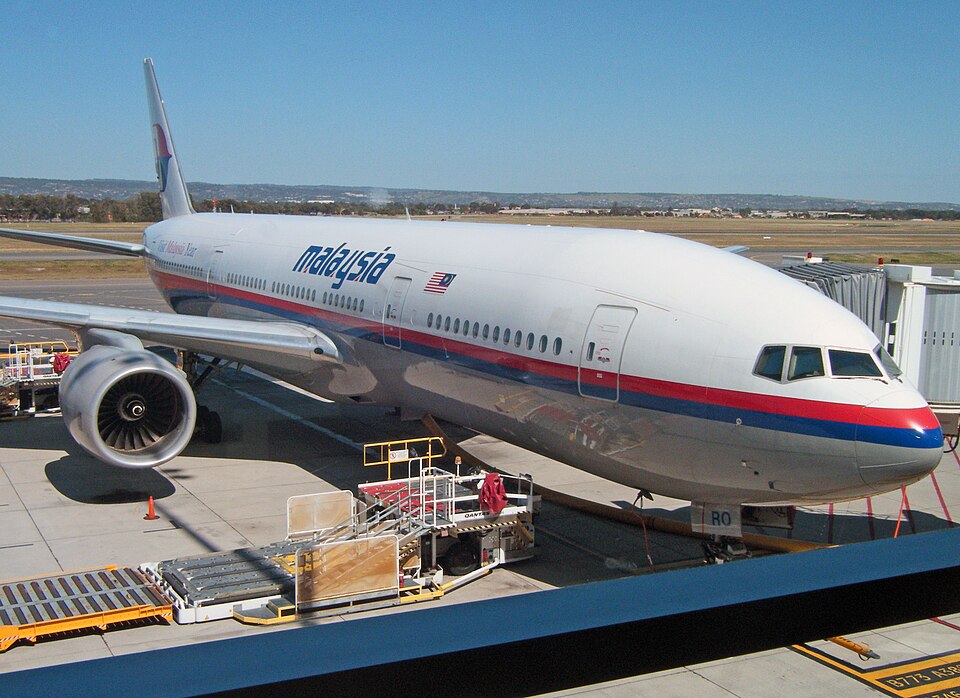
What happened
On March 8, 2014, a Boeing 777-2H6ER departed from runway 32R at Kuala Lumpur Airport, destined for Beijing. At 0107LT, the aircraft sent its final ACARS message, which indicated no technical malfunctions or errors. The last verbal communication from the crew occurred at 0119LT with the phrase "All right, good night." Shortly thereafter, the transponder was deactivated, and radar contact was lost at 0130LT while the plane was near the IGARI waypoint in the Gulf of Thailand.
Following the disappearance, a multi-national search and rescue operation involving Malaysia, China, Thailand, Vietnam, and the Philippines was conducted across the Gulf of Thailand, the Malacca Strait, and the South China Sea. While the aircraft's initial path was unknown, subsequent satellite analysis suggested the plane continued flying for several hours, likely deviating from its flight plan to travel south over the Indian Ocean. Based on new data, it was determined that the aircraft ended its flight in the southern Indian Ocean, approximately 2,600 km west of Perth.
Over time, various pieces of wreckage were recovered. In March 2014, witnesses reported seeing items such as life jackets and food trays near the Sunda Strait. Later, a flaperon was discovered on Réunion Island, and other fragments were found in Mozambique and South Africa. A large piece of an outboard flap found near Tanzania was confirmed to be from the aircraft registered 9M-MRO.
Findings
Extensive investigations by agencies such as the ATSB and BEA confirmed that recovered debris, including interior cabin laminates and structural components, originated from the specific Boeing 777-2H6ER involved in the disappearance. Despite the recovery of these parts, the total number of 239 occupants remains unaccounted for, and no definitive explanation for the flight's deviation or loss has been established.