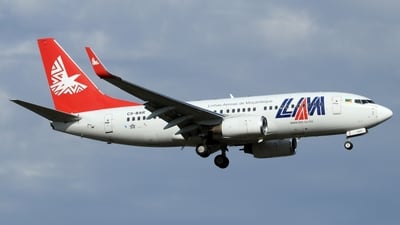
On October 26, 2021, a Boeing 737-700 (registration C9-BAR) was involved in an aviation accident near Pemba, MZ. Investigators recorded the probable cause as: Apron congestion, absence of marshaller and wingman, improper parking, and crew failure to take action regarding wing proximity. This summary draws on records from the Mozambique Civil Aviation Institute (IACM); 8 related events involving the same aircraft type or operator are linked below.
On 26 October 2021, a Linhas Aéreas de Moçambique Boeing 737-700, registration C9-BAR, struck a parked Botswana Air Force C-130 during taxi-out at Pemba Airport. No injuries were reported.
Incident overview and aircraft details On 26 October 2021, a Linhas Aéreas de Moçambique (LAM) Boeing 737-700, registration C9-BAR, was involved in a serious incident while taxiing out at Pemba Airport in Cabo Delgado Province, Mozambique. The aircraft, serial number 30674, was operating flight TM 461 from Dar es Salaam to Maputo with six crew members and 89 passengers on board. During the taxi-out phase, the left winglet of the Boeing 737-700 contacted the right wing of a parked Botswana Air Force Hercules C-130, registration OM-3, damaging the C-130's aileron. The incident occurred at approximately 16:45 local time (14:45 UTC). ## Operational context and sequence of events The LAM aircraft had arrived at Pemba Airport from Dar es Salaam and landed on runway 17 at 15:49 local time. The report states that parking was completed without timely assistance from a marshaller, who arrived one to two minutes after the crew reported the marshaller's absence to the tower. The parking was described as tight, resulting in close proximity between the left wing of the Boeing 737 and the right wing of the C-130. Before the impact, the co-pilot and mechanic performed a walk-around and identified the proximity, alerting the commander to turn the aircraft fully to the right to avoid contact. After all passengers had boarded and engine start and taxi clearance were received, the commander began taxiing with the mechanic acting as wingman. The taxi culminated in the collision. Following the incident, the commander used reverse thrust to move the aircraft back, made communications to passengers and the control tower, and passengers disembarked normally. ## Damage and injuries The left winglet of C9-BAR sustained abrasions, while the right aileron of the C-130 was damaged. No fatalities, serious injuries, or minor injuries were reported among the six crew members, 89 passengers, or one other person. ## Meteorological conditions Meteorological reports for Pemba Airport on 26 October 2021 indicated good weather conditions, with visibility above 10 km, cloud base around 2,000 feet, no rain or smoke, and light winds. ## Crew and aircraft status The crew was qualified for the flight, and the aircraft was airworthy. The commander was a 47-year-old Mozambican male with 9,829.36 total flight hours and 2,804.38 hours on the B737-NG type. The co-pilot was a 30-year-old Mozambican male with 763.58 total flight hours and 477 hours on the B737-NG type. The aircraft's airworthiness certificate was valid until 25 May 2022, and the operator's air operator certificate was valid until 11 November 2021. ## Preliminary analysis and probable causes The preliminary analysis identified several contributing factors: congestion on the Pemba Airport apron, the absence of marshallers for both arrival and departure, the personnel assigned to marshaller duties (firefighters) not having advance information about the aircraft's arrival time, improper parking that allowed excessive proximity between the wings of the two aircraft, the commander being warned by the co-pilot about the proximity but not descending to verify the degree of proximity, and the mechanic acting as wingman experiencing glare from the sun that impaired visibility. The most probable causes were listed as apron congestion, the absence of a marshaller and wingman, improper parking of the aircraft, and the crew's failure to take action in response to the potential hazard of wing proximity. ## Preliminary safety recommendations Preliminary recommendations included instructing LAM pilots not to park or taxi without marshallers at controlled airports, conducting crew resource management (CRM) refresher training for pilots, monitoring training for apron personnel (marshallers, firefighters, and air traffic controllers) and air traffic controller duty times, and issuing a NOTAM regarding apron congestion at Pemba Airport.