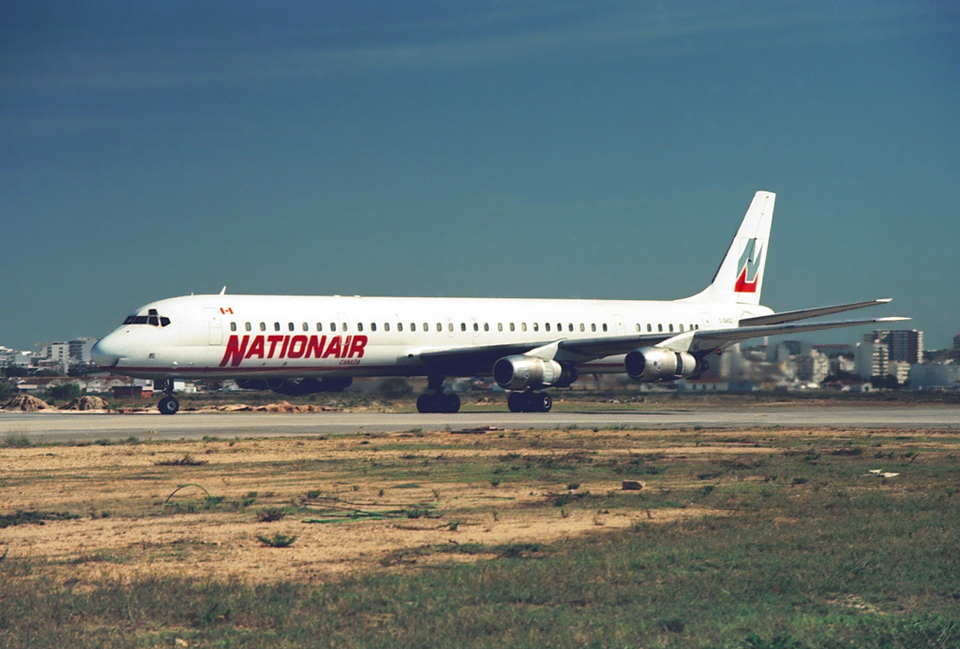
Accident Overview
On a flight from Jeddah to Sokoto, Nigeria, a McDonnell Douglas DC-8-61 (registration C-GMXQ) was destroyed in an accident near Jeddah-King Abdulaziz International Airport. The aircraft, owned by Canadian airline Nationair and operated on behalf of Nigeria Airways, was carrying hajj pilgrims. All 261 persons on board were killed.
Sequence of Events
The flight, designated Nigeria Airways Flight 2120, departed from Jeddah's runway 34L at 08:28. Approximately 15 seconds after brake release, an oscillating sound was heard in the cockpit. The flight engineer and first officer discussed a possible flat tire. The captain asked if the first officer was leaning on the brakes; the first officer denied. At about 80 knots, runway marks indicated the No.1 wheel began to break up. Flanges of No.2 wheel also contacted the runway. The captain called V1 about 45 seconds after brake release. After rotation, witnesses observed flames near the left main landing gear, which disappeared when the gear was retracted.
System anomalies followed: pressurization failure, gear unsafe light, and hydraulic loss. The captain requested a level-off at 2,000 feet due to pressurization issues. A radio call using the callsign "Nationair 2120" led to confusion with air traffic control, who mistakenly believed transmissions were from a different flight. About four minutes after brake release, the first officer declared an emergency due to blown tires. A flight attendant reported smoke in the cabin. The first officer reported loss of ailerons. The cockpit voice recorder and flight data recorder failed at 08:33:33.
Fire consumed the cabin floor above the wheel wells. When landing gear was extended, bodies and seat assemblies fell out due to fire damage. Despite structural damage, the aircraft remained controllable. Eight minutes after brake release, the captain declared an emergency, stating the aircraft was on fire and returning to base. The aircraft crashed nose-down 9,433 feet short of the runway at 08:38.
Investigation Findings
The official investigation identified multiple factors contributing to the accident:
- The deployment team's organizational structure was ill-defined and fragmented.
- Maintenance personnel releasing the aircraft were not qualified or authorized.
- The release was delegated to non-practicing Aircraft Maintenance Engineers who were flight crew.
- The aircraft was signed off as airworthy despite being unairworthy.
- Tire pressures on #2 and #4 were below minimum for flight dispatch; other tires may also have been low.
- Maintenance personnel were aware of low pressures but did not rectify them.
- A mechanic altered records of low pressures measured four days before the accident.
- No evidence that tire pressures were checked after that date.
- The lead mechanic and project manager were aware of low pressures but lacked knowledge of hazards.
- The project manager directed departure without servicing tires.
- The flight crew was not informed of low tire pressures.
- During taxi, load transfer from underinflated #2 tire to #1 caused over-deflection, overheating, and structural weakening of #1 tire, which failed early in the takeoff roll. #2 tire failed soon after.
- The #2 wheel stopped rotating; friction generated heat igniting tire remnants.
- The crew experienced unusual symptoms but continued takeoff; the aircraft lacked adequate warning systems.
- Gear retraction brought burning rubber near hydraulic and electrical components.
- The wheel well fire involved tires, hydraulic fluid, magnesium alloy, and fuel from a burn-through of the center fuel tank.
- Fire spread until cabin floor was breached and control systems were disabled.