Incident Overview
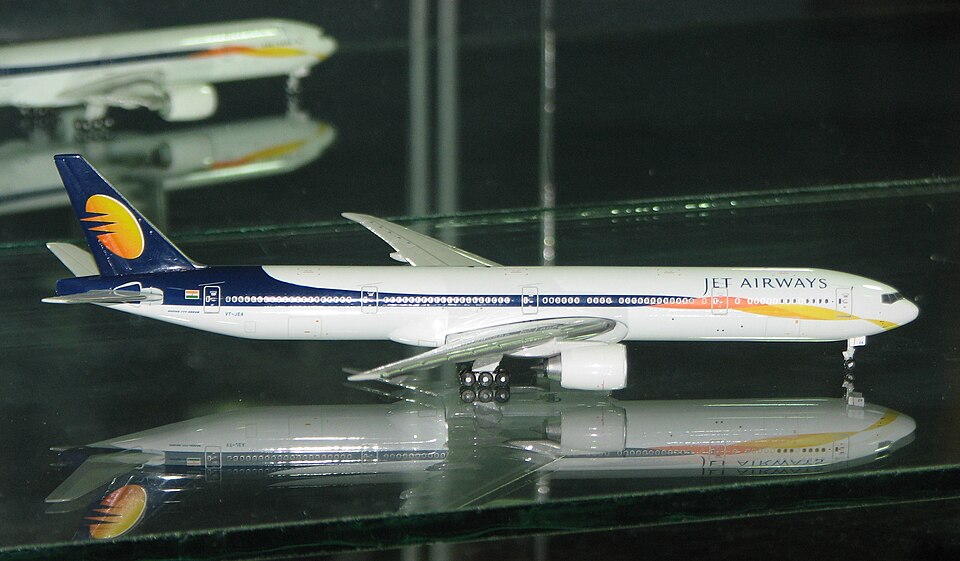
On October 8, 2009, a Jet Airways Boeing 777-300ER, registration VT-JEA, was operating a scheduled flight from London Heathrow to Mumbai. While overflying Hungarian airspace and later entering Romanian airspace, the flight crew requested a return to Hungarian airspace and a technical diversion to Budapest Ferihegy Airport (LHBP) due to a passenger exhibiting symptoms indicative of a heart attack. The captain decided to land immediately without dumping fuel, despite the aircraft being overweight for landing. No emergency was declared, but medical assistance and an ambulance were requested.
Landing and Fire Event
The aircraft performed a smooth, uneventful landing on runway 31R at 11:34 UTC. During taxi to parking position at Gate 84 of Terminal 2, ground personnel, including a loader placing chocks and a foreman, observed lubricant leaking from the brake hubs of the right main gear outer rear wheel and the left main gear inner front wheel. The leaking lubricant caught fire. The fire was extinguished using a portable fire extinguisher from a nearby service vehicle. Firefighters arrived on scene and used specialized high-volume cooling fans to cool the wheels and brake hubs. By 13:02 UTC, the wheels had cooled to hand-warm temperature, and the firefighters departed.
Crew Actions and Aircraft Return to Service
The aircraft commander continuously monitored the situation via factory-installed cameras displayed on the center instrument panel and determined that neither passenger evacuation nor an emergency declaration was necessary. The maintenance organization LHTB, contracted by the operator, performed inspections and maintenance in accordance with the Aircraft Maintenance Manual (AMM) procedures for overweight landing (AMM 05-51-35) and high-energy stop/brake fire (AMM 05-51-14). After completing these procedures, the aircraft was declared airworthy and departed for Mumbai at 16:05 UTC, continuing the flight.
Investigation Findings
The Hungarian Transportation Safety Bureau (KBSZ) investigated the incident. The KBSZ assumed that the fire originated at the wheel bearings due to maintenance non-compliance with AMM instructions. Specifically, either excess old grease was not removed, or grease not meeting the required specification was used. The KBSZ referenced Boeing statistics indicating that in 6,797 similar wheel fire events, the cause was failure to follow prescribed maintenance practices. The report also cited an AAIB investigation from 1994 into repeated brake hub fires on Boeing 777-300ER aircraft operated by a Pakistani airline at Manchester Airport. That investigation led to the issuance of Boeing Maintenance Tip MT 32-021 R1, which emphasizes removing old grease and applying only a thin layer of new grease to the axle, using grease conforming to MIL-PRF-81322. The KBSZ noted that it could not conduct a detailed examination because the aircraft had already been returned to service. No further investigative action was deemed necessary, and no safety recommendations were issued, as adherence to existing regulations was considered sufficient to prevent recurrence.