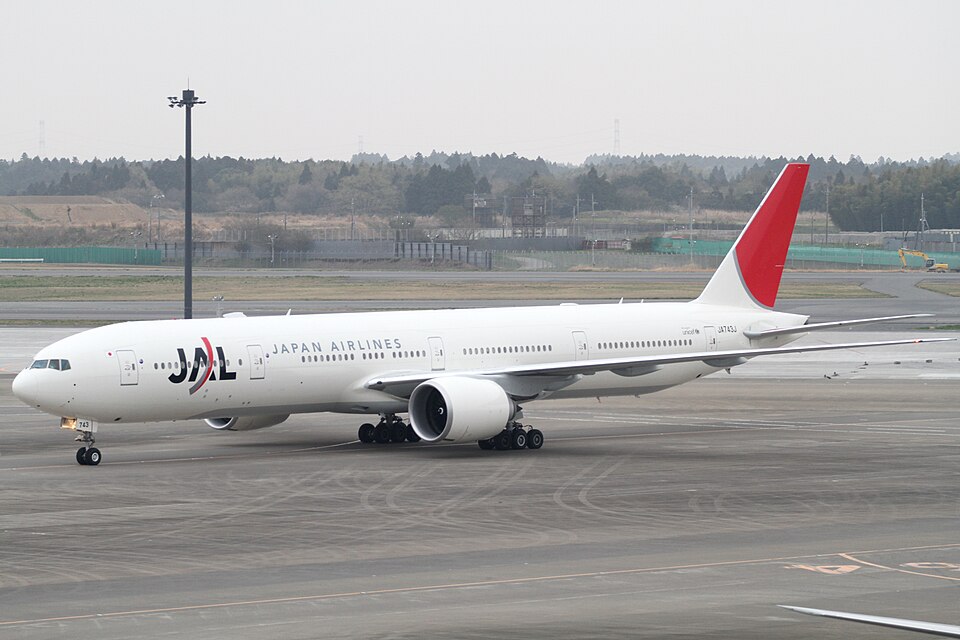
Incident Overview
On September 5, 2017, at approximately 11:00 JST, a Japan Airlines Boeing 777-300ER, registration JA743J, operating as Flight 006 from Tokyo International Airport to John F. Kennedy International Airport, experienced an engine failure shortly after takeoff. The aircraft had departed from runway 34R. Immediately after lift-off, the flight crew heard abnormal noise from the No. 1 (left) engine, and the engine rpm decreased. A caution message indicating reduced thrust illuminated. The local controller observed flame emanating from the engine. The takeoff was continued, and after mutual confirmation of the failure, the first officer shut down the engine per the captain's order. An emergency was declared, and after obtaining priority from air traffic control, the crew dumped fuel off the coast of Tateyama City to reduce weight and returned to Tokyo International Airport, landing on runway 34L at 12:09 JST. There were 251 persons on board (two captains, 16 crew members, and 233 passengers); no injuries occurred.
Aircraft and Engine Damage
The aircraft, a Boeing 777-300ER equipped with GE90-115B engines, sustained minor damage. The left engine suffered damage to multiple stages of low-pressure turbine (LPT) stator vanes and turbine blades. Specifically, one LPT fifth-stage stator vane was fractured, and adjacent segments showed wear on the inner platform. Fifth- and sixth-stage turbine blades were damaged circumferentially, and the sixth-stage stator vane was damaged except for a certain section. A hole approximately 6 cm by 1 cm, along with concave deformation and cracks, was found on the lower section of the turbine rear frame (TRF). No damage was observed forward of the LPT fifth-stage stator vanes, and no evidence of abnormal combustion was found inside the engine. The engine cowl was undamaged. The airframe suffered impact damage from debris, including the flaperon lower surface, flap inner side fairing, wing lower surface, outer flap lower surface, and left horizontal stabilizer leading edge. A grass fire along the runway side was extinguished by airport fire services. Many engine fragments were recovered from the runway and surrounding areas.
Investigation Details
The Japan Transport Safety Board (JTSB) investigated the incident, classifying it as a serious incident equivalent to engine casing penetration. The investigation included analysis of the TRF hole by the National Institute for Materials Science. The United States, as the state of design and manufacture, participated. The flight crew consisted of a captain (PIC), a captain (SIC), and a first officer, all with valid medical certificates and type ratings. The aircraft had been manufactured in 2009 and had accumulated 36,340 total flight hours on the left engine. Maintenance records showed that the sixth-stage turbine blade had been replaced in 2013, and recent checks included bore scope inspections of high-pressure turbine components. The report did not state a probable cause for the incident.