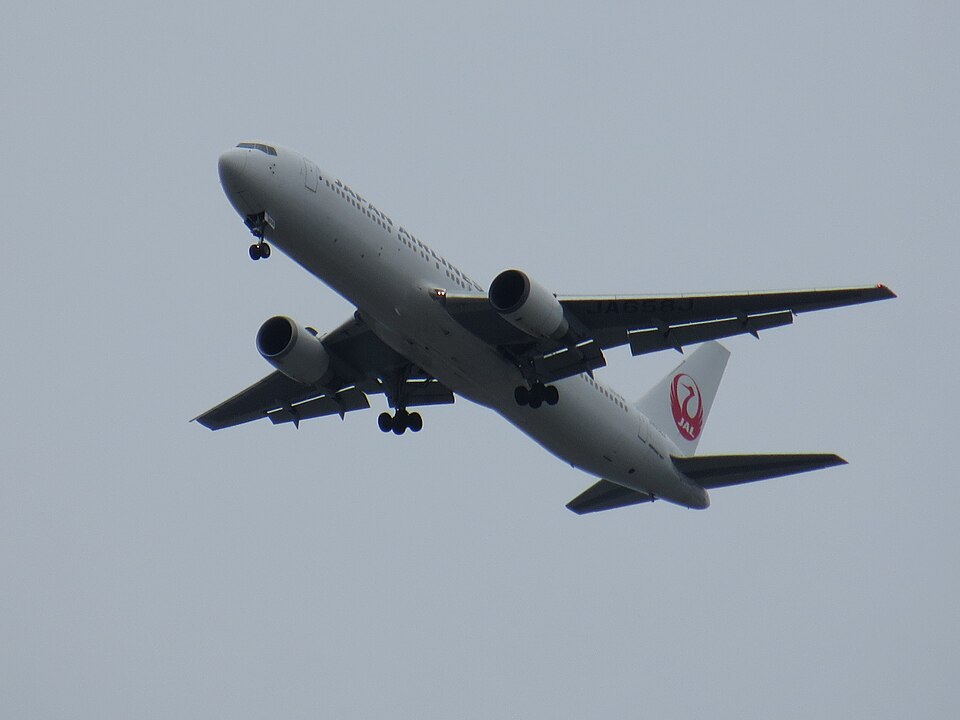
Accident Overview
On November 10, 2016, at approximately 13:21 JST, a Boeing 767-300, registration JA658J, operated by Japan Airlines Co., Ltd., was climbing from Kagoshima Airport to Tokyo International Airport when the aircraft encountered turbulence. A cabin attendant (CA) fell and sustained a bone fracture, classified as a serious injury. The aircraft was not damaged.
Flight History
The flight, scheduled as Flight 646, took off from Kagoshima Airport at about 13:15 JST with 11 crew members and 118 passengers. Prior to departure, the pilot in command (PIC) briefed the cabin crew that the seat belt sign would be turned on for 15 minutes due to expected turbulence from clouds moving from the west and possible wind changes during climb.
After takeoff, the aircraft experienced weak to moderate shaking at altitudes between about 10,000 and 13,000 ft. The first officer (FO), as pilot flying, set the autopilot speed to 290 knots as a turbulent air penetration target speed. The shaking weakened at about 14,000 ft and calmed at about 20,000 ft. The seat belt sign was turned off at about 22,000 ft.
Cabin Attendant's Actions
Approximately six minutes after takeoff, the CA noticed an infant crawling from its custodian to an adjacent vacant seat. The CA called out to the custodian, but the situation did not improve. Judging that the infant could be in danger, the CA unfastened her seat belt and attempted to stand up to intervene. At that moment, the aircraft banked to the right and experienced strong shaking, causing the CA to fall backward to the floor on the right side of the jump seat. She later reported the fall to the chief cabin attendant and was diagnosed with a bone fracture at a hospital after landing.
Analysis
The change in vertical acceleration recorded by the flight data recorder indicated that the aircraft encountered turbulence, likely associated with stratocumulus clouds. The CA's decision to leave her seat while the seat belt sign was illuminated was based on her assessment of an urgent need to secure the infant. The company's operations manual allowed cabin attendants to leave their seats in such circumstances, but required them to quickly return and fasten their seat belts after taking necessary action.
Injuries and Damage
Only the cabin attendant was injured, suffering a bone fracture. The aircraft sustained no damage.