Introduction
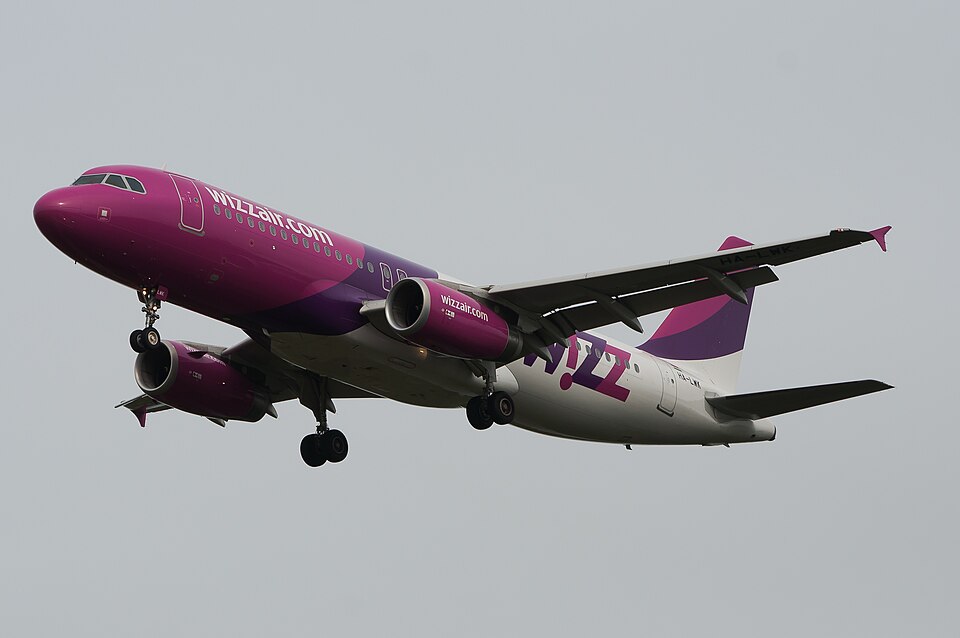
On 29 March 2018, an Airbus A320-232, serial number 04716, registration HA-LWK, operated by Wizz Air (WZZ), experienced an engine 1 stall during approach to International Airport Skopje (LWSK), North Macedonia. The stall led to an in-flight shutdown (IFSD) of engine 1. The aircraft landed uneventfully with the engine inoperative. The engines were IAE V2500 model V2527-A5, serial number V15280. At the time of the incident, the aircraft had accumulated 25,261 flight hours and 15,565 flight cycles.
Event Description
According to flight data recorder (FDR) information, at 20:40:09 UTC, while climbing through 4700 ft RA, a master caution triggered for 5 seconds. The pack 2 pushbutton was then switched on, and the pack 2 flow control valve opened. The aircraft leveled off at FL350 at 20:59:37 UTC. Descent began at 21:55:55 UTC. During descent, the pressure relief valve 1 (PRV1) started oscillating between open and closed positions, and the engine 1 regulated pressure (PR1) followed the PRV1 position.
At 22:12:05 UTC, while crossing 4300 ft STD in descent, several parameters changed abruptly: PS31 dropped from 45 psi to 26 psi in 2 seconds, then stabilized around 21 psi; EGT1 increased from 390°C to 570°C within 5 seconds, then increased towards 615°C; PR1 decreased from 20.0 psi to 8.5 psi within 9 seconds; N1A1 decreased from 26% to 19% in 3 seconds, then stabilized around 17%; N2A1 decreased from 58% to 38% in 60 seconds. At 22:12:09 UTC, a master caution triggered for 4 seconds, and it triggered three more times within the next 19 seconds. The post-flight report recorded engine 1 stall and engine 1 fail at 22:12 UTC. At 22:12:38 UTC, thrust lever 1 was pulled back to the idle notch, and auto thrust deactivated. Three seconds later, autopilot 1 was voluntarily disengaged for 4 seconds, and a master warning triggered for 3 seconds. Thrust asymmetry was countered by rudder and aileron deflection.
At 22:13:01 UTC, with EGT1 at 615°C, engine 1 master lever was set to OFF, and a master caution triggered for 3 seconds. Engine 1 parameters decreased accordingly. The post-flight report recorded engine 1 shutdown at 22:13 UTC. At 22:13:15 UTC, PRV1 closed durably. At 22:13:23 UTC, autopilot 1 and flight director modes changed, and the aircraft climbed towards the selected altitude of 6000 ft STD. At 22:15:26 UTC, thrust lever 2 was pushed to the climb notch, and auto thrust activated. At 22:15:34 UTC, a master caution triggered, then thrust lever 2 was pushed to the maximum continuous thrust notch. The rest of the flight proceeded uneventfully with engine 1 shut down. The aircraft landed at 22:32:41 UTC, with thrust lever 2 pulled back to idle reverse and thrust lever 1 remaining at idle.
Investigation Findings
Since September 2017, a total of 8 occurrences of engine stall were reported to Airbus and IAE. In all cases, the stall led to an engine in-flight shutdown. Due to the low altitude at which the stall occurred, the engine was not relighted, and the aircraft landed uneventfully. Investigation of these events revealed common attributes: the events occurred at or below 5,000 feet altitude; the high-pressure compressors (HPC) had greater than 10,000 cycles since new or overhaul; the engines were in Select Two configuration with EEC software version SCN22; the pack or bleed was off (normally on); and the bleed system ice protection (BSI) was clean with removed accessories deemed non-contributors. It was identified that under these conditions, there was a possibility of engine stall followed by IFSD during descent or approach. Analysis showed that setting the engine/nacelle anti-ice (NAI) to ON during descent would have prevented the engine stall, as it increases idle thrust and thus the stall margin.
IAE performed a teardown of the engine's HPC in June 2018 in the presence of Airbus and the operator. Extensive gas path measurements and visual inspection of all HPC hardware revealed no abnormal conditions. Inspection of other engine components, including the high-pressure turbine, engine accessories such as the variable stator vane actuator, fuel metering unit, 7th and 10th stage bleed valves and solenoids, and fuel nozzles, also showed no conditions that would implicate any accessory as a potential contributor to the descent stall.
Mitigation Actions
The investigations focused on increasing the stall margin in descent to avoid the stall condition. One solution was to unload the high-pressure compressor and increase idle thrust to gain stall margin. Use of nacelle anti-ice during descent was deemed beneficial, and back-to-back analysis indicated that all reported stall cases would have been avoided with NAI ON during descent. Consequently, Flight Operations Transmission (FOT) 999-0094-18-00 was distributed on November 16, 2018, to all V2500 operators, recommending the use of NAI ON in descent at and below 10,000 ft whenever the Master Minimum Equipment List (MMEL) was applied to inhibit bleed or pack valves in the closed position. The MMEL operational procedures were modified to include this mention. Additionally, the Flight Crew Operating Manual (FCOM) was updated to recommend NAI use in descent in case of failure or closure of bleed or pack valves during the flight.
Maintenance Information
For aircraft with bleed or packs locked closed as per MMEL, it was recommended to perform associated maintenance actions as soon as possible if the aircraft fell under the conditions of SCN22 on Select Two engines and HPC greater than 10,000 flight cycles. This would reduce the time for which flight crews would need to apply NAI ON in descent.
Final Solution
The permanent solution involved changing the logic of the 7th stage engine stability bleed valve closure to take into account the bleed consumer status and ensure sufficient stall margin in all cases. This was to be achieved through a modification of the EEC software, creating a new version called SCN23. The planning and content of this modification were being defined between IAE and Airbus.