History of the Flight
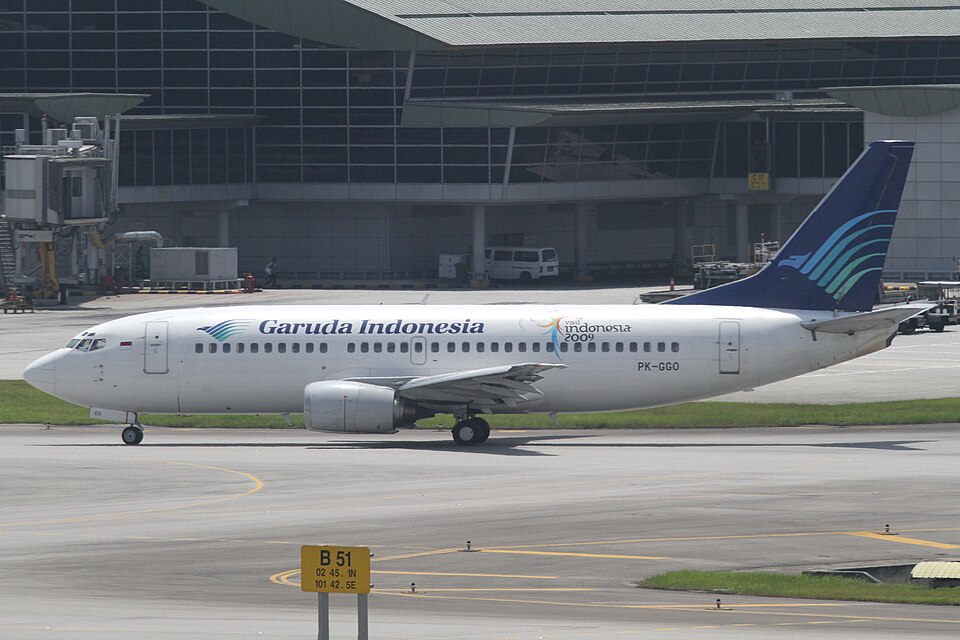
On 22 July 2011, a Boeing 737-300 aircraft registered PK-GGO, operated by PT. Garuda Indonesia Airways, was conducting scheduled passenger flight GA 292 from Soekarno-Hatta International Airport, Jakarta to Abdul Rahman Saleh Airport, Malang. The flight departed at 0546 UTC with 100 passengers on board. The flight crew consisted of three pilots: a Pilot in Command (PIC) acting as Pilot Monitoring (PM), a First Officer (FO) under line training acting as Pilot Flying (PF), a Second in Command (SIC) occupying the pilot jump seat, and five flight attendants. No abnormal conditions were reported during the flight.
Approach and Landing
Air Traffic Control instructed the pilots to commence a VOR approach to Runway 35 followed by a circling approach to Runway 17. The pilots sighted the runway at approximately 4 DME and initiated the circling procedure by joining the circuit pattern for Runway 17. While turning onto the base leg for Runway 17, the PM observed and assessed that the aircraft was above the normal glide path, had turned too early, and was positioned to the right of the runway centerline. The PM decided to take over control and continue the approach. The PIC attempted to correct the glide path by increasing the rate of descent, reducing power, and rolling to align with the runway centerline.
At 0709 UTC, the aircraft touched down on Runway 17, deviating slightly to the right of the centerline, and stopped on the runway. ATC instructed the pilot to stop and inquired about a possible hard landing, which the pilot confirmed. The Flight Data Recorder recorded a vertical acceleration of 3.473 G.
Damage
The aircraft sustained damage to the left engine and nose landing gear. The nose wheel hub was broken, and tire marks were found on the runway. No other damage or injuries to persons were reported.
Investigation Findings
The investigation was conducted by the Komite Nasional Keselamatan Transportasi (KNKT). The contributing factor identified was the PM's decision to take over control and continue the landing without stabilized approach criteria, while the aircraft was not in a stabilized condition, compounded by the lack of the Pilot Flying's ability to handle the aircraft properly.