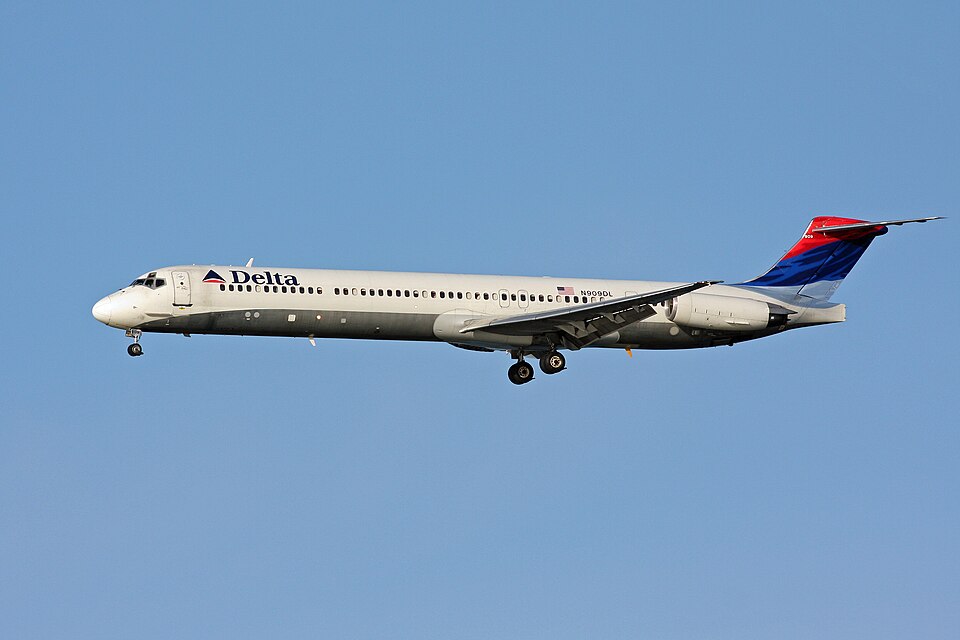
Accident Details
On an unspecified date, Delta Air Lines Flight 1086, a regularly scheduled passenger flight from Hartsfield-Jackson Atlanta International Airport (ATL) to LaGuardia Airport (LGA) in New York, New York, experienced a runway excursion during landing. The aircraft was operating under 14 Code of Federal Regulations Part 121. An instrument flight rules flight plan was filed, and instrument meteorological conditions prevailed at the time of the accident.
The airplane landed on runway 13, departed the left side of the runway, contacted the airport perimeter fence, and came to rest with the nose on an embankment adjacent to Flushing Bay. Of the 127 passengers, 29 sustained minor injuries; the 2 pilots, 3 flight attendants, and the remaining 98 passengers were not injured. The airplane was substantially damaged.
Crew and Prelanding Concerns
The captain and first officer were highly experienced MD-88 pilots, with the captain having accumulated about 11,000 hours and the first officer about 3,000 hours on the MD-88/-90. The captain was previously based at LGA and had made many landings there in winter weather conditions.
En route to LGA, the flight crew was concerned about the available landing distance on runway 13 and spent considerable time analyzing the airplane's stopping performance. They requested braking action reports about 45 and 35 minutes before landing, but none were available at those times due to runway snow clearing operations. The unavailability of braking action reports and uncertainty about the runway's condition created situational stress for the captain, who was the pilot flying.
After runway 13 became available, two preceding airplanes (landing about 16 and 8 minutes before the accident) reported good braking action. The flight crew expected to see at least some of the runway's surface after breaking out of the clouds, but instead saw that the runway was covered with snow. The snowier-than-expected runway, along with its relatively short length and the presence of Flushing Bay directly off the departure end, most likely increased the captain's concerns about stopping within the available distance, exacerbating his situational stress.
Landing and Loss of Control
The captain made a relatively aggressive reverse thrust input almost immediately after touchdown. Reverse thrust is used to decelerate the airplane during the landing roll; settings are expressed as engine pressure ratio (EPR). Both pilots were aware that 1.3 EPR was the target setting for contaminated runways.
As reverse thrust EPR was rapidly increasing, the captain's attention was focused on steering the airplane to counteract a slide to the left and ensuring spoilers had deployed (necessary for autobrakes to engage). The maximum EPR values reached were 2.07 on the left engine and 1.91 on the right engine, much higher than the target of 1.3 EPR. These high values likely resulted from a combination of the captain's stress, his aggressive reverse thrust input, and operational distractions, including the slide to the left despite steering efforts. All factors reduced the captain's monitoring of EPR indications.
The high EPR values caused rudder blanking (on MD-80 series airplanes, high reverse thrust disrupts smooth airflow over the rudder) and subsequent loss of aerodynamic directional control. Although the captain stowed the thrust reversers and applied substantial right rudder, right nosewheel steering, and right manual braking, the airplane's departure from the left side of the runway could not be avoided because directional control was regained too late to be effective.
Probable Cause
The National Transportation Safety Board determined that the probable cause of this accident was the captain's inability to maintain directional control due to his application of excessive reverse thrust, which degraded the effectiveness of the rudder in controlling the airplane's heading. Contributing to the accident were the captain's situational stress resulting from his concern about stopping performance and attentional limitations due to the high workload during the landing, which prevented him from immediately recognizing the use of excessive reverse thrust.