History of the Flight
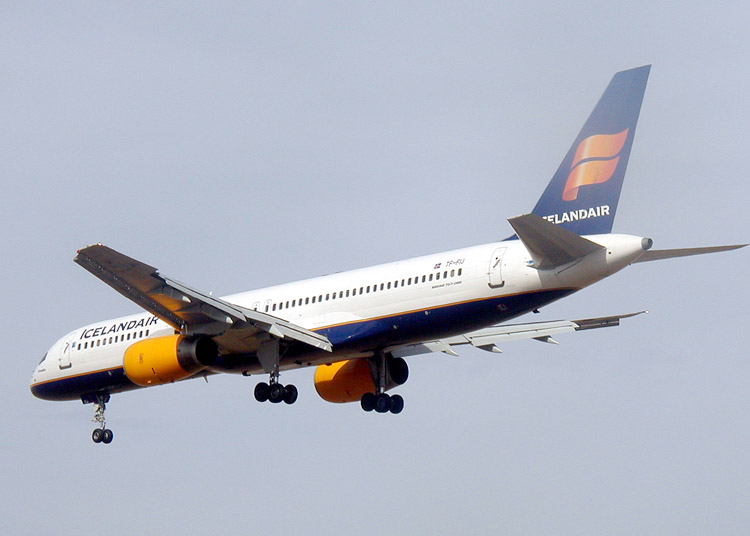
On the evening of February 26, 2013, an Icelandair Boeing 757-200, registration TF-FIJ, was en route from Copenhagen Airport (EKCH) to Keflavik Airport (BIKF) on a scheduled commercial flight. The flight crew comprised a commander and a first officer, with the first officer serving as the pilot flying. The center autopilot was engaged.
Shortly before top of descent at flight level 360, the fourth cabin attendant reported an unusual low-frequency sound in the cabin. The flight crew observed no abnormal indications on their instruments. At 21:52, during descent, the flight crew noticed floor vibration and an EICAS message "R HYD QTY" followed by "R HYD SYS PRESS", indicating a failure of the right hydraulic system. The crew consulted the Quick Reference Handbook (QRH) and performed the relevant checklists. They noted that the right autopilot, right thrust reverser, right stabilizer trim, and auto brake system were inoperative. During descent, the flight crew tested the spoilers and observed poor performance, with the EICAS showing "SPOILERS".
The flight crew requested vectors for runway 20 at Keflavik. The aircraft was in instrument meteorological conditions (IMC) until established on final approach. At approximately 22:26, while on a 7 NM final approach to runway 20 at an altitude of 2400 feet, the flaps were extended to the 30° position. At that moment, the aircraft began an uncommanded roll to the left. The pilot flying scanned the instruments but saw no asymmetry indications. The roll continued, and the aircraft experienced a partial loss of control. The flight crew declared an emergency. During recovery, flap overspeed occurred, followed by a pitch-down and rapid descent. The crew regained full control 2 minutes and 42 seconds after the onset of the roll. At 22:30, they advised ATC that they had regained control and were ready for another approach. The aircraft was then south of Straumsvík, near Hafnarfjörður. The crew subsequently landed safely with no injuries or damage.
Aircraft Information
The aircraft was a Boeing 757-200, serial number 25085, manufactured in 1991, registered in Iceland, and owned by Airco ehf. It was operated by Icelandair. The flight had 6 crew members and 165 passengers on board. No injuries or damage were reported. Meteorological conditions at the airport were visual (VMC), and the flight was conducted under instrument flight rules (IFR).
Investigation Findings
Examination of the flight data recorder (FDR) revealed that a latent spoiler module failure had existed for the previous 27 flights. Inspection of the spoiler system found a latent failure in the actuator of spoiler #6, specifically a cracked Blocking and Thermal Relief Valve Housing. The right hydraulic system failure had occurred due to a cracked hydraulic tube in the wheel well.
With the right hydraulic system unpressurized and the cracked valve housing, full deployment of the flaps caused spoiler #6 to float. This resulted in asymmetrical lift between the left and right wings, generating a rolling moment to the left. The investigation determined that the combination of the two failures led to the incident.
Conclusion
The incident was caused by a latent failure in the actuator of spoiler #6 due to a cracked Blocking and Thermal Relief Valve Housing, which combined with the right hydraulic system failure caused spoiler #6 to float, resulting in asymmetrical lift and an uncommanded left roll.