History of the Flight
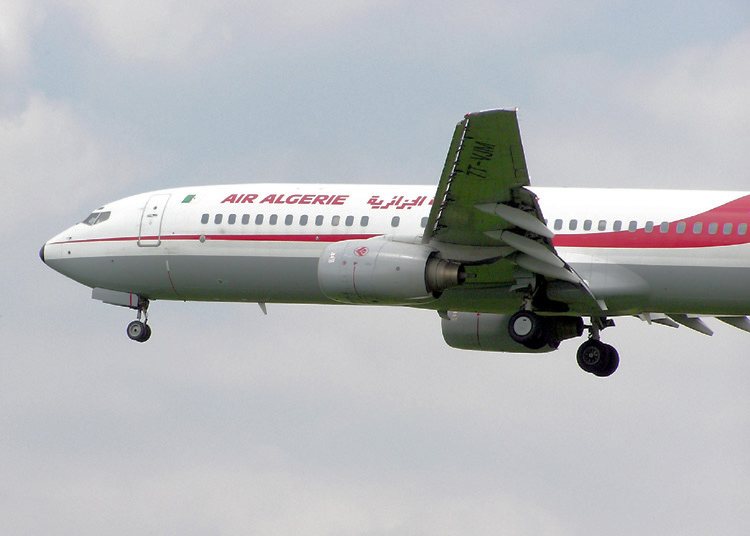
On 6 December 2019, a Boeing 737-800 registered 7T-VJM operated by Air Algérie was conducting a commercial passenger flight from Tlemcen, Algeria, to Paris-Orly, France. The crew initiated an ILS approach to runway 25, with the co-pilot acting as pilot flying (PF). At 11:12:02 UTC, the controller cleared the aircraft to land. The crew disengaged the autopilot at 11:14:01 and the auto-throttle at approximately 600 ft for a manual landing.
At 11:14:10, with the aircraft at 477 ft (13 ft below the decision altitude), the controller ordered a go-around following activation of a Runway Incursion Monitoring and Collision Avoidance System (RIMCAS) warning. The reason for the go-around was not communicated to the crew. The published missed approach procedure for runway 25 required climbing straight ahead to 700 ft, then turning left to magnetic track 199° and climbing to 2,000 ft initially.
The crew engaged TO/GA mode at 401 ft and manually advanced thrust levers to approximately 90% N1. The aircraft reached a minimum radio altitude of 73 ft before climbing. A Master Caution light illuminated for twelve seconds. Pitch increased to 18°, and vertical speed reached 4,000 ft/min. The crew retracted flaps to 15° and the landing gear. At 930 ft, LNAV mode engaged, followed by ALT ACQ at 1,210 ft, targeting the pre-set altitude of 2,000 ft.
During the left turn, bank angle reached 38°, triggering a "BANK ANGLE" alert. Speed decreased to 160 kt, 11 kt below the target. The aircraft peaked at 2,070 ft then began descending. The controller instructed a climb to 3,000 ft and a heading of 160°. Changing the altitude selection on the Mode Control Panel caused a reversion to Vertical Speed (V/S) mode, which kept the aircraft in descent. Two "DON'T SINK" alerts activated. The stick shaker activated momentarily. The crew eventually leveled off at approximately 1,300 ft, accelerated to 292 kt, and extended flaps beyond placard speed. They then climbed to 3,000 ft, re-engaged the autopilot, and were vectored for a new approach, landing on runway 25 at 11:37.
Crew Information
The captain held an Airline Transport Pilot Licence with approximately 8,000 flight hours, including 1,400 on the Boeing 737. The co-pilot held a Commercial Pilot Licence with around 3,700 flight hours, including 1,700 on type. Due to the passage of time, the captain could not precisely recall the event but noted surprise at the go-around instruction.
Weather Conditions
METARs at 11:00 and 11:30 reported wind from 200° at 10 kt, visibility 4,000–4,500 m, mist, light rain, and broken clouds at 500 ft. Recorded data indicated a wind gradient with a 40 kt wind at 1,500 ft.
Activation of RIMCAS Warning
The RIMCAS warning was triggered by a bird-control vehicle at holding point W33, approximately 700 m from the runway threshold. The vehicle driver did not respond to a request to exit the safety area because he was using gunfire to scare birds. The warning was erroneous due to an incorrect system configuration after the holding point was moved 12 m closer to the runway centerline following work on 2 December; the RIMCAS configuration was not updated. The warning activated even though the vehicle had not exceeded the holding point. The configuration was corrected after the incident.
Management of Automatic Systems
The climb performance of modern twin-engine jets can reduce crew time for managing dynamic maneuvers during go-arounds with low weight or low published altitudes. The Flight Crew Techniques Manual recommends a rate of climb of 1,000–2,000 ft/min and suggests disconnecting automatic systems if necessary.