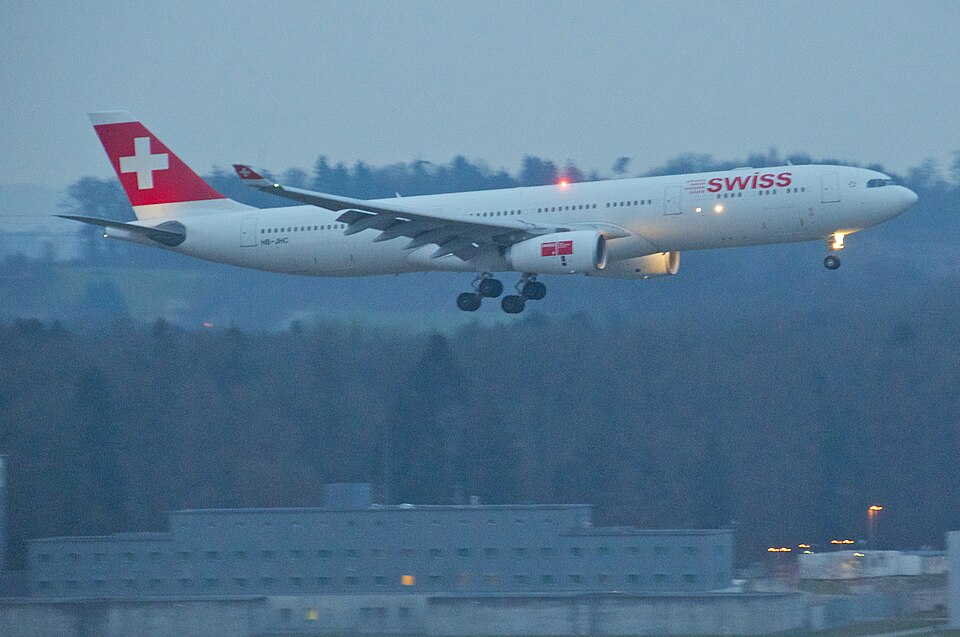
Tailstrike during takeoff at Zurich Airport involving Airbus A330

Casualties unknown • Zürich Flughafen (LSZH), ZH, CH

An Airbus A330 experienced a tailstrike during takeoff from Zurich due to a combination of wind fluctuations, reduced engine thrust, and specific flap configuration choices.

What happened

On 26 February 2020, an Airbus A330-343, registration HB-JHC, operated by Swiss International Air Lines, was preparing for a scheduled commercial flight from Zurich (LSZH) to Nairobi (HKJK). The weather at the airport included snow showers and a runway surface covered with approximately 3 mm of slush.

During the takeoff roll on runway 32, the flight crew utilized reduced engine thrust (FLEX power). As the aircraft reached the rotation speed, the pilot flying initiated rotation. However, due to fluctuating winds and windshear, the indicated airspeed dropped significantly during the rotation phase. This caused the aircraft to reach a pitch angle of 13.7 degrees at a speed of 154 knots, resulting in the rear of the fuselage making contact with the runway. The crew and passengers did not notice the tailstrike during the flight. Upon landing in Nairobi, maintenance personnel discovered scratches and grinding marks on the lower fuselage near the waste water door.

The investigation

The Swiss Transportation Safety Investigation Board (SUST) examined the takeoff performance calculations, the aircraft's flight data recorder, and the meteorological conditions. The investigation focused on the crew's decision to use a specific flap configuration and their method of calculating takeoff parameters using the Electronic Flight Bag (EFB). The investigators analyzed how the selection of a tailwind component for calculation and the use of reduced thrust influenced the aircraft's rotation speed and stall margin.

Findings

Several contributing factors led to the tailstrike:

  • The flight crew selected a configuration (CONF 1+F) intended to generate low resistance due to forecasted windshear, which reduced the stall margin.
  • To create a safety margin, the crew entered a tailwind component into their calculations instead of using the actual headwind, which resulted in a significantly lower rotation speed (VR).
  • The use of reduced engine thrust slowed the aircraft's acceleration, particularly during the critical rotation phase.
  • Sudden wind fluctuations and windshear caused the indicated airspeed to drop below the calculated rotation speed during the transition to lift-off.

Probable cause

The tailstrike was caused by a combination of selecting a low-resistance flap configuration, using an incorrect tailwind input for takeoff calculations, and utilizing reduced engine thrust, all of which were exacerbated by windshear-induced airspeed fluctuations during rotation.

Frequently asked questions

What happened in the 2020-02-26 AIRBUS S.A.S. A330-343 accident near Zürich Flughafen (LSZH), ZH, CH?

An Airbus A330 experienced a tailstrike during takeoff from Zurich due to a combination of wind fluctuations, reduced engine thrust, and specific flap configuration choices.

What aircraft was involved and where did it happen?

The accident on 2020-02-26 involved a AIRBUS S.A.S. A330-343, registration HB-JHC, at Zürich Flughafen (LSZH), ZH, CH.

What was the probable cause of the accident?

The tailstrike was caused by a combination of selecting a low-resistance flap configuration, using an incorrect tailwind input for takeoff calculations, and utilizing reduced engine thrust, all of which were exacerbated by windshear-induced airspeed fluctuations during rotation.

Loading the flight search…