Casualties unknown

2000-09-10: Boeing 727-224 (N296SC) — Sun Country Airlines — Minneapolis, MN

Minneapolis, MN, US

On September 10, 2000, a Boeing 727-224 (registration N296SC) operated by Sun Country Airlines was involved in an aviation accident near Minneapolis, MN. Investigators recorded the probable cause as: Fatigue failure of the wheel assembly emanating from a point at the inside diameter of one of the brake lugs, due to a manufacturing defect that created a stress concentrator. This summary draws on records from the U.S. National Transportation Safety Board (NTSB) historical archive; 9 related events involving the same aircraft type or operator are linked below.

Sourcesthe U.S. National Transportation Safety Board (NTSB) historical archivePrimary reportUpdated 1781061362Data APIEditorial standards
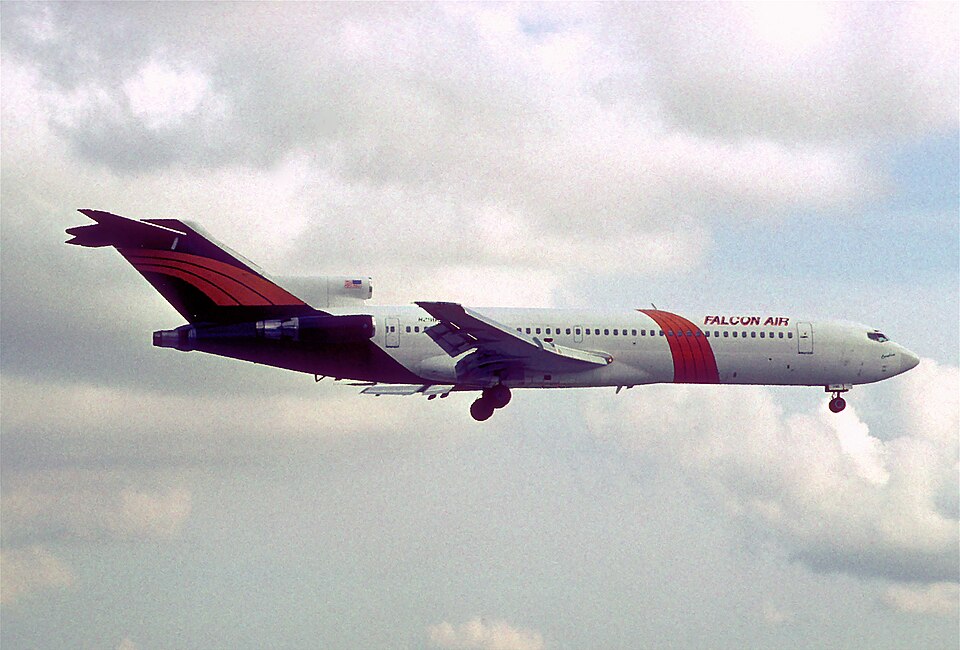
Aircraft registered N296SC
Aircraft registered N296SC. Photo: Aero Icarus from Zürich, Switzerland / CC BY-SA 2.0, via Wikimedia Commons

A Boeing 727-224 experienced a wheel assembly failure while taxiing for takeoff, causing damage to the aircraft. Investigation revealed fatigue cracking originating from a brake lug, with a manufacturing defect identified as the root cause.

Event Details

On an unspecified date, a Boeing 727-224 was taxiing for takeoff when the number 3 wheel assembly failed. Pieces of the wheel assembly impacted the airframe, resulting in damage. The aircraft had accumulated 356.2 hours of service since the wheel was installed.

Investigation

Examination of the failed wheel assembly revealed a fatigue failure that originated at a point on the inside diameter of one of the brake lugs. A circumferential scratch was found adjacent to the fatigue origin. The wheel half had been inspected and approved by an FAA-certified repair station, which shipped it to the airline on July 21, 2000.

A review of the repair station's records indicated that it had been rejecting approximately four wheel halves per month. Prior to the accident, the repair station had identified cracks on other wheel halves in the same area where the failure occurred. The repair station had contacted the wheel manufacturer regarding this issue and had sent representative wheel halves to the manufacturer for evaluation.

In a conversation with a Federal Aviation Administration representative, the wheel manufacturer stated that one of the returned wheel halves had been examined and that a manufacturing defect had created a stress concentrator, which resulted in a fatigue failure of the wheel half.

Manufacturer Action

Following the investigation, the wheel manufacturer issued a Service Bulletin that provided instructions for reworking the lugs and inspecting the affected areas of the wheel assembly.

Probable cause

Fatigue failure of the wheel assembly emanating from a point at the inside diameter of one of the brake lugs, due to a manufacturing defect that created a stress concentrator.

Investigation report by the U.S. National Transportation Safety Board (NTSB) historical archive. Original record: https://carol.ntsb.gov/event/20001212X21929. This page is a structured re-presentation; facts and quotes are in the National Transportation Safety Board (NTSB), United States.