Incident Overview
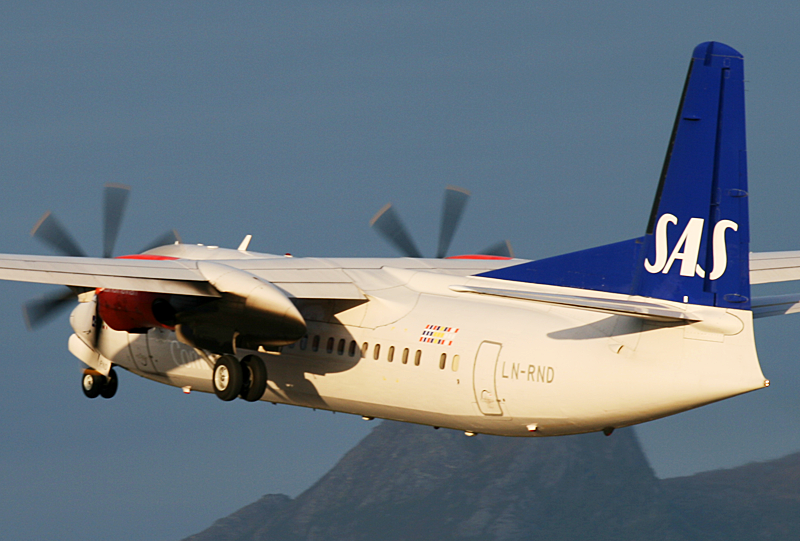
On July 19, 2002, at approximately 1115 local time, an Antonov 24 (registration RA 46651) operated by Arkhangelsk Airlines (flight AFL799) and a Fokker 50 (registration LN-RND) operated by SAS Commuter (flight SAS2351) were involved in an air traffic incident 40 nautical miles east of Tromsø, Norway. The weather was visual meteorological conditions (VMC) in daylight, and both flights were operating under instrument flight rules (IFR) above clouds.
Sequence of Events
The Antonov 24 was en route from Murmansk (ULMM) to Tromsø Airport Langnes (ENTC) at flight level (FL) 180, with inbound routing to NDB KV. The Fokker 50 was proceeding from Lakselv (ENNA) to Tromsø at FL 160, and had received clearance to descend to FL 100. The Fokker 50 was approximately 4 nautical miles behind the Antonov 24 but had a higher indicated airspeed.
The air traffic controller at Tromsø APP/TWR informed the Fokker 50 crew that they were number one for approach. The crew responded that they had the Antonov 24 in sight, approximately 2,000 ft above. The Antonov 24 was then informed that it was number two for landing behind the overtaking traffic below.
As the Fokker 50 began its descent from FL 160 to FL 100, the Antonov 24 was cleared to leave FL 180 for FL 160. Shortly thereafter, the controller observed on radar that the Antonov 24 was descending through FL 156 and requested its current flight level. The crew replied "FL 170 for FL 160." When the aircraft was observed passing FL 150 still descending, the controller made another check, to which the crew responded "descending to FL 160."
The controller then contacted the Fokker 50, and the crew confirmed they had the Antonov 24 in sight, closing in on their present flight level. The commander of the Fokker 50 stated that the other aircraft was providing incorrect information regarding its actual flight level.
The controller repeatedly requested the Antonov 24 to stop its descent. After radio communication confusion, it was finally confirmed that the Antonov 24 was maintaining FL 130. The remainder of the descents and approaches were uneventful.
The commander of the Fokker 50 reported that the closest horizontal distance between the two aircraft was approximately 0.5 nautical miles, and the closest vertical distance was 300 to 400 ft.
Aftermath
Both crews were informed by air traffic control after landing that the incident would be reported and that they should file an air traffic incident report. Despite attempts by both ATC Tromsø and the Accident Investigation Board of Norway (AIB-N), no oral or written report was received from Arkhangelsk Airlines.
Comments from Involved Parties
The commander of SAS2351 noted that the Antonov 24 continued its descent to FL 130 and then climbed steeply to FL 160 without acknowledging the deviation to ATC.
The Norwegian Pilots Association highlighted potential issues with altimeter calibration in meters versus feet, as Russian aircraft often use meters, and emphasized the importance of correct English phraseology to avoid misunderstandings.
The general manager of Arkhangelsk Airlines stated that based on flight data recorder analysis and the captain's report, the main reason was a short failure of the foot-graduated altimeter, and there was no resolution advisory signal from the TCAS system.
The Norwegian Traffic Controllers Association suggested factors including wrong altimeter input (QNH set too early) and incorrect conversion from meters to feet.
Board Comments
The AIB-N stated that all aircraft in controlled airspace must adhere to clearances given, and incorrect reporting when ATC requests the correct flight level is unacceptable. It noted that VMC conditions in the area may have prevented this violation from becoming a dangerous traffic conflict.