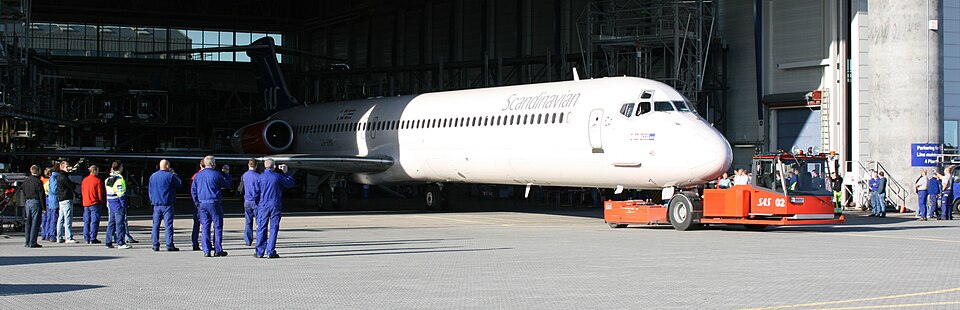
History of the Flight
SAS329, an MD-81 registered LN-RMO, departed Oslo Airport Gardermoen at 1900 local time on 24 March 2003, after a ten-minute delay. The flight carried two pilots, three cabin attendants, and 107 passengers. It was the second round trip of the day for the crew and their first working day in a five-day work period.
Upon arrival at Bergen Airport Flesland around 1945, low visibility prompted a holding pattern north of the airport. After 35 minutes, visibility improved along Runway 35, and the active runway was changed from 17 to 35. SAS329 was cleared for an ILS approach to Runway 35. The commander acted as pilot flying and planned to use the autopilot down to 50 feet radio altitude per company procedures.
Landing Sequence
The pilots acquired visual contact with the approach lights at approximately 200 feet above the runway threshold level. At around 100 feet radio altitude, the aircraft drifted to the right. The commander disengaged the autopilot and corrected left using left aileron. During the flare, a leftward drift was observed, and the commander applied powerful right rudder to realign the aircraft with the runway centerline. The aircraft touched down hard on the right main landing gear with a leftward skid. With the aircraft still moving left towards the runway edge, the commander held full right rudder to steer toward the centerline. During the right turn, the outer left main wheel collided with a runway edge light, breaking it. The aircraft then returned to the centerline, and the rollout and taxi to parking were uneventful.
Aftermath
The commander reported the landing on the left side of the runway and requested an inspection. Initially, nothing unusual was observed. After shutdown, a damaged main wheel tire was discovered. A second inspection revealed the broken runway edge light on the left side of Runway 35. The commander also reported a suspected bend in the localizer beam.
Investigation Findings
The Accident Investigation Board Norway noted that similar incidents had occurred previously at the same airport involving MD-80 aircraft from Scandinavian Airlines. Common factors identified in the incidents on Runway 35 included darkness, reduced visibility, the policy of using autopilot down to 50 feet, and a slight localizer bend causing a rightward drift near 100 feet, leading to manual overcorrection and leftward deviation. Contributory factors were a lack of updated runway visual range, absence of runway centerline lights, Norwegian yellow runway markings instead of white, and the procedure of not using landing lights in reduced visibility.