History of the Flight
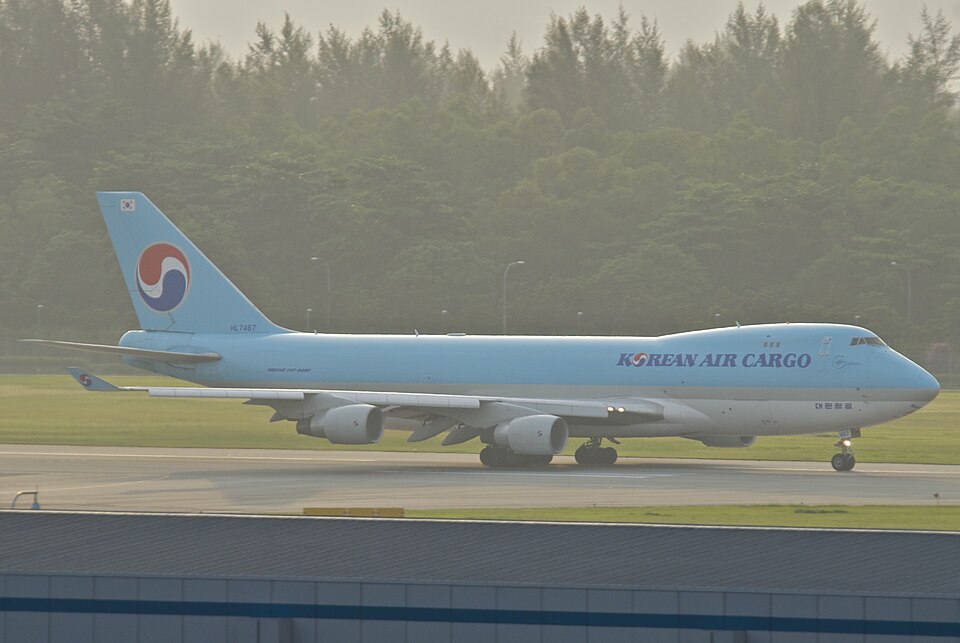
On 21 September 2004 at 1302 local time, Korean Air flight KAL520, a Boeing 747-400F registered HL7467, departed from Oslo Airport Gardermoen (ENGM) on a cargo flight to Incheon International Airport (RKSI), Seoul, Republic of Korea. The aircraft was loaded by SAS Cargo, with load planning and mass and balance calculations subcontracted to SAS Ground Services.
During load planning, the Load Master erroneously used the Standard Operating Mass (SOM) Center of Gravity (CG) Mean Aerodynamic Chord (MAC) percent value as the Index Unit (IU) number. As a result, the aircraft was loaded to a CG of 37.8% MAC, which was 4.8% aft of the certified aft limit of 33% MAC. This mistake was not detected by the Load Master, SAS Cargo personnel, the Korean Air Supervisor, or the Commander, who accepted and signed the cargo loading manifest before takeoff.
During the takeoff roll on runway 19R, the aircraft autorotated at approximately 120 knots calibrated airspeed (KCAS) due to the actual CG being aft of the limit. The stabilizer remained steady during acceleration. The aircraft became airborne at 165 KCAS with a pitch attitude of 11.5 degrees. After lift-off, the nose attitude increased to 12 degrees and then to 19 degrees. The Commander recognized that the aircraft's balance was incorrect because of the far forward trim setting. The control column position (CCP) showed values from -1.0 units during the takeoff roll to -4.6 units during the climb. Although the first officer observed excessive pitch-up, the pilot flying managed the pitch attitude using forward trim. The initial climb-out continued at 158 KCAS, well below the planned target speed of V2 (166 KCAS plus 10 knots).
During cruise, the crew suspected an error in the mass and balance calculation and contacted the company Operations Control Centre (OCC) via satellite communication. The OCC confirmed that the weight and balance manifest was incorrect and that the landing CG would be 43% (later estimated by AIBN at 43.7%). The flight crew decided to adjust the CG by relocating cargo pallets, achieving a landing CG of 40.2% MAC. However, this remained 7.2% aft of the certified aft limit of 33%.
During the approach briefing, the crew discussed landing procedures and requested airport emergency equipment to be on standby. During the landing rollout at RKSI, the aircraft's nose lifted at 60 knots, resulting in loss of nose wheel steering. The Commander stopped the aircraft on the runway and shut down all engines. The aircraft was subsequently towed to the parking stand.
The landing incident was investigated separately by the Korean Accident Investigation Board (KAIB). The AIBN issued two safety recommendations.
Probable Cause
The wrong CG location was caused by a mistake during loading: the Load Master mistook the Standard Operating Mass (SOM) Centre of Gravity (CG) Mean Aerodynamic Chord (MAC) percent number for the Index Unit (IU) number.