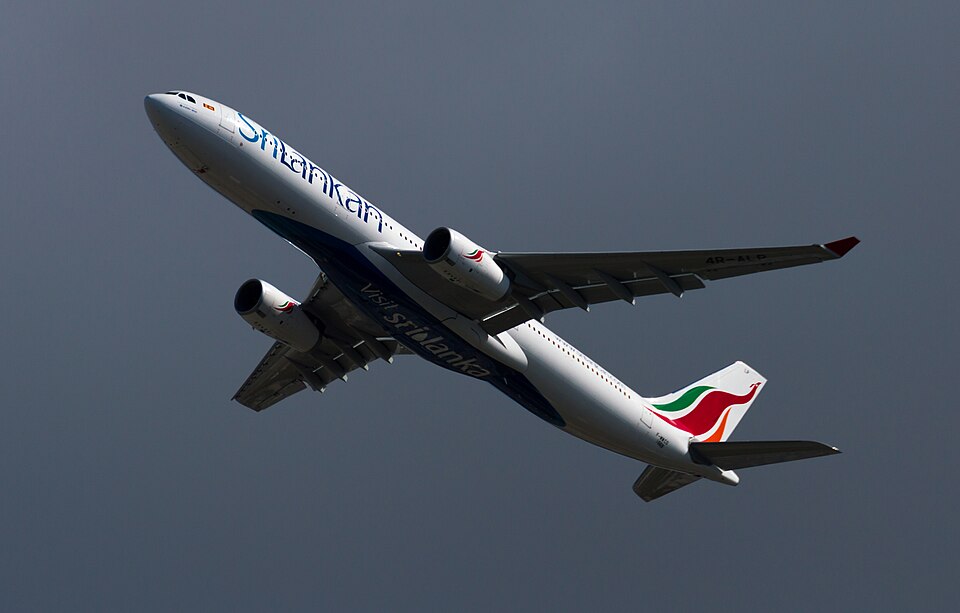
Synopsis
On 5 July 2023, SriLankan Airlines flight UL303, an Airbus A330-343 bearing registration 4R-ALP, was on a scheduled flight from Singapore Changi Airport to Bandaranaike International Airport (VCBI) in Katunayake, Sri Lanka. During the final approach to Runway 22, the flight crew encountered a wind shear condition and initiated a go-around. The aircraft subsequently landed safely on a second approach.
Flight History
The flight departed Singapore at 0820 UTC on 5 July 2023 with 196 passengers and 14 crew, totaling 210 persons on board. The flight was uneventful until the approach into VCBI. The aircraft was on a standard arrival for an ILS approach to Runway 22. The Pilot in Command (PIC) was the pilot flying, and the First Officer was the pilot monitoring. The crew had been advised of a light shower over the airfield but received no prior warning of wind shear.
At approximately 2000 feet, the aircraft intercepted the ILS and was fully configured for landing. At around 1100 feet and about 3.5 nautical miles (6.6 km) from the runway threshold, the flight crew experienced wind shear and heard an audio warning. The PIC then initiated a go-around at approximately 1205 UTC (1735 local time) and informed air traffic control, requesting a right turn to avoid a weather patch indicated on the weather radar. The crew climbed to 4000 feet as instructed and conducted a second approach to Runway 22, landing uneventfully at 1223 UTC (1753 local time).
Injuries and Damage
The investigation found no injuries among the aircraft occupants and no damage to the aircraft. However, after the incident, the Civil Aviation Authority of Sri Lanka (CAASL) received three complaints from residents living near the approach path of Runway 22. The complaints, received on 10, 11, and 27 July 2023, claimed that their properties were damaged by strong winds between 1730 and 1745 local time on 5 July, which they attributed to the approaching aircraft. One complaint (complaint no. 2) reported minor injuries. The CAASL's Aircraft Accident Investigation Board conducted site observations as part of the investigation.
Investigation
CAASL appointed an Aircraft Accident Investigation Board (AAIB) on 20 July 2023 to investigate the incident. The incident was notified to the Bureau of Enquiry and Analysis for Civil Aviation Safety (BEA-France) as the state of manufacturer and design of the aircraft. BEA appointed an accredited representative with technical advisers from Airbus and the European Union Aviation Safety Agency (EASA). The investigation decoded Digital ACMC Recorder (DAR) data and analyzed flight parameters. Meteorological data from the Department of Meteorology and advisories were also reviewed. The board concluded that the go-around was necessitated by wind shear encountered during the final approach.
Probable Cause
The investigation determined that the go-around was initiated due to a wind shear condition experienced by the flight crew during the final approach.
Recommendations
The final report included safety recommendations aimed at improving awareness and reporting of wind shear conditions, enhancing coordination between meteorological services and air traffic control, and reviewing standard operating procedures for go-around maneuvers in wind shear conditions.